Wednesday, September 14, 2016

Karl Marx And The Birth Of "Nations"

K Marx
 
In celebration of the 149th publishing day of Capital Vol I, I want to talk about something Marx never did. But let's approach it through him anyway. Let's start with a highly simplified version of Marx's historical period idea. Do you remember what Capitalism is, kids? That's right boys and girls, Marx defined capitalism as when the means of production (capital goods) are owned privately. The owners are called, conveniently enough, "capitalists". Capitalists are that large and politically powerful class of people who make their money off just owning said capital - called "profit". This gives rise to a Prisoner's Dilemma: if you - the capitalist - have more capital than your brother, then you win and make more and the same for him. But if you both try to buy more capital, that just lowers the price and therefore the profit. Do you remember Marx's word for such a fatal Prisoner's Dilemma? That's right, kids, it was "contradiction"!

Now remember Marx's outline of current history (current to him): Today we have the Capitalist mode of production, which was born from the contradictions of the Feudal mode of production and whose own contradictions will give rise to the Socialist mode of production (which totally will have no Prisoner Dilemma contradiction, promise).

Charlemagne (Left) and his son Pippin (right, with the hunchback)

What was the Feudal mode of production? It was dominated by powerful landowners called "Lords" who made their living off just owning land - called "rent" instead of profit. The contradiction of Feudal mode of production was that the core of it was zero-sum, nobody could have more land without taking it from someone else. Meanwhile, capital can be accumulated (this is called "primitive accumulation of capital") until its returns are more powerful than the rent of the local prince. Once this is achieved, its only a matter of time - Marx claimed - until the Capitalists take over. Because primitive accumulation of capital is insanely slow, this takes a long time. The Feudal mode of production completely dominated the world (off an on, sometimes empires fail for reasons unrelated to growth) from the time Sargon Of Akkad overtook the city of Uruk in 2340 BC until about 1776 AD, when the first explicitly non-feudal country was founded, and partially dominated it until WWI or II wiped the last bits of Feudalism off the Earth.

Otto Leopold, Prince of Bismarck

Marx isn't usually given credit for some predictions related to this, which he should. As he developed and perfected his system, the crafty Otto von Bismarck and his allies were carefully crafting a German superstate dominated by the Prussian Junkers class of landed noblemen. Lords, not Capitalists. Marx's prediction that this state could not be stable due to misjudging the economic base was interesting and basically correct (though perhaps not accurate in detail). Instead, Marx is blamed for his prediction that class would become the basis for politics (instead of nation or dedication to transclass and transnational liberal concerns). It is fair to blame him for this, but incomplete.

Gilgamesh I, King of Uruk
 
What gave rise to the Feudal mode of production? Well, the Feudal mode of production was based on high level elites (Emperors/Popes) exploiting low level elites (Princes) who themselves exploited peasants. This evolved out the Asiatic mode of production (Uncle Karl was not terribly politically correct), in which there were only equally sized local lords vying over the rents of their neighbor's land. The contradiction here is obvious - there's a Prisoner's Dilemma over whether two neighboring countries should go to war. The end of this mode of production coincided approximately with the beginning of history.
Nobody, Just A Drawing. Chill.

The "Asiatic" mode of production itself evolves out of the truly ancient mode of production, in which there are basically only individuals that give to their families ("primitive socialism"). Hmm...

If this outline seems bad, there are four reasons. One is that I don't remember every detail of Marx's theory and it is nothing if not detailed. Two is that I deliberately left some things out that I do know, because they aren't important for what I want to talk about. The third is that Marx was human and his theory was not perfect. The fourth is that I'm a bad writer with unclear ideas.

George C Williams

Okay, now I will deliver on my promise to talk about something Marx never did. In 1966, George C Williams launched an attack on the idea of group selection in his book Adaptation And Natural Selection. I see this as essentially taking our models of natural selection seriously. Our models include things like stable gene frequency ratios and fitness returns to individual genes, but nothing like staying in a group for the good of one and all. Williams could use the example of the life-cycle: why do we, human beings, die? It must be an biological trait, but how can that have a positive return under natural selection. There are organisms that do not age. The reason is because natural selection does not work on "us", but on genes. It might be worth it to a gene to be in an ever changing bundle of individuals. One reason could be that this shields it from happenstance of being placed with bad genes that make the individuals sick. Another reason is that genes can have multiple functions and dysfunctions over the life-cycle.
 W D Hamilton

If we abandon the unsound idea that evolution happens to individuals or groups, then how can groups exist at all? The first - but by no means sole - sound explanation came from W D Hamilton, who came up with "kin selection". The basic idea is that if a gene is in - or probably in - three individuals then it is in - or probably in - that gene's advantage to act the same in all three. The more related two individuals are, the less evolution can act on their differences. For instance, many of the cells in my body are almost perfectly related, so they all work together. That group of cells is "me", in a sense.

This isn't the only way groups can form. There are myriad helpful bacteria inside of me, maintaining my current state. I am not closely related to them, they are bacteria and I am a mammal. However, if they do good for me and I do good for them (by continuing eating). The genes within us maintain an equilibrium of reciprocal altruism - my immune system will exact harsh punishment to those bacteria that defect. This isn't "group selection" per se, all of this happens for the good of the genes and not those bacteria and I (we've never met). And it has to happen directly - there's no reciprocal altruism among individuals who can never meet (that's group selection). But it shows how careful one has to be.

Okay, but what does this have to do with Marx? The issue today is to go from the ancient mode of production up to the Feudal mode, past that into the Capitalist mode (and hey, can't forget the mysterious Socialist mode!), all while grounded in a psychology where brains are mostly made of fatty tissue. Where does the ultra-sociality of humans come from, if anywhere?

Mancur Olson

The above history, which I attributed to Marx, is actually much older. Thucydides, if he didn't expound it, could have. And there is certainly no shortage of explanations how one travels from one period to another. One very nice modern version of the trip from the primitive to the Asiatic mode of production is found in a paper by Mancur Olson. Start in a primitive mode of production. In this stage of history, people live in primitive communism based mostly on kin selection. They can also try to steal from each other, or band together to steal from a third party (reciprocal ... "altruism"). If everyone is in a roaming kinship band of hunter-gardener-thieves in a flat, undifferentiated world, they have no incentive to break out of this system. But lets say some gardens are better than others (maybe they're closer to water, maybe their land is more fertile). A stationary band of hunter-gardener-thieves has very different incentives than a roaming one. If the thieves are too nasty, people will abandon the garden for a worse one far from them. The thieves also have incentives to provide for a better garden (more to steal). These incentives are perverse from the point of view of a thief but positive from the point of view of a gardener (or, now that they are stationary, a farmer). They are the contradictions of the ancient mode of production. The leader of this group of thieves has become the first Asiatic king.
Frederich Nietzsche

This point of view, common to Marx, Hume and down to today, has been widely propagated. There seems to be little to criticize, except in a few details of exposition. But is there an alternative? The psychology in the above exposition is very English, in sense of the classical Humean Utilitarian school. People act according to their interests as best they can, and genes do the same more perfectly. But we know that this isn't a very good psychology. Can't you hear Nietzsche laughing at us for "looking for the efficient, governing, and decisive principle in that precise quarter [that is, Morals] where the intellectual self-respect of the race would be the most reluctant to find it (for example, in the vis inertia of habit, or in forgetfulness, or in a blind and fortuitous mechanism and association of ideas, or in some factor that is purely passive, reflex, molecular, or fundamentally stupid)"?

Yes, that's what we need. Not just a list of perverse incentives and Prisoners Dilemmas (in the old Marxian language again: "contradictions of society"), but a real living Genealogy of Development - Morals, if one holds with Marx that they too are derived from the means of production. But how could "the inertia of habit" form empires?

Sarah Brosnan

A new view could be evolving out of ... evolutionary psychology! Not the stuff you see mouthbreathers on the internet, the "examining how monkeys play games" stuff. Sarah Brosnan at the CEBUS Lab of Georgia State University has been doing fascinating work examining how - well, how monkeys play games in order to try to understand their reactions to unfairness. She finds that they don't like it! Brosnan proposes that monkeys don't like unfairness and have various social methods of dealing with it. If true, this shows that far from developing out of a bandit state, high levels of social development (on beyond kin selection and reciprocal altruism) may have been the norm even in very early human societies. Keith Chen is perhaps the first economist to take this area of research seriously and literally. He interprets the behavior seen by Brosanan as being the result of simple social heuristics. In other words, "the inertia of habit" gives rise to inequity aversion. Eventually, rules to deal with inequity are made. These are the first social institutions. This is a new and possibly groundbreaking way to look at the development of early societies. Replacing the long standing Humean psychology with a more realistic and fallible Nietzchean one is to be greatly desired.

Well, that's our Das Kapital birthday tour simplified history tour. Hope you enjoyed a couple factoids. For extra credit, solve for implications of the Brosnan-Chen-Nietzchean theory for modern society and any possible future society!

Thursday, September 1, 2016

What Was, Is And Could Be Austrian Economics?

Ludwig von Mises

So-called "Austrian Economics" didn't start as a by-word for "libertarianism" (whatever that is). That's not to say it wasn't political. The elder Carl Menger was part of the generation that discovered the method of marginal analysis but he also was a close associate of Crown Prince Rudolf. But when the Austrian School was still young and vital, Austrianism was capable of having wide differences of opinion. Wieser, Menger's first student, was sympathetic to some varieties of socialism. Bohm-Bawerk (according to Wikipedia) invented income tax as an alternative to a production tax laden with perverse incentives. Bohm-Bawerk's student Schumpeter believed that breakdown of the capitalist system was necessary, but bad and to be prevented as much as possible. What happened?

Morgenstern & von Neumann

Part of the later seeming uniformity is due to the re-writing of the books to separate The Austrians from ... the Austrians. Nobody wants to remember that von Mises was chief economist for the Austrian Chamber of Commerce when the city was called "Red Vienna". Morgenstern - despite having written one of the first, best and clearest books on the dangers of using measured aggregates to guide policy (and, through this analysis, a precursor to rational expectations and random walk stock hypotheses) has been written out of the official Austrian history book. Anyone who went on to have a good career in economics has been all but abandoned by the Austrians: Abraham Wald (probably the most important non-famous economist) and the younger Karl Menger both attended and loved von Mises's seminars.

Otto Neurath

This was made possible by the intellectual environment that the Austrian economists lived in. Higher education and research in Red Vienna was unusually loose and - as a result - creative. When the economist von Mises got his doctorate, Freud was beginning his own discussion group. Freud's group included Herbert Graf, who produced Schoenberg's operas. When von Mises was dealing with reactions to his book Liberalism, Neurath and the rest of the Vienna Circle was doing the same for The Scientific Conception of the World. The time was ripe for loose collections of followers. And Ludwig von Mises was part of that.

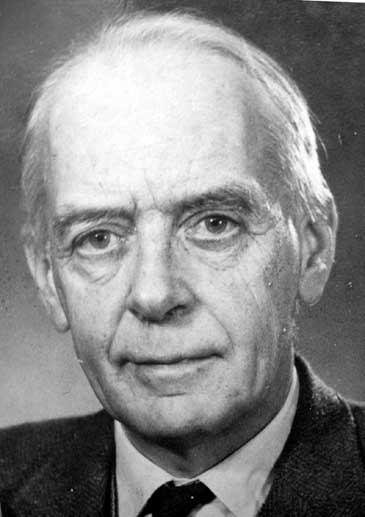
Piero Sraffa

With that out of the way, I want to talk about what I understand to be Austrian economics. I make no attempt to reconcile it with the precise words of von Mises et. al.. I offer the following pseudo-reason tounge-in-cheek: One can argue that as a brute historical matter, the great Austrians did not completely understand their own system. So my obvious misunderstandings are going to be only following in that tradition. Once upon a time, after publishing what seemed to most like it would be the new big book on the macroeconomy (a useful phrase not yet then coined), Frederich Hayek was unable to answer his critic Piero Sraffa's simple question of why there is only one interest rate if capital is dis-aggregated. This question is easily answered (in fact, Irving Fisher had solved the problem before Hayek was born), which I take as evidence that Hayek did not understand the intertemporal equilbrium framework he proposed. Ludwig von Mises's approach to anything resembling disagreement or criticism was not to respond, but to spew bile and anger (hey, this approach seems to work for physicists), which leaves open the possibility that even if his formulation of Austrianism had a flaw, he wouldn't discover it.

Roger Garrison

As a result, I will be relying largely - but not completely - on Roger Garrison's easily understood and probably-not-entirely-stupid formulation from Time And Money. I thought this book was just the bee's knees, and anyone who likes pre-Lucas economics should check it out (preferably after you've read some less biased introductory stuff).

I will start where Garrison suggests but does not go, with a highly dis-aggregated production function. There are \( N \) goods in the economy (let's not worry about innovation and entrepreneurship yet, we're gonna start with an "evenly rotating economy"). The production function is therefore is a vector function \( \vec{f} : \mathbb{R}^{+N} \to \mathbb{R}^{+N} \). The quantity of outputs of each good is summarized in the vector \( \vec{Q_1} \in \mathbb{R}^{+N} \) , the quantity of inputs of each good is summarized in the vector \( \vec{Q_0} \in \mathbb{R}^{+N} \), the quantity of labor allocated to the production of each good is \( \vec{L} \in \mathbb{R}^{+N} \), and the quantity of land allocated to each good is \( \vec{T} \in \mathbb{R}^{+N} \). For each \( \vec{L} \) and \( \vec{T} \) fixed, I assume there is a unique stable growth path. I will assume these are fixed for the rest of this post and therefore ignore writing them over and over again. Around this stable growth path, the "means of production reproduce themselves" in Marxist language. I will call this the "golden path". That is,

\[ \vec{Q_1} = \vec{f}(\vec{Q_0}) \approx A \vec{Q_0} \]

around the growth path for an all positive matrix \( A \) (there are weaker conditions than positivity, I won't use them). By the Perron-Frobenius theorem, there is therefore a unique, positive, simple largest eigenvalue \( \lambda \) with an all-positive eigenvector \( \vec{\lambda} \). Obviously, the real interest rate is then \( r  = \lambda - 1 \).

Every other eigenvector of \( A \) has at least one negative component. One might think (with some allowance for vagueness and intuition) that any small deviation from the golden growth path will involve some eating of resources, which will eventually return the system to the golden path.

This is a loose, "Austrian" version of a Turnpike "Theorem". I put "Austrian" in quotes because a Marxist could accept it and "Theorem" in quotes because it isn't anything near a theorem. Let me pause to explain why I think it could be seen as Austrian. Let's say the initial quantity of goods \( \vec{Q_0} = a \vec{\lambda} + b \vec{v} \), for \( a,b > 0 \) but \( b \ll 1\). The initial quantity is "mal-distributed", the \( b \vec{v} \) portion of the distribution is actually going to destroy some goods. But if the production function is iterated (i.e. the market is allowed to operate without interference), because \( \lambda \) is the largest eigenvalue the system will eventually go back to the equilibrium growth path. This won't be caught by all aggregates (that is, non-negative scalar functions \(g(\vec{Q}) \) ), so using them to guide the economy might not be the best.

Trotsky

Let's pause for a moment. Now I think this is a good mathematical approach to von Mises's position, but I haven't yet captured the idea in its entirety. So far, there is nothing in the above that would ruffle the leather jacket of a loyal Communist leader. In order to complete this theory, one would need to describe the method by which final demand impute backwards to determine \(\vec{f} \) and \( A \). This imputation process is where the system becomes neoclassical and eventually perhaps distinctively Austrian.

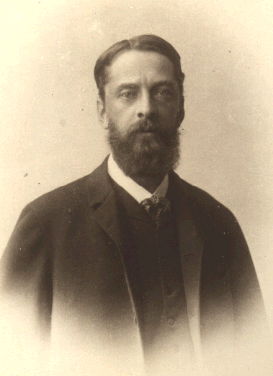
Frederich von Wieser
 
The Austrian economist who completely developed this theory was Wieser. Through Frank Knight into Paul Samuelson, Wieser's method has been absorbed into mainstream theory as Linear Programming. There are many technical steps along the way, for instance, as Uzawa points out the opportunity costs of factors of production are not well defined in the general case (but downward opportunity cost - the shadow price of lacking a quantum of a factor - is, which allows him to save the theory). One of the victims of the explicit thinking through is probably "roundaboutness", "capital intensity" and other scalar measures of capital except as first order approximations. Dimension is conserved by continuous functions and Brouwer will not be mocked. Even when we aggregate, we must not do so willy-nilly.

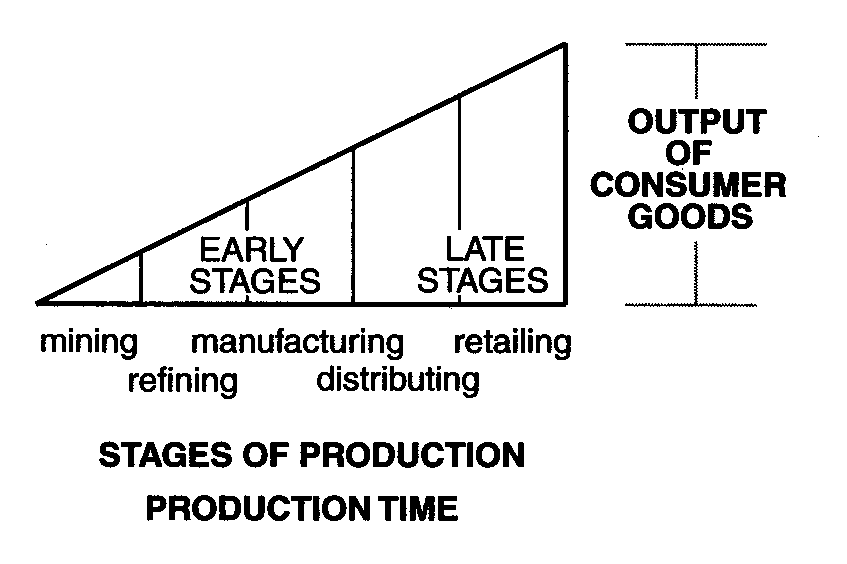
Hayek Triangle

Well, then let's move to a more aggregated view. We measure aggregate output with some scalar function \( Y = g( \vec{Q} ) \). One good such function is \( g( \vec{Q} ) = min_i (Q) \), \( g( \vec{Q} ) = \Sigma_i (Q_i) \) another. According to our earlier view, if \( Q_0 \) is near the golden path, then after \( T \) time units, \( Y = \lambda^T g(Q_0)\), or just about. Since this is an aggregate, we can even look at real data. Let's look at a nice period of time with no recessions - the Clinton years (height of the New Neo-Classical Consensus)


Obviously, this isn't evidence of anything in particular, partly because the theory so far can fit everybody from Karl Marx and Joan Robinson through Paul Samuelson and Robert Solow all the way to von Mises and Hayek.

Hey yeah, what about that? So I sort of posited a capital theory that can be verbally described as maybe having some Austrian characteristics. What about the distinctive Mises Austrian macroeconomics - where is von Mises's idea that the dance of the dollar distorts capital structure and and is the sole cause of recessions/depressions/etc.? I've left out all discussion of money so far. It's been an "evenly rotating economy", if not a barter economy.

 John Hicks

To continue further we need a money market and that for Garrison that means IS-LM. Garrison underrates the influence of his Keynesian schooling which he disliked as much as he overrates his Austrian enthusiasm which he liked. I think Garrison this gives the Austrian school more credit than they deserved by giving them the benefit of a post-war theory. The IS-LM analysis was not possible until after Keynes, General Equilibrium theory and probably much besides. Interestingly, IS-LM was invented by one of Hayek's students, the eclectic Sir John Hicks. I won't go into detail about IS-LM now, because I think that the Krugman description is basically right. One hitch for the uninitiated: most economists would say IS-LM is connected to the Keynesian Cross, but Krugman develops a model that works on nothing but neo-classical fundamentals and aggregation, so you might get confused if you use Krugman's advanced model and suddenly see someone object to a feature of the other model.

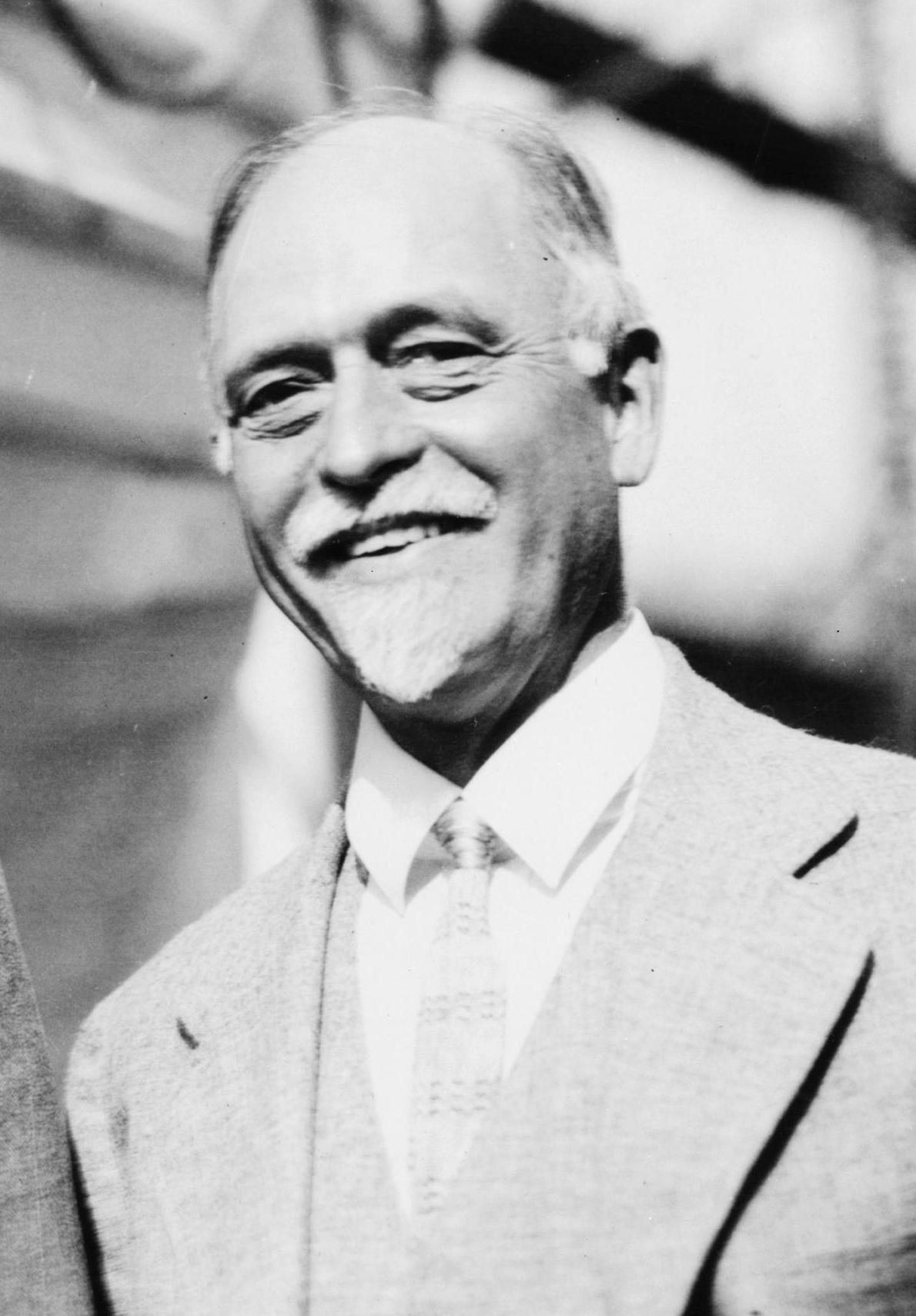
Irving Fisher

Hicks' IS-LM model is the second simplest possible money theory, but there is one simpler - the equation of exchange of Irving Fisher, Alfred Marshall etc.. This was the money model of the early neoclassicals, Mises very much included. When an Austrian tells you that printing money always leads to inflation and only inflation, they have this model in mind. I honestly doubt one could be "distinctively" Austrian with an IS-LM money model, and his use of this model explains to me why Garrison is able to approach Monetarist models when Mises and Hayek could not.

When I say "equation of exchange", I don't just mean \(M V = P Y \) - where \( M \) is the quantity of money, \( V \) is the velocity of money, \( P \) is the price level and \( Y \) is real output - though that is part of it. I mean the pre-Keynesian, pre-Friedmanian classical and neo-classical understanding of those variables as functions of the deeper economy. This isn't quite what the Austrians thought, but one must begin at the beginning. That understanding is as follows:

The meaning of \( M \) has remained unchanged and vague. The velocity of money \( V \) is best understood as \( V  = \frac{1}{k} \), where \( k\) is the portion of real output that people want to save (Garrison - and, well, everyone - represents this with a PPF curve). This is a deep and unchanging fact about human nature, society, etc. As before, aggregate output \( Y = g( \vec{Q} ) \). The price level \( P \) adjusts more or less rapidly to changes in \( M \). (Without a definition of the price level, one may not even talk about inflation.)

So the ultra-classical theory of money contains two variables and two constants. It could be better written \(\frac{M}{P} = k Y = const\) - verbally, "The real amount of money is equal to the amount of savings, which is a constant.". The problem with this ultraclassical theory is in the second equation \( k Y = const\). The problem is called the Lucas Critique, first pointed out by Keynes. There is no actual theory of which k is chosen, other than that it is related to something deep and immovable. Keynes pointed out that it should be affected by the interest rate, which is agreed upon by Garrison's PPF diagram. The point on the PPF diagram is decided by the IS-LM equilibrium. So one can see Garrison giving a Keynesian innovation to the Austrians for free isn't without consequence. Garrison's system fixes \( k \) - and therefore \( V \) - by using a general equilibrium framework in a way that was missing from pre-macro "macro".

Ludwig von Mises

Okay, okay. What does all of this have to do with Edler von Mises? Well, von Mises was not one of those who left the sentence "The price level \( P \) adjusts more or less rapidly to changes in \( M \)." alone. In fact, von Mises believed that "price level \( P \) ... less rapidly to changes in \( M \).". Remember that the real interest rate is determined by the structure of the highly dis-aggregated production function - the capital structure. This is the same in all markets, including money. But von Mises believed that it was difficult for practicing capitalists to tell the difference between a temporary mistaken change in the money or bank interest rate and the underlying true interest rate. Some entrepreneurs mistakenly switch to a technique only viable at the bank rate of interest (which drives \( Y \) up), but then get stuck when the interest rate inevitably returns to the unique real interest rate (which drives \( Y \) down). Overshooting causes a boom-bust business cycle. The only thing that can be done during the bad times is to let the mistaken entrepreneurs liquidate and purge the unstable techniques. This, I think, completes the basic overview of what is distinctive about Austrian economics as I understand it.

So what is wrong with this, if anything? I can think of four objections:

First of all, it's hard to develop realistic examples of this kind of reswitching, since reswitching takes place in logical space and not temporal. That is, von Mises and the others (Joan Robinson etc.) treat the loans behind the choice of technique as if they were constant interest rate loans, then make the interest rate vary - it's no surprise that the outcomes are paradoxical! Why haven't modern banks innovated loans that are aware of the dance of the dollar (you can really tell I love saying that)? As far as I am aware, Austrians simply haven't thought this out very well, but I could be wrong - they write an awful lot of words.

Secondly, von Mises's system assumes that the government can fool people in predictable ways, but you can't fool all the people all the time. If the government tries to take advantage of the "drives \( Y \) up" part of the Austrian business cycle during election years (and Austrians claim that they always will! They don't though), why can't people figure that out? A vague place for expectations is a huge flaw in any intertemporal system, and Austrians are all about how cool an intertemporal their system is. While on this subject, von Mises assumes that \( M \) is determined willy-nilly, not by a policy rule. Both of these are considered severe limitations in modern economics, which has gone a long way to treat them (not long enough!).

Thirdly, von Mises seems to assume that it is obvious that the direction of causation is from the means of production onto the monetary superstructure (again, using Marxist language). But, if the Daishogun declares that on pain of death the inflation rate shall be 2% and the nominal interest rate will be 5%, then eventually the capital structure will move to make the real interest rate 3% and not the Daishogun. This, arguably, is what we are seeing in the Euro Area right now. In other words, von Mises was positing a particular institutional structure (perhaps strong neo-liberalism with skittish bankers) without being explicit about it. I don't know if this is a criticism, since Austrians feel that Austrian-style institutions would be a boon...

Fourthly, we can return to the theory of positive matrices in the dis-aggregated production function. Recall that all the vectors leading away from the golden path have negative entries. I interpreted this loosely as meaning mal-distribution eats away resources (or, at least, does not produce as fast). The golden path is unique in not doing so. Therefore, we might expect mal-distribution not to create a von Mises style boom-bust cycle, but rather a Friedman style plucking model. I'm not sure that this objection holds water on a mathematical level, but examining linear algebra and the theory of positive matrices would be worth doing.

Well, I'm sure much of this has been covered before and better, so I'd be happy to take any useful comments you might have. I'd be particularly interested in demolitions (or demonstrations) of the first and fourth objections, or even just a numerical working through of the fourth objection. I hope it is clear that I am not unsympathetic to Austrian Economics, even if I don't yet think that it is as all-fired great as Garrison does. The question in the title is one that I am asking you, not one that I want to explain!

Friday, July 22, 2016

The Fregean Vision Of Language

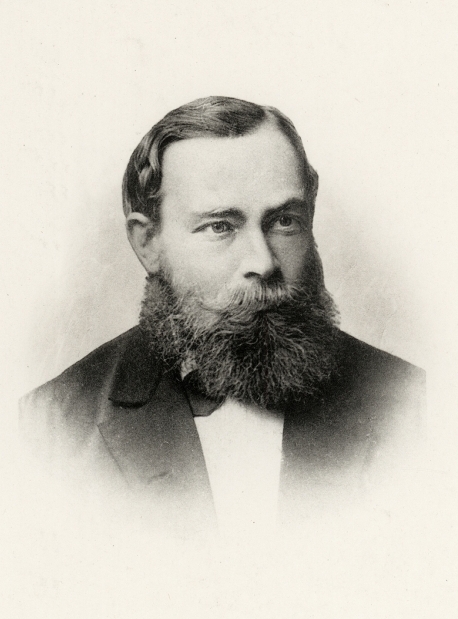
Gottlob Frege

It's interesting, though not surprising, that Frege toiled in such obscurity. All of mathematical logic was suspect until it finally started bearing fruit by taming set theory and giving rise to computers. Mathematical logicians had a reputation of pedants even among mathematicians - and Frege was unusually careful and rigorous even by the standards of mathematical logician.

Bertrand Russell

Of course, Frege wasn't a complete unknown. Frege influenced Bertrand Russell and Peano to be more bold in their formalism. Obviously, Wittgenstein's early philosophy is entirely an attempt to draw out more philosophical consequences of Frege's methods and insights. His later philosophy is also deeply Fregean, though more critical than his fawning early work. I'll come back to this in a bit. Dedekind and Zermelo were aware of his work and held it in esteem. At the time, the analytic/continental philosophy distinction did not exist, so Frege actually had a good bit of influence on several "continental" philosophers. He was one of very few teachers Gershom Scholem respected. Scholem attempted to communicate Frege's ideas to Walter Benjamin, which seems to have been a bit optimistic on Scholem's part. Frege helped embolden Husserl to completely abandon psychologism in mathematics - which became a major plank in developing transcendental phenomenology. All this adds up to one thing: this is going to be one of those black and white pictures of dead men posts.

Gottlob Frege

Frege's analysis of mathematical language was a shining philosophical gem: it killed the mistaken Millian theory of psychological abstraction as a foundation for mathematics and seriously wounded Kant's related notion that arithmetic was synthetic (further work by Godel showed that it was not synthetic in another sense). His book Begriffsschrift may be the greatest technical piece of philosophical argument ever written. I'd like to spend a little time developing what his analysis would be in modern terms.


How do you define "a definition"? This is one of the most fundamental tasks one must take in logical analysis, but it can be surprisingly difficult to do. One answer would be naive atomism: each word (except the logical connectives) represents one idea and sentences are fusions of such ideas. This won't do. Some words are relations which gain meaning only when surrounded by other words. Some words are functions that gain meaning when given an argument. Examples include "My father's mother is gone.", "God's in His Heaven - all's right with the world!", "The cat is on the mat." and "The square of two is four.". The word 'square' in the sense used in the last example is obviously a function. The word "My" in the first is also a function, as is "father's". The word 'on' in the third example is a binary relation.

Frege's solution, which you might call "limited holism", was that each word gains meaning only in the context of the sentences in which it is used. The basic unit of meaning is the sentence in the following sense: only a sentence may be true or false. A "definition" is a rule that tells one how to go about using a word in a way that generates true sentences. When you observe a certain state of the world (in a very rough grained, perception/culture/etc mediated way), you may convey that state of the world to an English speaker by uttering "The cat is on the mat.". When young Pippa observes a certain state of the world (or, more accurately, passes without carefully observing it) she conveys this to the people of Asolo (including herself) by saying "God's in His Heaven - all's right with the world!". There is little syntactical difference between these sentences.

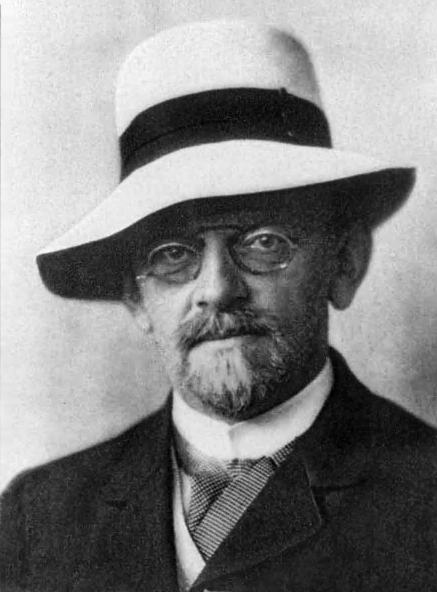
David Hilbert
 
Frege's vision was somewhat confused because he did not always carefully distinguish syntax and semantics. If symbols are "defined" in the sense above, then they have semantic content. The "definitions" of all the terms of a Fregean language give a model for a syntactical system. The well formed formulas of the syntactical system are given by the true sentences of any model of that system. This means that, for instance, if a formula can be shown to be well formed by purely syntactical means, then it must also be true in all models (I think Godel was the first to notice this). But a formal system may have multiple interpretations, more than one model. This was first formally recognized by Hilbert, who used it to demonstrate the relative consistency of different formal systems.

 Carl Gauss

However, even before Hilbert, this model theoretic vision was being used to do non-trivial mathematical and philosophical work. I'll try to explain how one can use model theory to prove that the parallel axiom is independent of the others. Start with all of Hilbert's Axioms considered purely as a formal system. Obviously, Euclidean geometry is one model of these axioms systems. Guided by that model, construct the following objects: great circles on a sphere and antipodal points on the same sphere. Call the great circles "line2s" and antipodal points "point2s". We know have new sentences that are concatenations of old primitives. If we take these sentences as our "primitives", then we find that line2s and point2s satisfy all the axioms ... except Euclid's axiom! When we get to that one, we find instead that given a line2 and a point2 not on that line2, any line2 passing through that point2 will intersect the given line2. Put aside the model for a moment. The syntax of line2s and point2s is just concatenations of earlier concepts. But we don't have to bring in the Euclidean models for these meaningless symbols. We can use elliptic geometry by itself as a model. They have two - really, infinitely many since there are so many Riemannian geometries - models. This shows that the two systems are relatively consistent - one is not contradictory unless they both are.

Ludwig Wittgenstein with his family (including his sister, a woman! Wooo)

I promised earlier to go over one of Wittgenstein's criticisms of the Fregean vision outlined above. Since we only observe people's behavior, we cannot in general know the rules that they are "really" using. Let's say that a highly educated person, like myself, is working on a programming project that puts them along side a brilliant self-taught programmer. At one point in the project, presumably as she's explaining something, she writes "1+1=2". We both agree that this sentence is true. At another point, I write on the same board "23,412,341,243+432,141,234=23,844,482,477" and she storms out of our work area and demands that I be fired. You see, she learned to add on a 32 bit machine. The correct version of the above sentence is clearly "23,412,341,243+432,141,234=2,369,645,997". Why should she have to work with an incompetent like me?

Physical behavior (including human behavior) is syntactical ("The world is the totality of facts, not of things."). We want to be able to attribute to this syntax certain semantics. For instance, I might want to interpret your sound making as a meaningful sentence. I have a model for your verbal utterances. But this model is not unique. The meaning of terms is a social process that can break down, as shown above.

This was part of Wittgenstein's general criticism of (his interpretation of) Frege's idea of language. Fregean analysis works fine on many things - for instance those Hamiltonian systems I'm always talking about. I have a great example in terms of Sinai Billiards in particular that I don't now have the energy to go through. Even given this, Wittgenstein's example shows that it may not be very good at analyzing language - which is what it promised to be!

David Lewis

In order for a rule to be learnable, it must be (at most) recursive. In fact, it must be fairly efficiently learnable to gain any popularity. Bacteria and other primitive organisms signal each other, these signals may be very low on the Chomsky hierarchy. The theory of signalling in biology is well established. It's a particularly successful application of game theory, first applied by the philosopher David Lewis in his book Convention. This may be the single most successful theory started by a pure philosopher in the 20th century. The theory was actually perfectly rigorously described by Hume in the 18th century. The core insight is that conventions are not essentially linguistic, instead language is conventional. Successful communication is given by success in some other sense (biological fitness, utility, etc.). We only care about having different models insofar as they are inconsistent and even then only insofar as the inconsistency affects things. This is not what Frege promised. He promised too much. Wittgenstein was correct to point this out.

Donald Davidson

The signalling games considered by Lewis explicitly are very simple, though he gives a sketch of how to go about human language. If signaling rules are learnable, then they must be at most recursive in complexity. Living humans have an extremely advanced immune system that is a "model" in the Hilbert sense for a Fregean formal syntax. The immune system learns and communicates in a very complex way. Humans also have spoken language which is also at most recursive. Learning a language is (partially) gaining enough of a culture that one can apply enough of a model to the verbal syntax of other speakers that behavior can be coordinated. A command is true when it is obeyed, a question is true when its declarative translation is true, etc. The varieties of signalling syntax that can be understood so are called "languages". Other signals - such as the chin flick, the "get bent" gesture, the Bronx cheer, the middle finger, blushing, smiling etc. - cannot be interpreted so and are not languages (though they may be cultural - such as the middle finger - or biological - such as smiling determined signals). The signal game is larger than the language game.


Well, we've come a long way from the original, simple Fregean vision. I believe that vision is broadly correct, even with all the adjustments made above. Frege's seeming pedantry and perfectionism made him obscure in his life except to a few people who shared similar obsessions, but they gave birth to the modern, computational world.

Wednesday, July 20, 2016

Against The 70s


Someone not so recently asked a big question, "Why does the 1970's inflation matter so much to economic thought?". There are so many stories told about that period that it has passed into myth. It isn't really clear why, at least if you look at it through the lens of high powered macroeconomic theory. Supposedly it all has something to do with the Phillips curve. The Phillips curve is an expression of the observation that the rate of inflation is negatively correlated with the rate of unemployment. The Phillips curve hypothesis is that this correlation is stable (at least, holding institutions constant) and that the order of causation can run from inflation onto unemployment. The usual story is simplistic: "Back then we believed in the Phillips curve, but the 70's taught us not to do so.". That sound you hear is a vortex generated by philosophers of science rolling their eyes.

When you try to put meat on these bones, you find they break too easily. It isn't easy to find a high flying macro theorist who actually believed in a stable, exploitable Phillips curve. The classics certainly couldn't believe in such a money illusion; Keynes couldn't have argued for a stable inflation/unemployment trade-off (if it existed, why would we need G > 0 ?); Samuelson and Solow certainly didn't believe in it; nor did Fed Chairman at the time Arthur Burns. It's hard to find a single person that "believed" in the Phillips curve in the way it is said to have been.

Milton Friedman

These facts - and they are brute historical facts - have led some to believe in a conspiracy theory of the 70's. "Milton Friedman and the Chicago School convinced everyone that the 70's 'proved Keynes wrong because the Phillips Curve was wrong!1!' was all a lie and therefore modern macro is an illusion meant to disguise naked power grabs by The Enemy.". I put it in a way that you could see how fallacious such reasoning is, but I've seen it put almost as bluntly before.

It is strange, you have to admit, that such brilliant people would be snookered by it. Not just right wing radicals who want validation came out of this. Ed Phelps, Stanley Fischer, and Tom Sargent all saw ... something invalidated. But if it wasn't the Phillips curve, what was it?

Stevie Nicks

The first thing that you have to realize about the 1970s is that it was not, in fact, the 2010s. Nobody in 1976 - not Nixon, not Friedman, not Samuelson and not anyone in heterodox economics - was also in 2016. Everybody was groping blindly and if some had more insight than others, well we should be so lucky. The other thing to realize is that high falutin' macro theory is a tiny and rare thing. Nixon certainly never read a single work in the field and didn't have any friends that did. Ed Cole - one of the presidents of General Motors - could tell you a lot about the Chevy Corvair or Vega, but knew and needed to know nothing of the debate over large scale statistical models and certainly he had no opinions worth noting on anything as abstruse as the Cambridge Capital Controversy that was so distracting in the 60's. This is interesting given how macroeconomic his job was. Some basic facts from Wikipedia: GM at its height measured its profits in % of GDP. GM was the second largest employer in the world - behind only the entire Soviet state.

So, given that Cole was no expert in high macroeconomic theory for its own sake, what did he believe? Clearly, I can't read his mind. But I can give you a picture of what he likely believed, even if he would quibble with a nibble or two. If you are a fan of brief summaries, I'll give you one: "He thought he lived in the era of Mad Men.".

John Kenneth Galbraith

The person who most clearly put the vision to paper is J K Galbraith in his books The Affluent Society and The New Industrial State. Since this vision failed, it might seem that I came to pick on him, but I actually a lot of sympathy for him. He was trying his best and had a basically empirical outlook. He was basically right on backing imperfect competition. Even if he went too far and replaced it with something equally simplistic, Galbraith was right to question consumer sovereignty. He worried about the structure of the firm and capture of government legislation by business before it was cool. Galbraith was trying to think through ideas that don't formalize very easily. He was trying to get away from the myth of the rational consumer. Herbert Simon was working on similar ideas and did better work, but never anything macro related. Galbraith tried his hand and if he didn't succeed, well, did anyone?

Carlo Ponzi

Galbraith's method is developed in his second book, The Great Crash, 1929. This is a strange book for a modern to read. The first thing one notices is how little a role the year 1929 plays. The lengthy, hilarious section on the Florida real estate bubble is the best part of the book - but what all does it have to do with the Great Depression? This part of the book is an argument - I don't remember if it is explicit or implicit - that the market is not guided by rational consumers. The masses are irrationally attracted (that is to say, they will invest more than they would expect to receive if held down and forced to think it through) to the promise of easy money, even if it comes from Carlo Ponzi or Donald Trump. They are irrationally repelled by the slightest loss. They put good money after bad. They're moved by emotional displays from the wealthy. They do many things, but they do not maximize net present value like Irving Fisher taught us.

Sigmund Freud

Though the masses are not very good consumers, the advertisers and engineers, they're very good (supposedly). From this vision, the corporation emerges as the fundamental entity of economics. A corporation consists of four parts (my typology, not his): the capitalist, the engineer, the laborer and the advertiser. The advertiser has read his Freud and empirically studied the deep parts of human nature. As depicted in Freud On Madison Avenue, the advertiser designs the aesthetics of the car to be a giant phallus with a clitoral emblem on a vaginal grille. He can then determine exactly how much the irrational consumer will buy in aggregate. The engineer then designs the car as a functional item, which selects the costs of production. The laborer and capitalist then build the cars. The income is then divided among the four parts of the corporation by the labor contract (which is fixed by negotiation between the capitalist and labor, which in practice is represented by union officials). Note that it is not the profit that is divided, but the income. That doesn't matter in this system - income and profit are jointly decided by the engineering and advertising experts. The corporation never has to worry about society wanting less products in general, demand will be simply created by the government if it ever accidentally slackens.

There is much to criticize in the above system. The biggest problem is a very strong difference that is assumed to exist between the irrational common consumer and the tiny echelon of experts that control them. There's no way to get around this, there should be no apologetic for it and there is no question into which class Galbraith put himself. It is assumed, not proven. When pushed on this point, Galbraith would fall back on his endless supply of jokes about irrational consumers. In his economics and his novel, this was all but explicit. The only question was whether people Galbraith would be allowed by his fellow elites to make the masses a comfortable world. There is no freedom to give them.

The role of the state is very strong in Galbraith's mind. I've already mentioned maintaining demand at a full employment level. Another is managing labor unions. The labor unions face a macroeconomic prisoner's dilemma. Imagine two labor unions that have the choice of either asking for higher wages or keeping them stagnant. If they both keep stagnant, then the price level stays the same and everyone is well off. If just one asks for an increase, then its members are much better off. But if both ask for an increase, relative wages stay the same but the money price of everything goes up. Therefore, people are worse off. (This actually happened in England in the 70's) This is one of the state's tasks as countervailing power against the large corporations (and their unions). The simplest and most dangerous way of doing this is wage controls - Galbraith never bothered to ask for another one. Price controls in general follow from the same argument on advertisers instead of laborers.

 Panasonic Space Age Television

Outside of the secluded world of high economic theory, much of what I just exposited was uncontroversial. Arthur Burns, the head of the Federal Reserve at the time, believed much of it. Galbraith's books were best sellers. Further, it was in the general culture. To be an adman in the 60's was to be the king of the world.

What happened in the 70's was the fall of the whole idea. For the first time, the mandarins in charge were forced to admit that demand management was non-trivial. The incoherent system of monetary policy, price supports, unpredictable government regulation and massive war time spending interacted with oil-induced supply shocks and changing culture demand shocks to pull aggregate demand in every direction. The net result was gas queues, stagflation and malaise. The role of the failure of price supports, while not shocking to any theorists, bolstered Friedman's claims that markets were a necessary part of demand management (he didn't put it like this). Friedman prestige didn't come from just getting it right, it came from how he got it right. No high powered macroeconomist denied the possibility of stagflation - but Friedman happened to have the perfect combination of being against price supports, for rule based monetary policy, for smooth government regulation (okay, I'll be fair. He was against government regulation in general) and having done deep work about how the economy can smooth over shocks. It was exactly what people needed in 1971 (well, government regulation in general is arguable, but certainly not basically arbitrary price controls).

The markets upset the Galbraithian vision in a deep way. Recall that GM's deeply learned advertisers decide on how much sales they make this year. The human mind cannot resist the sexual allure of their automobiles ... supposedly. But the oil crisis meant that people wanted smaller, more efficient cars, not rolling slabs of steel. The Japanese entered the automobile market with cars that people wanted and GMs sales declined. Wasn't GM supposed to control sales?

Another example. When GE designed a television, they decided the sales. They knew - knew - what people wanted in a TV: they wanted a wood exterior and a durable stainless steel frame. They wanted furniture (I know they thought this, because I've talked with the people who built them at the time). When Japanese companies started exporting cheaper, lighter all plastic televisions, GE was sure no American would want one. As it turned out, those "irrational" consumers resisted the psychological allure of the expensive American furniture and just bought cheap, functional boxes. This is not how the system was supposed to work! Didn't these consumers know that they were irrational?

The important thing about the 70s is that they seemed to show that irrationality could only be pushed so far. Consumer preferences can't be written off as a minor addendum. The point of Friedman about inflation expectations in the Phillips curve is minor. People had been writing about inflation expectations since monetary analysis began. What was influential was his whole approach. It was part of a general tendency to move toward rationality - game theory began to go deeper into traditional economic realms (such as industrial organization). And damn it, if you presume consumers act basically according to their preferences, then price controls and shocks cannot coexist. Friedman and others hammered on these points as far as they could. And then they were pushed even further...

You see, through the lens of the 70s experience outlined above, purely rational expectations economics starts to look good. However, once the "t"s were crossed and the "i"s dotted, the New Classical school that supposedly took them as their basis didn't live up to its promises. I mean this explicitly - they promised to pass statistical tests that they did not. The New Classicals stopped using these statistical methods because "they were rejecting to many 'good' models". Perhaps this movement toward "rationality" was itself irrational. In many ways, by the time the 80s ended, the rationality revolution of macroeconomics was spent. In other fields (the aforementioned industrial organization, for instance), the move to rationality bore better fruit.

Even with all these qualifiers, it was still the 70's that forced people in power to consider the consumer as an autonomous human being. And that is why it looms so large in our thought.

Thursday, July 14, 2016

Idealism And Modern Science: Space And Time

Kant, again

So, another post on High German Idealism. Before, I'd been pretty kind and polite, even being careful to point out good parts in Hegel. But today, I'd like to point out a major error in the philosophy of Kant, Schopenhauer and others, one that makes much of their exposition wrong as a matter of strict fact. This major error has to do with the division between the underlying "noumenal world"/World As Will and the phenomenal world of experience/World As Representation. Kant and Schopenhauer believe that spatial and temporal order of the world is part of human experience, but not the world in itself - this is simply completely wrong. That the world of experience is 3+1 dimensional is a deep fact about the underlying physical world in itself. Further, human perception does not, in fact, take place in a mostly "geometric" manner, by which Kant would mean specifically Euclidean geometry. This is not a minor flaw, but appreciating it requires far more technical apparatus than Kant and Schopenhauer had access to, even giving them the benefit of deep insight through dim appreciations. I'm going to go about this exposition quickly but carefully. First, I will again recapitulate the core Kantian argument so that it will be understood that Kant meant these terms literally. I'll give an example of a seemingly objective property of an object that is actually not mind-independent. After that, I will give a brief description of the correct modern understanding of these facts.


Kant began his career as a serious natural philosopher in an initially typical 18th century mold. He studied physics with great intensity and soon was setting very difficult physical problems for himself to solve. He had been a minor player in the debate over whether energy or momentum is conserved - unfortunately only publishing after it was understood that both were. This book, though confused by Cartesian concepts, also contains many important insights - such as the correct general explanation of inverse square laws. Kant appreciated that conservation of momentum implied that a collapsing cloud of particles would force the system to rotate and flatten out. Eventually, he argued, the cloud will condense into a star and planets. Kant used this to explain the two dimensionality of the solar system, and went much further than that. He argued that the solar system itself was part of a much larger scale condensation, what we now call the Milky Way Galaxy. At the time, this was a novel and innovative hypothesis. It turned out to be impressively correct. Such arguments shows that Kant was familiar with conservation laws and how they can be used to give powerful qualitative arguments. When Kant was 30, he won a prestigious prize for a demonstration that resistance to tides causes the rotation of planets to slow. This implicitly involves energy considerations and demonstrated that the solar system could not be infinitely old (an open question before this).


Kant's peaceful potential life as an eminent but minor Prussian physicist was ruined one day when he happened to read a book by David Hume, the greatest of all philosophers. Kant's research had convinced him completely of the correctness of Newtonian mechanics - classical mechanics to me and you. But Hume had a devastating and novel argument in favor of skepticism of what is called "induction" - essentially learning. Induction obviously cannot be justified by empirical knowledge, since learning from observation requires learning. No particular induction can be justified on general logical principles - since such an induction would be a general deduction. There are some truths - such as conservation of energy - that are either true or not about particular systems, we have to learn whether they are. So this kind of reasoning is not enough. Finally (and this was Hume's addition to the skeptical argument) induction cannot be justified inductively - that's a vicious circle!

Hume forced Kant to see how delicately his hypotheses leaned on conservation laws that he (and everyone at that time) barely understood and were certainly not necessarily true. In particular, Hume forced Kant to question whether we could learn the laws of physics. Kant spent years - decades - attempting to carefully develop both the system of the world and our knowledge of it into a coherent whole even given Hume's critique. In 1781, he hastily published a massive tome containing all of his work, after a health scare convinced him he would die unpublished if he did not.

Kant's system is not easily explained, partly because it involves such a complex mingling and careful separation of the world as it is and our perception of it. But it goes something like this. The world in itself consists of innumerable particles. The particles move around by exchanging energy and momentum with each other, according to specific - Newtonian - laws. But we cannot see the naked system of the world - instead we see a coarse grained, psychological, language drenched, enculturated, clothed system. In modern physics, we represent the whole system by a vector, and the motion of the particles are given by the so-called "Hamiltonian" of the system. This gives the fine-grained reality of the system, but the world of experience with fluids, pressures, etc. "exists" only as an approximation at a coarse grained higher level.

Homer

The whole world of experience may be coarse-grained, but that doesn't make it "subjective", in the usual sense. Purely physical systems interact on a coarse grained level. The usual thermodynamic functions are minimal statistics of systems, so that any reasonable description of the world must include some of them. They are "forced moves" in Dennett's words.

But very little of our representations of the world are forced! In fact, perception is highly dependent on language, culture and conditioning. The most famous example - first pointed out by John Locke - is color. To an English speaker, it seems to be an objective fact that the sky on a hot cloudless day is blue and the sea on that same day is also blue. But if I were to mention this to Homer, he would be shocked! How could the sun bright sky and the wine dark sea be "the same color"? The answer is that in my culture - the culture of English speaking people - we learned to divide up the spectrum of light in ways that some are called blue and others not.

 This is a somewhat dishonest way of living, color is not so simple, color perception even less than that.  To our culture - you and I are English speakers after all - black is white. It's plain to see that the dark blue sea is the same color as the bright blue sky. If we merely apply the same argument to grey, we see that black and white are obviously the same color.

How do we survive zebra crossings then? In spoken language, our culture simply partitions sufficiently dark greys into black and sufficiently light ones into white. It's hardly less arbitrary than most of life. Our non-linguistic experience of color that motivates most of our actions may be different. Generally, we try to keep life or death situations away from subtle color gradations.

Of course, much more than just color is part of the World As Representation that isn't grounded in the underlying physical world (Schopenhauer's World As Will) in a unique way. Psychologists study physical perception in the form of affordances. Beyond that there are complex social systems that include languages, governments, markets and all that goes with them (such as philosophy).

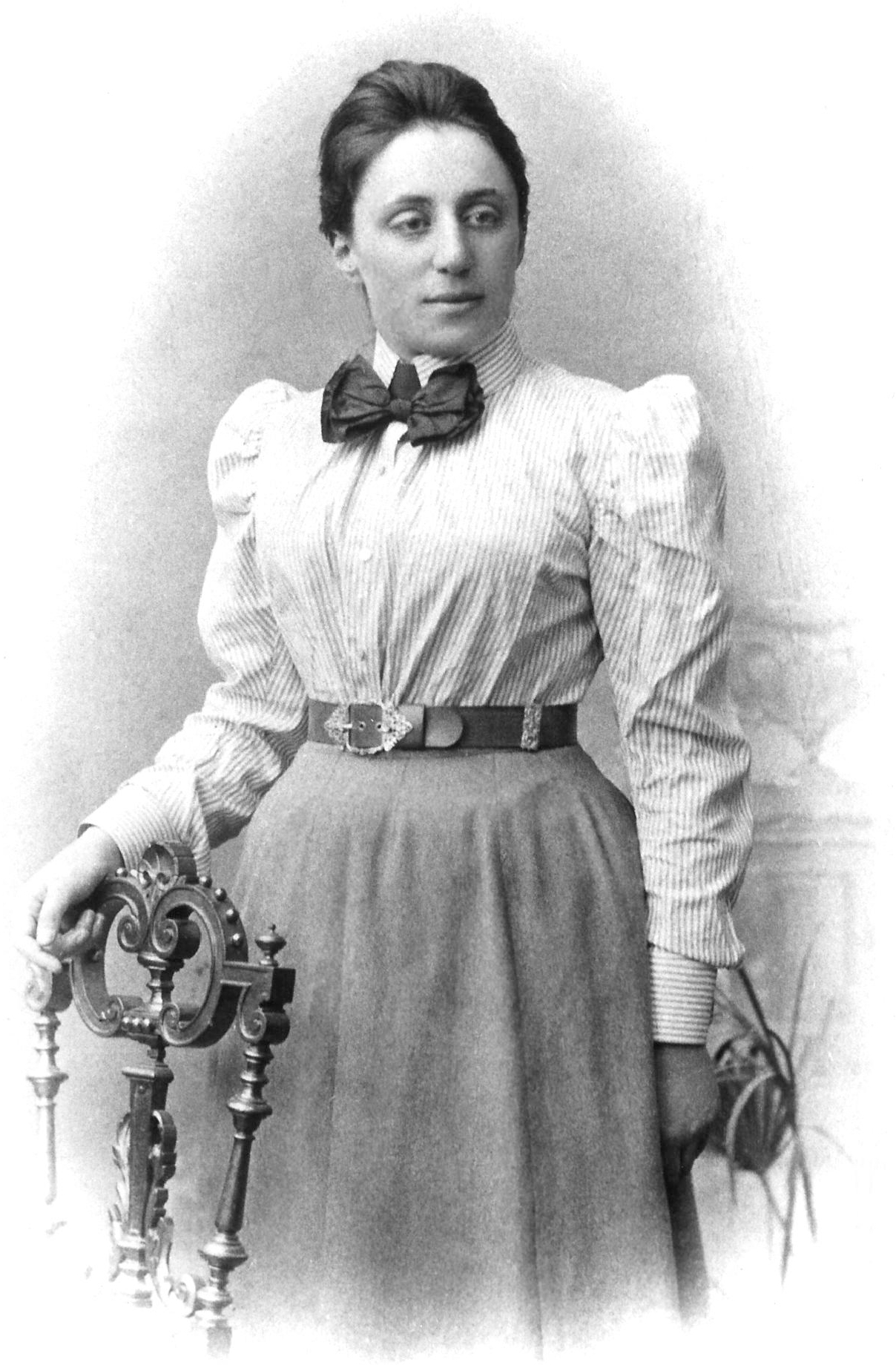
Emmy Noether

So, if so much of the world is ungrounded in the huge vector and the Hamiltonian rules that make up The Dang-An-Sich, what makes me so sure that space, time or spacetime is part of it? In order to understand this, you have to use tools far more modern than anything to which Kant had access. Kant understood that the rules of The Dang-An-Sich conserved certain global properties such as energy and momentum. This was not an easy thing to figure out, and he had to do it for himself. But in order to understand space and The Dang-An-Sich, one must understand the connection between conserved properties and symmetry. This could not have been done before group theory, it could not have been done before Lie groups and algebras, it could only have been done by someone who understood them both. The person who did so was Emmy Noether, and this alone would have made her one of the most important persons in mathematical physics. The fact that the theory of groups was entirely absent from physics before her makes her probably the most important person in the history of mathematical physics. Kant appreciated that conservation of momentum was a fact about physical systems, what he did not and could not have known that this equivalent to the existence of an symmetry operator on the laws of physics - on the Hamiltonian. This can be strengthened by Wigner's Theorem - not only must every conservation law give a differential symmetry, but the symmetry must take a very special form. To say that these theorems is the very foundation of modern physics would be to understate how central they are.

Let's look in particular at conservation of momentum, which suffices to give the philosophical flavor. It arises from the following symmetry: if every particle was moved in a way that keeps all the relative distances the same, then the relative motions of each particle wouldn't change. This symmetry operator defines the three dimensions of space. This is a fact about the Hamiltonian, a fact about The Dang-An-Sich and therefore has nothing to do with perception. It is not even a coarse grained fact, but applies on the microscopic level. Perception may take advantage of this organization, though it only does less than one might think. Actual perception is a lot more edge detection and topological relations, Euclidean geometric representation (with it's angles etc.) is learned.

The above argument has many slight alterations important to physics but not philosophy. The symmetry operators that defines actual physical space are called the Poincare Group and they give rise to geometry which is relativistic - not Euclidean. But these alterations, constrained as they are by Noether's and Wigner's Theorem, cannot alter the simple fact is that spacetime is part of the organization of the world in itself and the Kantian/Schopenhauerian thesis that it is not is simply incorrect.

Saturday, July 2, 2016

Idealism And Modern Science: Intentionality

Immanuel Kant

Last time we talked about High German Idealism, I concentrated on giving an example of how it attempts to reconcile the physical portrait of the world with the world of experience and intuition. We constructed a loose picture of what I called The Dang-An-Sich, which was - roughly speaking - the entire universe. I used Kant's name, but it could also be called Schopenhauer's "World As Will" with no loss. I said that The Dang-An-Sich was "empty of content". There was no volumes and pressures, no fluids or gasses, no chairs or minds, etc. I showed where one could find proofs that, among other things, the basic thermodynamic functions such as volume and so forth could be shown to be "minimal statistics" of the behavior of The Dang-An-Sich. Therefore, they or functions of them will be in every living thing's description of the physical world. This is part of what is called in Schopenhauer's language "My Representation", which exists and is well formed even though The Dang-An-Sich cannot be directly probed. This gave us good examples of idealism and showed that their ideas were not empty of content.

Arthur Schopenhauer

Today I'm going to talk about some more philosophical concerns of Idealist philosophers. In particular, it can be shown exactly that Schopenhauer is correct when he says  the universe as a whole, The Dang-An-Sich, must be purposeless in some sense. That is, The Dang-An-Sich has a special property that means that it doesn't care at all what overall state it is in beyond an important technical detail. This demonstration implies that any system that does care about what state it is in, called by Husserl an "intentional system",cannot be the whole universe. Therefore, any subsystem of the Dang-An-Sich that has the property that it prefers some states to others must divide the universe into an inside and outside. This means that an idealist may not be "solipsistic", in a well defined sense.

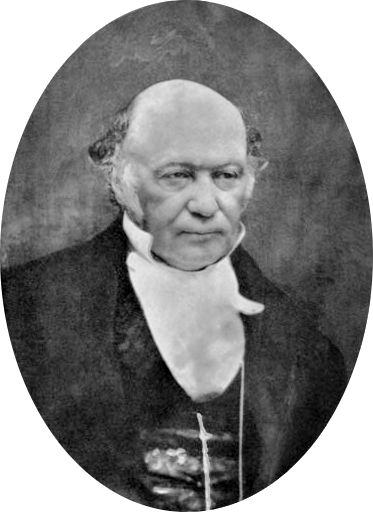
W R Hamilton

The fundamental thing about the universe as a whole, The Dang-An-Sich, the thing that distinguishes it from any other object is this: it does not interact with anything outside of itself. I will talk about a universe that consists of many, many classical particles. Each particle has a position and momentum at a particular time, so that the entire system can be seen as a vector in a very high dimensional space. This space is called "phase space" and its points are the states of the system. Any particular fact about the system at a given time is a function of the position and momentum of (at most) every particle. There are few essential changes to this picture if we move to quantum mechanics, except the dimension of the space is infinite and the algebra of dealing with the functions is different.

The laws of physics do not depend upon time, which can be derived from the first fact. Any system where the laws of physics depend upon time can be expanded as a subsystem of one where the laws of physics do not, but the universe is not a subsystem of a larger system. Therefore, laws of physics of the universe are time independent. If the laws of physics of a system are time independent, the system described conserves energy. Therefore, the entire evolution of the system is given by the level curve of a so-called "Hamiltonian" function. These functions were named after their discoverer - the above pictured William Rowan Hamilton, based on his work with optics (and Lagrange's equally foundational work). I will throughout call an energy conserving system a Hamiltonian system.

But what is a Hamiltonian? Recall that we've just proved an essential physical fact about a system - it has constant energy. The system can change phase only by moving energy around - between its particles, for instance. The Hamiltonian function captures all of the flow of energy within a system. From a given state, the amount of energy it takes to get to a neighboring state by changing the position or momentum of one or another particle (including that - unique! - neighboring state which requires no energy change) gives the change in the Hamiltonian. As before, if energy is conserved, then the system moves on the level curves of the Hamiltonian.


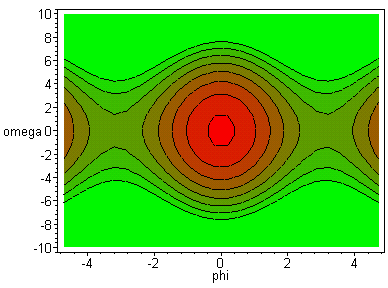
The most simple Hamiltonian is that of a harmonic oscillator. The idea is of a particle bobbing up and down, as on a spring. As the velocity goes up, the particle gets a little farther (closer) from (to) equilibrium. This causes some of the energy to move from (to) the spring and restore . As a result, the level curves are simply ellipses. We can similarly find the results for pendulums and many other system. Most Hamiltonian systems cannot be solved exactly, but wander around state space almost randomly. Much like a fractal, such curves (nearly) fill the volume of state space.

There are many important facts about Hamiltonians. For instance, their level curves (constant energy trajectories) of a Hamiltonian never intersect, so that no two identical systems will be in the same state unless they also have the same energy. Classically, they can get as close as they like, however quantum mechanics forces a discrete separation. Energy is therefore a macroscopic "state function". There is no cheating here, since non-dependence of the laws of physics everywhere is not a local property, we shouldn't be surprised that one derives global properties from it.

Possibly the most important fact about Hamiltonian systems is what is called Liouville's Theorem (notice, again, there is a proof in the quantum mechanical case as well). This means that a cloud starting points of always has the same "volume" as each point moves on its own curve. Looking at the above example. If one draws a circle of starting points on the above graph and lets follows the lines, the ellipses will stretch and bend but never grow or shrink. This means that, in particular, it is never the case that the circle grows or shrinks. This is perfectly general.

Liouville's Theorem implies that there are no stable equilibria for a Hamiltonian system. In the oscillator example, the system stays still if the spring is left at rest, but every perturbation no matter how small means the system moves forever. Since the universe is a Hamiltonian system, it has no stable equilibrium states. This means that the evolution of the universe cannot be "toward" some final state. The Dang-An-sich, the universe in itself, has no preferences among states. It just wanders around state space. It is not only empty not only of content, but it also has no goals.

Edmund Husserl

Edmund Husserl is often called the "father of phenomenology", supposed to be an exact philosophical science of all perception. Husserl was originally a mathematician trained by no less than Leopold Kronecker and Karl Weierstrass. Like many of Weierstrass's students, he was acutely sensitive to foundational issues in mathematics. This lead him into philosophy, where he was inspired by the philosopher and co-founder of psychology Franz Brentano (you might have heard of another one Brentano's students - Sigmund Freud). Brentano was a Catholic priest and took from the Scholastic's interpretation of Aristotle and Aquinas the idea that conscious is always directed at something. One can be conscious of one's surroundings or of one's goals or (most importantly for the Scholastics) of God, but not conscious in general. As G K Chesterton said in Orthodoxy "The worship of will is the negation of will ... because the essence of will is that it is particular.".

Husserl claimed to invent a psychological/philosophical/transcendental method of achieving absolute certainty by "bracketing" each little bit of sense-data and examining it, disregarding questions of its existence. Every time we bracket a blob of sense-data, either 1) we discover it's content is identical with something we already are certain exists or 2) our world grows by one object (More on this in a bit). Why? We may be absolutely certain that we exist and the existence of an object toward which consciousness is directed toward. If it can be known that it is not an object that we were previously aware of, then it is a new object. Therefore, we can supposedly - very slowly! - build a build a world of absolute certainty.

There are flaws with this idea. A system which is directed may not be conscious. Alfred North Whitehead said that it was a profound mistake to think about what we are doing. Not only may the majority of the activities of a system that is conscious be only scarcely directed by consciousness, some of the activities we value most may be barely conscious. This was pointed out by Heidegger to Husserl, who ignored it. The "bracketing" process is vague on how we can learn enough about a piece of sense-data to absolutely know it consists of an object about which we do know absolutely know, kicking that whole important process over to science per se. It isn't clear whether bracketing is psychological or transcendental. Husserl himself changed his mind about this - initially he thought it was psychological, later transcendental. Husserl was a Christian (a Lutheran), but it isn't clear how to treat things we have no sense-data of - like the divine.

But one of the important assumptions, that the above concept of intentionality (interpreted in a highly minimalistic way) always implies that there is at least two "objects" is rigorously true. It follows from Liouville's theorem above. A system that prefers a given, for example, temperature, it must have an outside. This is not a trivial factoid - it is seen in real physics of Hamiltonian "thermostats". These can be checked theoretically and numerically. One can also consider "barostats", etc. that prefer states with particular values of other thermodynamic potentials.

Since human beings are - among other things - thermostats and barostats, they may not be closed systems. Therefore, one may not be The Dang-An-Sich by oneself. This shows that there should be no idealist solipsists.


I have stated all of this without reference to the higher level phenomena of actual experience. I left out the "minimal statistics" state functions (other than energy) such as pressure, volume, etc. These state functions can be described as functions on every possible state. We can then define a "macrostate" as the set of states such that all the state functions are the same for each state (or "microstate") in that set. Here the story actually gets a bit more complex. It turns out there are some macrostates that have a lot more microstates in them than others. Since "most" Hamiltonians wander around phase space almost at random, we can see that a Hamiltonian system will (probably) spend (almost) all of its time at the unique macrostate with maximum entropy. This can be made much more precise, of course.

It is not clear to me yet how this relates to the simple story of Schopenhauer and his followers (such as Heidegger and Sartre). It is philosophically important that The Dang-An-Sich has no direction, but it is not so clear that the non-intentionality of My Representation follows from any principle. I would like to take up this some time later, but no promises.

Tuesday, June 14, 2016

Cowboy Bebop Review #7: Heavy Metal Queen


Space Truckin'! Goin' around space, hauling things! Decorating your cab! CB radio lingo! It's back, but this time in space!!!!

So, this is the first time I can say this: today's episode is not completely essential to the Bebop series. If you miss it, later episodes won't confuse you. This is good news for me, since it finally gives me a chance to breathe and bring in even more extraneous things that I've been wanting to say. And it gives me one more review before the next episode, which is a big deal for me personally. But for you, the viewer at home?

This episode is awesome! It's fun, funny, well written and packed with surprises. Like episode 5, this episode was written by heavy hitting writer Michiko Yokote, who did a great job fighting off cliches. I'll get back to her in a sec. It was directed by Takashi Okamura, the same director as the last episode. I still haven't seen Darker Than Black, so there. And the standout storyboards are from Kunihiro Mori, a long time Gundam vet.

Today's episode draws a lot more on Detective Story, the old Japanese P.I. comedy, than previous episodes. As I've pointed out in previous reviews, Spike's design takes a lot from that series star Yusaku Matsuda. The big difference is that Kudo was kind of lame, and Spike is made of cool.

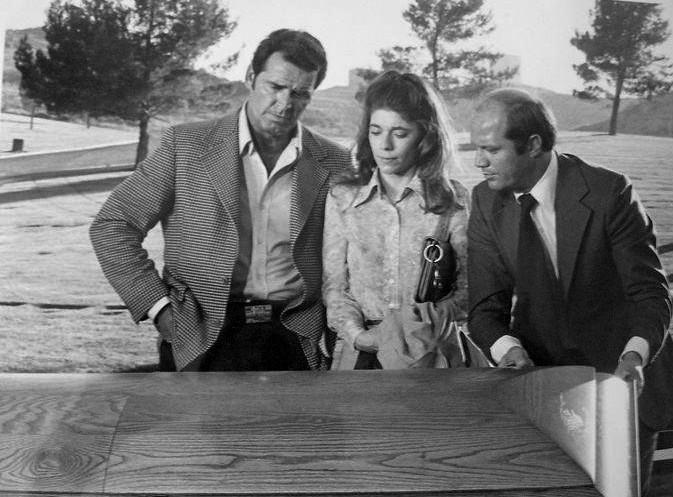
The Rockford Files

Instead of that actual connection, I'm gonna talk about a more spiritual connection. The Rockford Files is a show very similar "defective detective" type show. Lead character James Rockford was just cynical enough to qualify for the descriptor, called the police every time he got assaulted, kicked when they were down and always backed down from a fight when he could. He was played by a ninety nine foot (thirty three yard) pile of charisma named James Garner. The powers behind the show were co-creators Roy Huggins & Stephen J Cannell, James Garner himself, and de facto head writer Juanita Bartlett. I want to talk about her in particular.

What The Rockford Files and Cowboy Bebop share is powerful female writers, which gives them a leg up on other shows. In most sci-fi, the viewer isn't expected to think about why these young people are falling in love - it's just expected that main characters do that. Star Wars, of all things, was actually pretty good about it (in the first two movies anyway), but by and large most SF is vapid about love. Even talented writers - Delany, Gibson, Dick, etc. - did you ever come away from one of their books and think "I really liked that love story."? I'd really have to break my brain to find a straight SF story that even approaches the ironic kissing scenes in The Princess Bride (the book version). Spike Spiegel and James Rockford are believable as romantic leads. Not only are they physically tall, dark and handsome types, but they have a talent for saying exactly what needs to be said at exactly the right time. In the words of Orson Welles, they are only occasionally and only deliberately clowns. It's something that a mix gendered creative team can do more honestly and simply their monogendered counterparts.

Also, they have to be talented, which unfortunately knocks Sense8 out of the running.

Oh right, we're talking about The Wachowskis' inspirations, not their decline. Bebop is always finding ways of breaking up what could be the monotony of villain-of-the-week bounty hunting. In this episode, they do it by substitution - instead of the bounty being the focus of the episode, its another character they meet along the way!

Zeros and VT

Meet VT, a tough old broad who wears pants under her dress under her jacket, because in her day the layered look was in I guess. She has this weird running bet where people try to guess her name. She's also got a powerful kick, so don't mess with her. There are four named female characters in this episode - VT, Muriel, Faye & Ein - yes, I will always count Ein.

 Ein being fed bean sprouts

There's a lot of funny animation and ideas in this episode. Ein is fed bean sprouts, but even funnier I think is her "swimming" in place while Jet and the crew are arguing. Faye has some big funny reactions that unfortunately didn't take to still images very well. And the ostensible goal of the episode is to capture Woody Allen - er, Dekker

Dekker

which in light of what we know about Woody Allen, maybe takes a little bit of the humor off finding him in a restaurant aimed at little kids...

All kids should come to Woody's P! (...)

The episode begins with VT pulling into an asteroid way station. This kind of 2D/3D mix animation shot would slowly become the norm, perfected in shows like Futurama. VT and her cat zeroes go to Mac's, the local bite and fight. Outside some old timer is bragging about knowing some legendary bounty hunter named "Terpsichorde". Huh, what an irrelevant detail. Mac's is crawling with bounty hunters because of a tip that Dekker, an explosives smuggler, will be there. And who should be hung over in the bathroom but Spike Spiegel.

Space Hero

Some of the bounty hunters start to harass Muriel, the cute local waitress. When things start to escalate to "outright assault" levels of harassment, VT intervenes on Muriel's behalf. Muriel is this super-exaggeratedly anime girl. Her reactions are always huge and her eyes don't seem to focus right.

Why is she leaning here, in character? Because it makes for a hilarious set up!

When it becomes clear that they're not going to be able to beat her, they pull out knives. In this process, they bump into Spike, which makes him spill his hangover cure into his lap.

Very Tantei Monogatari-esque reaction

Needless to say, Spike wipes the floor with the jerks. Literally beaten, they run off and basically key his space ship behind his back. A simple example of real world life that never happens in SF outside of Bebop. When they meet on friendlier terms after the fight, we find out that VT loathes bounty hunters and is nostalgic for her ex-husband. Hm.

"Woody's P" has a vampire bat girl in a kimono, as expected

While all this is going on, Faye is chasing the less promising lead. In a wacky and not at all foreseeable turn of events - the less likely lead turns out to work out! There's a funny scene here where Faye misidentifies someone as Dekker and rips off his shirt to check his tattoo. Is this supposed to parallel/invert Muriel's troubles at Mac's? Maybe, maybe not. There are a lot of funny takes from Faye in this episode, but I just don't have room for them.

With Spike's ship damaged by the jerks and Faye's hit by one of Dekker's explosives, VT has to give them a ride back home. Faye gives as many details about Dekker as she can while VT blasts heavy metal.

This is a good time to talk about the music in this episode. There's only one real heavy metal song in the Bebop catalog, "Live In Baghdad". It's used really well a couple times in this episode. There are several remixes and rearrangements in this episode, but I neglected to name them all in my notes. As far as I know none of these have been released outside of what is seen here (they may be on Kanno's misc. album Space Bio Charge). How many other 26 episode series can release seven albums without repeats and have music to spare? And needless to say, all the music in this episode is amazing and used perfectly.


Back on the Bebop, Spike and Faye are still arguing about the uselessness of Faye's information. Spike is washing his clothes because he got egg on them, which is frankly just plain impressive continuity. Admit it, you thought the egg thing would have no consequences. One detail that Faye keeps repeating is that Dekker's truck has Saraswati painted on it.


And wouldn't ya know it, a friend of VT's got into a hit and run with the fleeing Dekker! I love how they gave all of the trucker's cabins such personality. They really make hauling cargo in empty space seem fun and impressive. They even get time units correct! VT uses her CB friends to track Dekker, who is hiding out in an old, unstable asteroid mine. VT informs our heroes and starts chasing him down.


They have no missiles and Faye's ship is outfitted with pinchers. I wonder if they'll need them in the climax? (They do.)


Linus Mine?

VT tries to corner Dekker at the ... Linus Mine, who tries to blow her up. Unfortunately, this causes the whole mine to blow, killing Dekker immediately. Oh well. Right around this time, them ol' Duke Bo... Spike & Faye catch up with her and they begin the process of worming their way out of the mine. What should happen but an obstruction? They have to use Dekker's explosives to blow their way out, which they manipulate with Faye's pinchers! See, told you they'd come in handy. Faye complains that she isn't the delicate cautious type and shouldn't be handling high explosives. Both are true. She calls Spike "Mr Perfect", in context this is in regards to his lightning quick reflexes but if you want to see it as a Freudian slip, I won't stop you.

They place the explosives into Spikes monoracer pod, which then shoots itself forward. Apparently, you can just make it do this, which is a convenient little macro. Spike however has to get himself out of that pod, which is not convenient. He misses VT on the first go, but with some quick thinking is able to get a second try. Luckily this show tries to respect Newton's Second Law - in a less well written SF, he'd be doomed.

More neat framing

While in VT's cabin, Spike takes a crack at the guessing game. He gets it right, which explains her bitterness at bounty hunters and her nostalgia. And, being Spike Spiegel, he ends the episode by saying exactly the right thing.

This episode was really good! Every series should have its inessential episodes at this level. This episode seems very different visually than the last, despite sharing a storyboard artist. Less fast cuts and more big takes. I presume that it is Watanabe's influence keeping style to what the script needs and allows. With a lighter script, they were able to do wackier things. They were willing to have characters upside down and sideways in the low gravity scenes and have a cat that loves to sit on Spike's head. The colors were, as always, amazing. Bebop doesn't really do limited palates, but it is able to prevent the colors from becoming too loud, which helps keep comedy episodes like this grounded. Verdict: you can skip this one, but don't!