Showing posts with label Physics. Show all posts

Thursday, July 14, 2016

Idealism And Modern Science: Space And Time

Kant, again

So, another post on High German Idealism. Before, I'd been pretty kind and polite, even being careful to point out good parts in Hegel. But today, I'd like to point out a major error in the philosophy of Kant, Schopenhauer and others, one that makes much of their exposition wrong as a matter of strict fact. This major error has to do with the division between the underlying "noumenal world"/World As Will and the phenomenal world of experience/World As Representation. Kant and Schopenhauer believe that spatial and temporal order of the world is part of human experience, but not the world in itself - this is simply completely wrong. That the world of experience is 3+1 dimensional is a deep fact about the underlying physical world in itself. Further, human perception does not, in fact, take place in a mostly "geometric" manner, by which Kant would mean specifically Euclidean geometry. This is not a minor flaw, but appreciating it requires far more technical apparatus than Kant and Schopenhauer had access to, even giving them the benefit of deep insight through dim appreciations. I'm going to go about this exposition quickly but carefully. First, I will again recapitulate the core Kantian argument so that it will be understood that Kant meant these terms literally. I'll give an example of a seemingly objective property of an object that is actually not mind-independent. After that, I will give a brief description of the correct modern understanding of these facts.


Kant began his career as a serious natural philosopher in an initially typical 18th century mold. He studied physics with great intensity and soon was setting very difficult physical problems for himself to solve. He had been a minor player in the debate over whether energy or momentum is conserved - unfortunately only publishing after it was understood that both were. This book, though confused by Cartesian concepts, also contains many important insights - such as the correct general explanation of inverse square laws. Kant appreciated that conservation of momentum implied that a collapsing cloud of particles would force the system to rotate and flatten out. Eventually, he argued, the cloud will condense into a star and planets. Kant used this to explain the two dimensionality of the solar system, and went much further than that. He argued that the solar system itself was part of a much larger scale condensation, what we now call the Milky Way Galaxy. At the time, this was a novel and innovative hypothesis. It turned out to be impressively correct. Such arguments shows that Kant was familiar with conservation laws and how they can be used to give powerful qualitative arguments. When Kant was 30, he won a prestigious prize for a demonstration that resistance to tides causes the rotation of planets to slow. This implicitly involves energy considerations and demonstrated that the solar system could not be infinitely old (an open question before this).


Kant's peaceful potential life as an eminent but minor Prussian physicist was ruined one day when he happened to read a book by David Hume, the greatest of all philosophers. Kant's research had convinced him completely of the correctness of Newtonian mechanics - classical mechanics to me and you. But Hume had a devastating and novel argument in favor of skepticism of what is called "induction" - essentially learning. Induction obviously cannot be justified by empirical knowledge, since learning from observation requires learning. No particular induction can be justified on general logical principles - since such an induction would be a general deduction. There are some truths - such as conservation of energy - that are either true or not about particular systems, we have to learn whether they are. So this kind of reasoning is not enough. Finally (and this was Hume's addition to the skeptical argument) induction cannot be justified inductively - that's a vicious circle!

Hume forced Kant to see how delicately his hypotheses leaned on conservation laws that he (and everyone at that time) barely understood and were certainly not necessarily true. In particular, Hume forced Kant to question whether we could learn the laws of physics. Kant spent years - decades - attempting to carefully develop both the system of the world and our knowledge of it into a coherent whole even given Hume's critique. In 1781, he hastily published a massive tome containing all of his work, after a health scare convinced him he would die unpublished if he did not.

Kant's system is not easily explained, partly because it involves such a complex mingling and careful separation of the world as it is and our perception of it. But it goes something like this. The world in itself consists of innumerable particles. The particles move around by exchanging energy and momentum with each other, according to specific - Newtonian - laws. But we cannot see the naked system of the world - instead we see a coarse grained, psychological, language drenched, enculturated, clothed system. In modern physics, we represent the whole system by a vector, and the motion of the particles are given by the so-called "Hamiltonian" of the system. This gives the fine-grained reality of the system, but the world of experience with fluids, pressures, etc. "exists" only as an approximation at a coarse grained higher level.

Homer

The whole world of experience may be coarse-grained, but that doesn't make it "subjective", in the usual sense. Purely physical systems interact on a coarse grained level. The usual thermodynamic functions are minimal statistics of systems, so that any reasonable description of the world must include some of them. They are "forced moves" in Dennett's words.

But very little of our representations of the world are forced! In fact, perception is highly dependent on language, culture and conditioning. The most famous example - first pointed out by John Locke - is color. To an English speaker, it seems to be an objective fact that the sky on a hot cloudless day is blue and the sea on that same day is also blue. But if I were to mention this to Homer, he would be shocked! How could the sun bright sky and the wine dark sea be "the same color"? The answer is that in my culture - the culture of English speaking people - we learned to divide up the spectrum of light in ways that some are called blue and others not.

 This is a somewhat dishonest way of living, color is not so simple, color perception even less than that.  To our culture - you and I are English speakers after all - black is white. It's plain to see that the dark blue sea is the same color as the bright blue sky. If we merely apply the same argument to grey, we see that black and white are obviously the same color.

How do we survive zebra crossings then? In spoken language, our culture simply partitions sufficiently dark greys into black and sufficiently light ones into white. It's hardly less arbitrary than most of life. Our non-linguistic experience of color that motivates most of our actions may be different. Generally, we try to keep life or death situations away from subtle color gradations.

Of course, much more than just color is part of the World As Representation that isn't grounded in the underlying physical world (Schopenhauer's World As Will) in a unique way. Psychologists study physical perception in the form of affordances. Beyond that there are complex social systems that include languages, governments, markets and all that goes with them (such as philosophy).
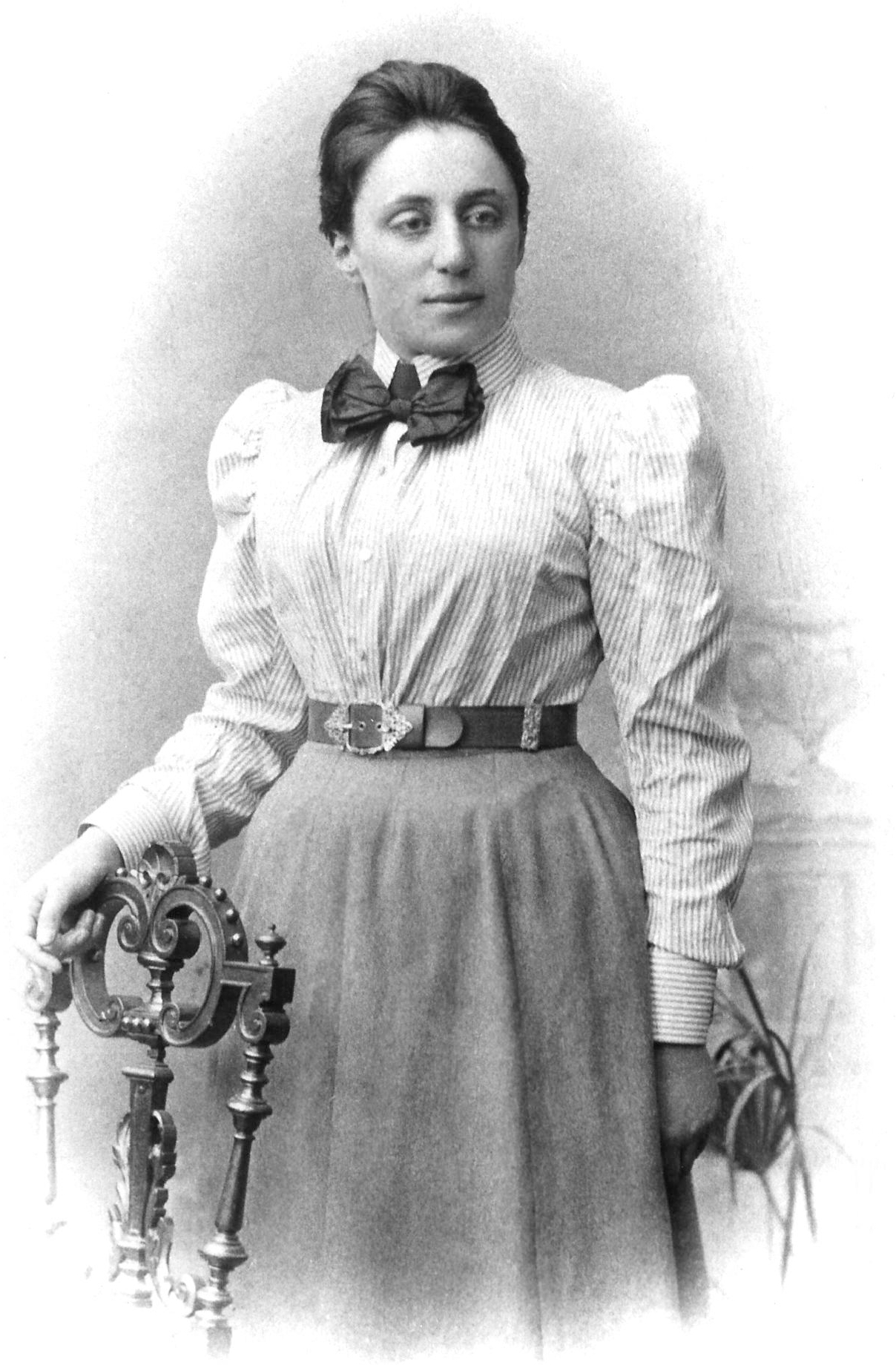
Emmy Noether

So, if so much of the world is ungrounded in the huge vector and the Hamiltonian rules that make up The Dang-An-Sich, what makes me so sure that space, time or spacetime is part of it? In order to understand this, you have to use tools far more modern than anything to which Kant had access. Kant understood that the rules of The Dang-An-Sich conserved certain global properties such as energy and momentum. This was not an easy thing to figure out, and he had to do it for himself. But in order to understand space and The Dang-An-Sich, one must understand the connection between conserved properties and symmetry. This could not have been done before group theory, it could not have been done before Lie groups and algebras, it could only have been done by someone who understood them both. The person who did so was Emmy Noether, and this alone would have made her one of the most important persons in mathematical physics. The fact that the theory of groups was entirely absent from physics before her makes her probably the most important person in the history of mathematical physics. Kant appreciated that conservation of momentum was a fact about physical systems, what he did not and could not have known that this equivalent to the existence of an symmetry operator on the laws of physics - on the Hamiltonian. This can be strengthened by Wigner's Theorem - not only must every conservation law give a differential symmetry, but the symmetry must take a very special form. To say that these theorems is the very foundation of modern physics would be to understate how central they are.

Let's look in particular at conservation of momentum, which suffices to give the philosophical flavor. It arises from the following symmetry: if every particle was moved in a way that keeps all the relative distances the same, then the relative motions of each particle wouldn't change. This symmetry operator defines the three dimensions of space. This is a fact about the Hamiltonian, a fact about The Dang-An-Sich and therefore has nothing to do with perception. It is not even a coarse grained fact, but applies on the microscopic level. Perception may take advantage of this organization, though it only does less than one might think. Actual perception is a lot more edge detection and topological relations, Euclidean geometric representation (with it's angles etc.) is learned.

The above argument has many slight alterations important to physics but not philosophy. The symmetry operators that defines actual physical space are called the Poincare Group and they give rise to geometry which is relativistic - not Euclidean. But these alterations, constrained as they are by Noether's and Wigner's Theorem, cannot alter the simple fact is that spacetime is part of the organization of the world in itself and the Kantian/Schopenhauerian thesis that it is not is simply incorrect.

Saturday, July 2, 2016

Idealism And Modern Science: Intentionality

Immanuel Kant

Last time we talked about High German Idealism, I concentrated on giving an example of how it attempts to reconcile the physical portrait of the world with the world of experience and intuition. We constructed a loose picture of what I called The Dang-An-Sich, which was - roughly speaking - the entire universe. I used Kant's name, but it could also be called Schopenhauer's "World As Will" with no loss. I said that The Dang-An-Sich was "empty of content". There was no volumes and pressures, no fluids or gasses, no chairs or minds, etc. I showed where one could find proofs that, among other things, the basic thermodynamic functions such as volume and so forth could be shown to be "minimal statistics" of the behavior of The Dang-An-Sich. Therefore, they or functions of them will be in every living thing's description of the physical world. This is part of what is called in Schopenhauer's language "My Representation", which exists and is well formed even though The Dang-An-Sich cannot be directly probed. This gave us good examples of idealism and showed that their ideas were not empty of content.

Arthur Schopenhauer

Today I'm going to talk about some more philosophical concerns of Idealist philosophers. In particular, it can be shown exactly that Schopenhauer is correct when he says  the universe as a whole, The Dang-An-Sich, must be purposeless in some sense. That is, The Dang-An-Sich has a special property that means that it doesn't care at all what overall state it is in beyond an important technical detail. This demonstration implies that any system that does care about what state it is in, called by Husserl an "intentional system",cannot be the whole universe. Therefore, any subsystem of the Dang-An-Sich that has the property that it prefers some states to others must divide the universe into an inside and outside. This means that an idealist may not be "solipsistic", in a well defined sense.

W R Hamilton

The fundamental thing about the universe as a whole, The Dang-An-Sich, the thing that distinguishes it from any other object is this: it does not interact with anything outside of itself. I will talk about a universe that consists of many, many classical particles. Each particle has a position and momentum at a particular time, so that the entire system can be seen as a vector in a very high dimensional space. This space is called "phase space" and its points are the states of the system. Any particular fact about the system at a given time is a function of the position and momentum of (at most) every particle. There are few essential changes to this picture if we move to quantum mechanics, except the dimension of the space is infinite and the algebra of dealing with the functions is different.

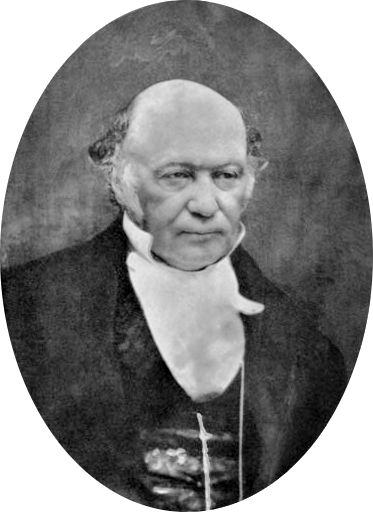
The laws of physics do not depend upon time, which can be derived from the first fact. Any system where the laws of physics depend upon time can be expanded as a subsystem of one where the laws of physics do not, but the universe is not a subsystem of a larger system. Therefore, laws of physics of the universe are time independent. If the laws of physics of a system are time independent, the system described conserves energy. Therefore, the entire evolution of the system is given by the level curve of a so-called "Hamiltonian" function. These functions were named after their discoverer - the above pictured William Rowan Hamilton, based on his work with optics (and Lagrange's equally foundational work). I will throughout call an energy conserving system a Hamiltonian system.

But what is a Hamiltonian? Recall that we've just proved an essential physical fact about a system - it has constant energy. The system can change phase only by moving energy around - between its particles, for instance. The Hamiltonian function captures all of the flow of energy within a system. From a given state, the amount of energy it takes to get to a neighboring state by changing the position or momentum of one or another particle (including that - unique! - neighboring state which requires no energy change) gives the change in the Hamiltonian. As before, if energy is conserved, then the system moves on the level curves of the Hamiltonian.


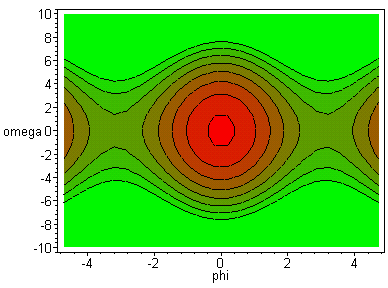
The most simple Hamiltonian is that of a harmonic oscillator. The idea is of a particle bobbing up and down, as on a spring. As the velocity goes up, the particle gets a little farther (closer) from (to) equilibrium. This causes some of the energy to move from (to) the spring and restore . As a result, the level curves are simply ellipses. We can similarly find the results for pendulums and many other system. Most Hamiltonian systems cannot be solved exactly, but wander around state space almost randomly. Much like a fractal, such curves (nearly) fill the volume of state space.

There are many important facts about Hamiltonians. For instance, their level curves (constant energy trajectories) of a Hamiltonian never intersect, so that no two identical systems will be in the same state unless they also have the same energy. Classically, they can get as close as they like, however quantum mechanics forces a discrete separation. Energy is therefore a macroscopic "state function". There is no cheating here, since non-dependence of the laws of physics everywhere is not a local property, we shouldn't be surprised that one derives global properties from it.

Possibly the most important fact about Hamiltonian systems is what is called Liouville's Theorem (notice, again, there is a proof in the quantum mechanical case as well). This means that a cloud starting points of always has the same "volume" as each point moves on its own curve. Looking at the above example. If one draws a circle of starting points on the above graph and lets follows the lines, the ellipses will stretch and bend but never grow or shrink. This means that, in particular, it is never the case that the circle grows or shrinks. This is perfectly general.

Liouville's Theorem implies that there are no stable equilibria for a Hamiltonian system. In the oscillator example, the system stays still if the spring is left at rest, but every perturbation no matter how small means the system moves forever. Since the universe is a Hamiltonian system, it has no stable equilibrium states. This means that the evolution of the universe cannot be "toward" some final state. The Dang-An-sich, the universe in itself, has no preferences among states. It just wanders around state space. It is not only empty not only of content, but it also has no goals.

Edmund Husserl

Edmund Husserl is often called the "father of phenomenology", supposed to be an exact philosophical science of all perception. Husserl was originally a mathematician trained by no less than Leopold Kronecker and Karl Weierstrass. Like many of Weierstrass's students, he was acutely sensitive to foundational issues in mathematics. This lead him into philosophy, where he was inspired by the philosopher and co-founder of psychology Franz Brentano (you might have heard of another one Brentano's students - Sigmund Freud). Brentano was a Catholic priest and took from the Scholastic's interpretation of Aristotle and Aquinas the idea that conscious is always directed at something. One can be conscious of one's surroundings or of one's goals or (most importantly for the Scholastics) of God, but not conscious in general. As G K Chesterton said in Orthodoxy "The worship of will is the negation of will ... because the essence of will is that it is particular.".

Husserl claimed to invent a psychological/philosophical/transcendental method of achieving absolute certainty by "bracketing" each little bit of sense-data and examining it, disregarding questions of its existence. Every time we bracket a blob of sense-data, either 1) we discover it's content is identical with something we already are certain exists or 2) our world grows by one object (More on this in a bit). Why? We may be absolutely certain that we exist and the existence of an object toward which consciousness is directed toward. If it can be known that it is not an object that we were previously aware of, then it is a new object. Therefore, we can supposedly - very slowly! - build a build a world of absolute certainty.

There are flaws with this idea. A system which is directed may not be conscious. Alfred North Whitehead said that it was a profound mistake to think about what we are doing. Not only may the majority of the activities of a system that is conscious be only scarcely directed by consciousness, some of the activities we value most may be barely conscious. This was pointed out by Heidegger to Husserl, who ignored it. The "bracketing" process is vague on how we can learn enough about a piece of sense-data to absolutely know it consists of an object about which we do know absolutely know, kicking that whole important process over to science per se. It isn't clear whether bracketing is psychological or transcendental. Husserl himself changed his mind about this - initially he thought it was psychological, later transcendental. Husserl was a Christian (a Lutheran), but it isn't clear how to treat things we have no sense-data of - like the divine.

But one of the important assumptions, that the above concept of intentionality (interpreted in a highly minimalistic way) always implies that there is at least two "objects" is rigorously true. It follows from Liouville's theorem above. A system that prefers a given, for example, temperature, it must have an outside. This is not a trivial factoid - it is seen in real physics of Hamiltonian "thermostats". These can be checked theoretically and numerically. One can also consider "barostats", etc. that prefer states with particular values of other thermodynamic potentials.

Since human beings are - among other things - thermostats and barostats, they may not be closed systems. Therefore, one may not be The Dang-An-Sich by oneself. This shows that there should be no idealist solipsists.


I have stated all of this without reference to the higher level phenomena of actual experience. I left out the "minimal statistics" state functions (other than energy) such as pressure, volume, etc. These state functions can be described as functions on every possible state. We can then define a "macrostate" as the set of states such that all the state functions are the same for each state (or "microstate") in that set. Here the story actually gets a bit more complex. It turns out there are some macrostates that have a lot more microstates in them than others. Since "most" Hamiltonians wander around phase space almost at random, we can see that a Hamiltonian system will (probably) spend (almost) all of its time at the unique macrostate with maximum entropy. This can be made much more precise, of course.

It is not clear to me yet how this relates to the simple story of Schopenhauer and his followers (such as Heidegger and Sartre). It is philosophically important that The Dang-An-Sich has no direction, but it is not so clear that the non-intentionality of My Representation follows from any principle. I would like to take up this some time later, but no promises.

Tuesday, July 22, 2014

Maxwell's Demon


In Theory of Heat, J C Maxwell - one of the greatest physicists of all time - attempted to illustrate the new theories of molecular flux and thermodynamics in a form as complete as the science allowed. He finished this section with a thought experiment that purported to show "Limitation of the Second Law of Thermodynamics". "Before I conclude, I wish to direct attention to an aspect of the molecular theory which deserves consideration". He introduced the idea we now call Maxwell's Demon, meant to illustrate the nature of Maxwell's thoughts on the Second Law. I'll let Maxwell illustrate:

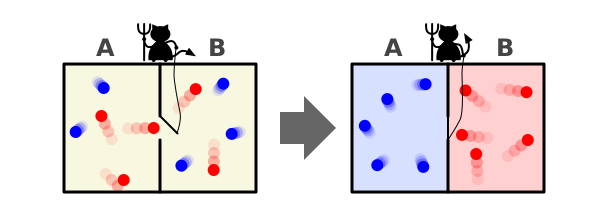
"One of the best established facts in thermodynamics is that it is impossible in a system enclosed in an envelope which permits neither change of volume nor passage of heat, and in which both the temperature and the pressure are everywhere the same, to produce any inequality of temperature or of pressure without the expenditure of work. This is the second law of thermodynamics, and it is undoubtedly true as long as we can deal with bodies only in mass, and have no power of perceiving or handling the separate molecules of which they are made up. But if we conceive a being whose faculties are so sharpened that he can follow every molecule in its course, such a being, whose attributes are still as essentially finite as our own, would be able to do what is at present impossible to us. For we have seen that the molecules in a vessel full of air at uniform temperature are moving with velocities by no means uniform, though the mean velocity of any great number of them, arbitrarily selected, is almost exactly uniform. Now let us suppose that such a vessel is divided into two portions, A and B, by a division in which there is a small hole, and that a being, who can see the individual molecules, opens and closes this hole, so as to allow only the swifter molecules to pass from A to B, and only the slower ones to pass from B to A. He will thus, without expenditure of work, raise the temperature of B and lower that of A, in contradiction to the second law of thermodynamics."

The Wikipedia image is much better than the one I tried to make.

This brief thought experiment has given rise to a minor, but interesting, literature on whether Maxwell's reasoning is correct. Surprisingly, smart money says "No."! . The primary difficulty in Maxwell's thought experiment is his opinion that just because you can capture one fast particle that you can continue to capture more. In fact, this is a direct violation of the principle of detailed balance - if the door is open for any length of time, it is as likely to let a particle out as in (there are as many fast moving particles on one side of the door as the other after all!). Maxwell's reasoning is therefore circular, it assumes that if one could violate the second law, then he could. Another way of putting this is that he did not include the work done by the demon as a part of the system. If the demon is considered a rectifier or computing device, then the entropy of this device must be such that equilibrium will still be reached. This approach is demonstrated in a state of great excellence in this paper. Since the invariance of phase volume is a principle of mechanics, the circularity of reasoning described is revealed. This second approach - really the first approach in new clothing - was pioneered by Szilard and brought to a state of modernity by Landauer. In this paper, the Szilard-Landauer approach is given a simple model which is solved explicitly. They don't go into detail about the equivalence of these lines of thinking, in fact I don't know if anyone has bothered to do so. Incidentally, this literature has been tough for me to track down, even some of the most famous papers by Smoluchowski (as far as I know, Experimentally Verifiable Molecular Phenomena that Contradicts Ordinary Thermodynamics has never been translated!). Still, I can give examples of pieces of the literature. This literature is not pure theory, it also includes plentiful experimental and numerical examinations of these thought experiments. This excellent paper includes both a good summary of the issues and a formal model of the above trapdoor, showing precisely how it fails. This paper shows how well numerical experiments can clarify and elucidate, something near to my own heart.

Before I go, I should mention that I first became aware of this literature through the Feynman Lectures on Computation, which includes chapters on Quantum Computing, Reversible Computing and the physics of computation. His discussion of these issues probably influenced me a lot, but I don't want to dig it out of it's current location. Feynman also made a sizable contribution to this literature in his Lectures on Physics, where he introduced the Brownian Ratchet to illustrate the concepts above. This section is a very good example of how theory can be used to elucidate.
Much, much better than my attempts  

The two sides of the ratchet are in two boxes of gas, to the center a mass is tied. Randomly, the gas will push the blades in tank 1 (at temperature 1) left and the pawl in tank 2 (at temperature 2) stops the ratchet from moving right. This means that just like the Smoluchowski trap, the ratchet works as a rectifier. Feynman analyzes in detail why this fails - and it fails for the same reason that Maxwell's failed. There is a presumption that the pawl is not subject to the same random fluctuations, in other words that one need not worry about gas particles moving the other way. This whole chapter is worth reading (of course, the entire book is worth reading...) but I will only reprint his final words:

"If T2 were less than T1, [then] the ratchet would go forward, as anybody will believe. But what is hard to believe, at first sight, is the opposite. If T2 is greater than T1, the ratchet goes the opposite way! A dynamic ratchet with lots of heat in it runs itself backwards, because the ratchet pawl is always bouncing. If the pawl, for a moment, is on the incline somewhere, it pushes the inclined plane sideways. But it is [almost] always on an incline plane, because if it happens to lift up high enough to get past the point of a tooth, then the inclined plane slides by, and it comes down again on an inclined plane. So a hot ratchet in pawl is ideally built to go around in a direction exactly opposite to that for which it was originally designed!"

Exciting stuff!

Sunday, July 13, 2014

Classical Thermodynamics From "Intuitive" Symmetries? Part 1

In my last post, I promised to talk about Paul Samuelson's paper "Conserved Energy Without Work Or Heat". Now I will do so. Even earlier I had earlier promised a post about Disney Princesses. While I have a variety of observations, I haven't yet put them together into a theme.

First, a word about our author.

P Samuelson

Paul Samuelson is one of the father's of modern economics. Even more than with more famous economists like Keynes or Friedman, one can divide economics into a pre- and post-Samuelson quite easily. Paul Samuelson's most important work was his dissertation, Foundations of Economic Analysis. In that book, he provided perhaps the first completely mathematically clear explanation of what it is economists where doing. When an economist says that, for instance, a given tax is good or bad, what he or she means is that changing something given, the rest of the economy will eventually adjust and where it will settle will be better or worse than where it is now. A good example (with applications to finance) can be found here - and in innumerable other places! Samuelson made many other advances in almost every area of economics. Much can be said about his "scientific personality". He considered himself a child genius well into his 80's. He was immensely concerned with every aspect of scientific work, empirical, theoretical, philosophical, historical and pedagogical. Unlike many economists of his stature and influence, Samuelson almost never outright dismissed an economist or an economic theory, always describing them as containing nuggets of truth - of course, truths that he himself has formally obtained. His scientific ideal was that of classical thermodynamics, where the foundations were clear, the applications enormous and the empirical validity impeccable. Some have objected to his appreciation for classical thermodynamics, but most of these complaints are ill founded. To the extent he was inspired by classical thermodynamics, classical thermodynamics is inspiring. (Aside: it is not at all correct to believe that just because pre-Samuelsonian economists mostly used geometry and post-Samuelsonian economists mostly used algebraic notation that one was less mathematical. J.C. Maxwell's Theory of Heat was written almost entirely with geometry, and this example can be multiplied.)

Now on to the paper itself. This paper has multiple goals. One is a slick derivation of deep aspects of physics (esp. thermodynamics) from a few qualitative empirical regularities. One is to present the argument that one could have - in an alternate universe - completely missed the deep connections of thermodynamics to Newton's Laws. I am going to play loose with language, sometimes I will say "amount of heat" and other imperfectly defined things in order to bring these ideas closer to everyday experience. If this confuses anyone, then I will do another version which I am more careful (or they can read Samuelson's original).

(Aside 2: This idea, in a loose philosophical way, might be connected to "microfoundations" debate economists sometimes talk about. If microfoundations can be seen to be like statistical mechanics, then macroeconomics is like thermodynamics. This paper would then be an example where a simple empirical regularity is all that is needed to establish deep economic laws, rather than investigation of the deepest parts of the consumer's psyche. This argument is unimpressive, and Samuelson would never have dreamed of making it, but you can think about it if you like.)

Now, on to the deep parts of the paper. The main empirical principle of this paper is that if you put two hot things in contact, then they will equilibrate. A cold drink will turn warm in the hot summer afternoon. This principle is purely qualitative, but quantitative measures will fall out of it. Notation will simplify things. Our Principle is that "The Temperature of System 1 and the Temperature of System Two go to the Equilibrium Temperature in System 1 and the Equilibrium Temperature in System 2.". This is a mite cumbersome. Instead we say \( (t_1 ; t_2) \rightarrow (t_eq ; t_eq) \). We assume that \(t_eq\) is a function of the initial conditions.

Brief considerations as to measurability of heat are given, but these are minor enough that the assumption that the only important conclusion is that the final temperature is to be a function of the initial temperatures. This paper is written as an alternate history past Carnot, so we aren't interested in chemical, gravitational, electromagnetic, etc forces (more on aside 2: one of the many arguments against the above aside is that one couldn't do this without "microfounding" heat. Is this true? Discuss.). We consider the effects of heat by itself.

A thought experiment. Consider a bowl of hot soup kept in contact with a container of cool apple sauce. The bowl and the container are strong, they do not melt or flex because of the heat. They are kept in a insulating lunch bag, so that they don't lose heat to the environment. A sort of drawing of this situation:
What will happen? By our principle founded on common observation, the substances will come to be the same temperature. Of course, there is more to consider than just the temperature. I drew the above as if the soup and apple sauce were in equal volumes, but if I had enormously more soup or enormously more apple sauce, then the one with enormously more volume would barely notice the change due to the other. There might be other dependencies, but Samuelson follows Carnot wisdom that the main action can be captured considering only the interaction of volume and heat - and sometimes heat alone! Symbolically: $$(t_1,v_1 ; t_2,v_2) \rightarrow (t_eq,v_1; t_eq,v_2)$$ $$t_eq = f(t_1,v_1 ; t_2,v_2)$$ The first part is read "The Temperature and Volume of System 1 and the Temperature and Volume of System Two go to the Equilibrium Temperature and Original Volume of  System 1 and the Equilibrium Temperature and Original Volume in System 2.". Obviously, this doesn't depend on how the apple sauce and the soup are oriented, since the bag is being thrown around all day anyway. This implies that \(f(t_1,v_1 ; t_2,v_2)= f(t_2,v_2; t_1,v_1 )\). Today, I will concentrate solely on what can be concluded from experiments of this type alone, but in Part 2 I will introduce a more complex experiment involving pistons.

These experiments can be compounded arbitrarily. For instance, we can put four substances together:
And the above reasoning still applies. The arrangement can be manipulated so that red and yellow equilibriate while orange and burgandy equilibriate, then those two are placed next to each other and the whole system is allowed to equilibriate. Alternately, the arrangement can be manipulated so that red and orange equilibriate while yellow and burgandy equilibriate, then those two are placed next to each other and the whole system is allowed to equilibriate. Either way, the system comes to the same temperature. It is easy to arrange the volumes (actually, specific volumes) to be the same. In this case we have the simple symbolic expression for the above: \(f(f(t_1,t_2);f(t_3,t_4))=f(f(t_1,t_3);f(t_2,t_4))\). It is read "The equilibrium temperature of the equilibrium temperature of the first two substances touching the second two substances is equal to the equilibrium temperature of the equilibrium temperature of the first and third substances touching the second and fourth two substance.". You can start to see why we invented this notation!

Now we add a couple new assumptions. These assumptions are unobtrusive and intuitive, but they might be wrong and must be stated. We have already extensively discussed the existence and symmetry of the function \(f \), which takes the system set up and gives the equilibrium temperature. We also assume that the function \(f \) has the property that if two substances have the same temperature, then the equilibrium temperature is that temperature. (more on aside 2: if we were interested in "microfoundations" right now, then this would be a statement about the nature of an equilibrium - namely that it is an equilibrium!) Otherwise, purely mental divisions could make physical changes. Finally, we assume that if you perform the same experiment, but you make one of the substances hotter before hand, then you always get a hotter equilibrium. It is these properties of heat, perhaps, that lead to the idea that heat was an independent substance!

These assumptions give a remarkable conclusion, the existence of a sort of energy function! Perhaps a better name would be a caloric function (this does not mean, of course, that there is any such physical substance!). A brief verbal argument can be made. I said before that the above that the latter assumptions make heat seem like a substance, since if you add more of it, more comes. The amount of that substance is the caloric. The equilibrium temperature is derived by averaging the amount of caloric in both substances (notice averaging, not summing. This becomes clearer when the mathematical argument is fully expounded). What is remarkable is the role of symmetry in the proof. If the function were not symmetric, we'd have no reason to think that the equilibrium temperature could be found by averaging equilibrium temperatures of partitions. It was this fact that is the foundation of this theory! By choosing references, one can convert this equation into a standard internal energy function. We have begun the battle of recovering classical thermodynamics from simple symmetry arguments.

Phew! I have covered much ground and only barely scratched the surface of this paper! I need to go through and show how this caloric function is found, give more examples, and there's a an entire second experiment! These posts will come every Sunday. If there's particular aspects of this argument that interest you, drop me a comment. Before I go, however, there are a couple things I would like to highlight. First of all, notice that we derived an energy function, but I didn't check anything about its form. For instance, I didn't make any assurances that it was always positive. It is this reason I prefer to call it a caloric function, even if I risk misinterpretation that this somehow vindicates the physical concept of caloric. More importantly, I want to highlight that this argument makes no reference to Newton's or Schrodinger's laws. Physicists have a deep rooted appreciation for the laws of thermodynamics, and it is arguments like these that gives substance to those feelings. No matter what the universe is like, the laws of thermodynamics will apply as long as those fundamental symmetries are observed. This does not establish that the laws of thermodynamics are universal, but a non-physicist might wonder why they are believed to be and arguments like this will help the intuition in that regard.

Finally, a social observation. The laws of thermodynamics are wildly misused in bad science, bad philosophy and even bad politics. I have seen irresponsible writers on the internet imply and argue that they make action on global warming impossible, often with naive importations into economics or politics. What I hope is that when reading this, you absorb some of the actual intuition of this science, rather than the slogans such people use. When someone claims an application of thermodynamics, check first to see if even first principles - such as these - apply. If it is not obvious how, then they are not obviously right. See you next week!