Showing posts with label History of Economics. Show all posts

Wednesday, July 20, 2016

Against The 70s


Someone not so recently asked a big question, "Why does the 1970's inflation matter so much to economic thought?". There are so many stories told about that period that it has passed into myth. It isn't really clear why, at least if you look at it through the lens of high powered macroeconomic theory. Supposedly it all has something to do with the Phillips curve. The Phillips curve is an expression of the observation that the rate of inflation is negatively correlated with the rate of unemployment. The Phillips curve hypothesis is that this correlation is stable (at least, holding institutions constant) and that the order of causation can run from inflation onto unemployment. The usual story is simplistic: "Back then we believed in the Phillips curve, but the 70's taught us not to do so.". That sound you hear is a vortex generated by philosophers of science rolling their eyes.

When you try to put meat on these bones, you find they break too easily. It isn't easy to find a high flying macro theorist who actually believed in a stable, exploitable Phillips curve. The classics certainly couldn't believe in such a money illusion; Keynes couldn't have argued for a stable inflation/unemployment trade-off (if it existed, why would we need G > 0 ?); Samuelson and Solow certainly didn't believe in it; nor did Fed Chairman at the time Arthur Burns. It's hard to find a single person that "believed" in the Phillips curve in the way it is said to have been.

Milton Friedman

These facts - and they are brute historical facts - have led some to believe in a conspiracy theory of the 70's. "Milton Friedman and the Chicago School convinced everyone that the 70's 'proved Keynes wrong because the Phillips Curve was wrong!1!' was all a lie and therefore modern macro is an illusion meant to disguise naked power grabs by The Enemy.". I put it in a way that you could see how fallacious such reasoning is, but I've seen it put almost as bluntly before.

It is strange, you have to admit, that such brilliant people would be snookered by it. Not just right wing radicals who want validation came out of this. Ed Phelps, Stanley Fischer, and Tom Sargent all saw ... something invalidated. But if it wasn't the Phillips curve, what was it?

Stevie Nicks

The first thing that you have to realize about the 1970s is that it was not, in fact, the 2010s. Nobody in 1976 - not Nixon, not Friedman, not Samuelson and not anyone in heterodox economics - was also in 2016. Everybody was groping blindly and if some had more insight than others, well we should be so lucky. The other thing to realize is that high falutin' macro theory is a tiny and rare thing. Nixon certainly never read a single work in the field and didn't have any friends that did. Ed Cole - one of the presidents of General Motors - could tell you a lot about the Chevy Corvair or Vega, but knew and needed to know nothing of the debate over large scale statistical models and certainly he had no opinions worth noting on anything as abstruse as the Cambridge Capital Controversy that was so distracting in the 60's. This is interesting given how macroeconomic his job was. Some basic facts from Wikipedia: GM at its height measured its profits in % of GDP. GM was the second largest employer in the world - behind only the entire Soviet state.

So, given that Cole was no expert in high macroeconomic theory for its own sake, what did he believe? Clearly, I can't read his mind. But I can give you a picture of what he likely believed, even if he would quibble with a nibble or two. If you are a fan of brief summaries, I'll give you one: "He thought he lived in the era of Mad Men.".

John Kenneth Galbraith

The person who most clearly put the vision to paper is J K Galbraith in his books The Affluent Society and The New Industrial State. Since this vision failed, it might seem that I came to pick on him, but I actually a lot of sympathy for him. He was trying his best and had a basically empirical outlook. He was basically right on backing imperfect competition. Even if he went too far and replaced it with something equally simplistic, Galbraith was right to question consumer sovereignty. He worried about the structure of the firm and capture of government legislation by business before it was cool. Galbraith was trying to think through ideas that don't formalize very easily. He was trying to get away from the myth of the rational consumer. Herbert Simon was working on similar ideas and did better work, but never anything macro related. Galbraith tried his hand and if he didn't succeed, well, did anyone?
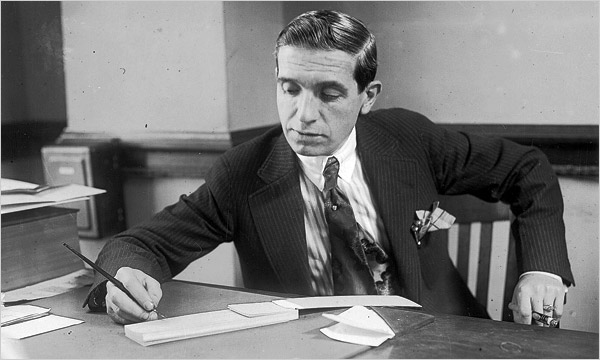
Carlo Ponzi

Galbraith's method is developed in his second book, The Great Crash, 1929. This is a strange book for a modern to read. The first thing one notices is how little a role the year 1929 plays. The lengthy, hilarious section on the Florida real estate bubble is the best part of the book - but what all does it have to do with the Great Depression? This part of the book is an argument - I don't remember if it is explicit or implicit - that the market is not guided by rational consumers. The masses are irrationally attracted (that is to say, they will invest more than they would expect to receive if held down and forced to think it through) to the promise of easy money, even if it comes from Carlo Ponzi or Donald Trump. They are irrationally repelled by the slightest loss. They put good money after bad. They're moved by emotional displays from the wealthy. They do many things, but they do not maximize net present value like Irving Fisher taught us.

Sigmund Freud

Though the masses are not very good consumers, the advertisers and engineers, they're very good (supposedly). From this vision, the corporation emerges as the fundamental entity of economics. A corporation consists of four parts (my typology, not his): the capitalist, the engineer, the laborer and the advertiser. The advertiser has read his Freud and empirically studied the deep parts of human nature. As depicted in Freud On Madison Avenue, the advertiser designs the aesthetics of the car to be a giant phallus with a clitoral emblem on a vaginal grille. He can then determine exactly how much the irrational consumer will buy in aggregate. The engineer then designs the car as a functional item, which selects the costs of production. The laborer and capitalist then build the cars. The income is then divided among the four parts of the corporation by the labor contract (which is fixed by negotiation between the capitalist and labor, which in practice is represented by union officials). Note that it is not the profit that is divided, but the income. That doesn't matter in this system - income and profit are jointly decided by the engineering and advertising experts. The corporation never has to worry about society wanting less products in general, demand will be simply created by the government if it ever accidentally slackens.

There is much to criticize in the above system. The biggest problem is a very strong difference that is assumed to exist between the irrational common consumer and the tiny echelon of experts that control them. There's no way to get around this, there should be no apologetic for it and there is no question into which class Galbraith put himself. It is assumed, not proven. When pushed on this point, Galbraith would fall back on his endless supply of jokes about irrational consumers. In his economics and his novel, this was all but explicit. The only question was whether people Galbraith would be allowed by his fellow elites to make the masses a comfortable world. There is no freedom to give them.

The role of the state is very strong in Galbraith's mind. I've already mentioned maintaining demand at a full employment level. Another is managing labor unions. The labor unions face a macroeconomic prisoner's dilemma. Imagine two labor unions that have the choice of either asking for higher wages or keeping them stagnant. If they both keep stagnant, then the price level stays the same and everyone is well off. If just one asks for an increase, then its members are much better off. But if both ask for an increase, relative wages stay the same but the money price of everything goes up. Therefore, people are worse off. (This actually happened in England in the 70's) This is one of the state's tasks as countervailing power against the large corporations (and their unions). The simplest and most dangerous way of doing this is wage controls - Galbraith never bothered to ask for another one. Price controls in general follow from the same argument on advertisers instead of laborers.

 Panasonic Space Age Television

Outside of the secluded world of high economic theory, much of what I just exposited was uncontroversial. Arthur Burns, the head of the Federal Reserve at the time, believed much of it. Galbraith's books were best sellers. Further, it was in the general culture. To be an adman in the 60's was to be the king of the world.

What happened in the 70's was the fall of the whole idea. For the first time, the mandarins in charge were forced to admit that demand management was non-trivial. The incoherent system of monetary policy, price supports, unpredictable government regulation and massive war time spending interacted with oil-induced supply shocks and changing culture demand shocks to pull aggregate demand in every direction. The net result was gas queues, stagflation and malaise. The role of the failure of price supports, while not shocking to any theorists, bolstered Friedman's claims that markets were a necessary part of demand management (he didn't put it like this). Friedman prestige didn't come from just getting it right, it came from how he got it right. No high powered macroeconomist denied the possibility of stagflation - but Friedman happened to have the perfect combination of being against price supports, for rule based monetary policy, for smooth government regulation (okay, I'll be fair. He was against government regulation in general) and having done deep work about how the economy can smooth over shocks. It was exactly what people needed in 1971 (well, government regulation in general is arguable, but certainly not basically arbitrary price controls).

The markets upset the Galbraithian vision in a deep way. Recall that GM's deeply learned advertisers decide on how much sales they make this year. The human mind cannot resist the sexual allure of their automobiles ... supposedly. But the oil crisis meant that people wanted smaller, more efficient cars, not rolling slabs of steel. The Japanese entered the automobile market with cars that people wanted and GMs sales declined. Wasn't GM supposed to control sales?

Another example. When GE designed a television, they decided the sales. They knew - knew - what people wanted in a TV: they wanted a wood exterior and a durable stainless steel frame. They wanted furniture (I know they thought this, because I've talked with the people who built them at the time). When Japanese companies started exporting cheaper, lighter all plastic televisions, GE was sure no American would want one. As it turned out, those "irrational" consumers resisted the psychological allure of the expensive American furniture and just bought cheap, functional boxes. This is not how the system was supposed to work! Didn't these consumers know that they were irrational?

The important thing about the 70s is that they seemed to show that irrationality could only be pushed so far. Consumer preferences can't be written off as a minor addendum. The point of Friedman about inflation expectations in the Phillips curve is minor. People had been writing about inflation expectations since monetary analysis began. What was influential was his whole approach. It was part of a general tendency to move toward rationality - game theory began to go deeper into traditional economic realms (such as industrial organization). And damn it, if you presume consumers act basically according to their preferences, then price controls and shocks cannot coexist. Friedman and others hammered on these points as far as they could. And then they were pushed even further...

You see, through the lens of the 70s experience outlined above, purely rational expectations economics starts to look good. However, once the "t"s were crossed and the "i"s dotted, the New Classical school that supposedly took them as their basis didn't live up to its promises. I mean this explicitly - they promised to pass statistical tests that they did not. The New Classicals stopped using these statistical methods because "they were rejecting to many 'good' models". Perhaps this movement toward "rationality" was itself irrational. In many ways, by the time the 80s ended, the rationality revolution of macroeconomics was spent. In other fields (the aforementioned industrial organization, for instance), the move to rationality bore better fruit.

Even with all these qualifiers, it was still the 70's that forced people in power to consider the consumer as an autonomous human being. And that is why it looms so large in our thought.

Monday, May 30, 2016

Karl Marx At The Sunset Of Classical Economics

Adam Smith

For such a famously humble man, Adam Smith left a complicated legacy. A friend and student of David Hume and Francis Hutcheson, Adam Smith took it upon himself to inquire upon the Nature and Causes of the Wealth of Nations since the wealth of a nation had so much obvious bearing upon the quality of life of its inhabitants.

David Ricardo

Within Wealth Of Nations, there are mixed up two very different forms of analysis which are not easily reconciled. On the one hand, there was analysis of the "state of nature" and "stationary state", both concepts learned from Hume. In these states, there was a labor theory of value and life was static. On the other hand, there was the dynamic life of growth that he saw in England and America, where he applied a more lax "Supply and Demand" analysis. In so doing, Smith was the father of both classical economics as developed by Ricardo and neoclassical economics as developed by Alfred Marshall.

Thomas Malthus 

The stationary state is one in which land and capital have been distributed and innovation is low enough to be negligible. It is a very unpleasant place: "Though the wealth of a country should be very great, yet if it has been long stationary, we must not expect to find the wages of labour very high in it.". Without movement or innovation, capitalism would then take on many of the aspects of feudalism - Adam Smith examined the late Chinese Empire as a model stationary state.

Without innovation, wages would become a decreasing function of population. This state is often now called "Malthusian", even though it was first developed by Smith and its reality and immanence was not questioned by any classical economist (including Marx). Ricardo (and Malthus) differed from Marx in their predictions about the stability of the stationary state. All agreed that it was, in Marx's famous words, the center of gravity about which capitalist prices moved. Ricardo and Malthus believed that it would be stable, and that life would be horrible forever.

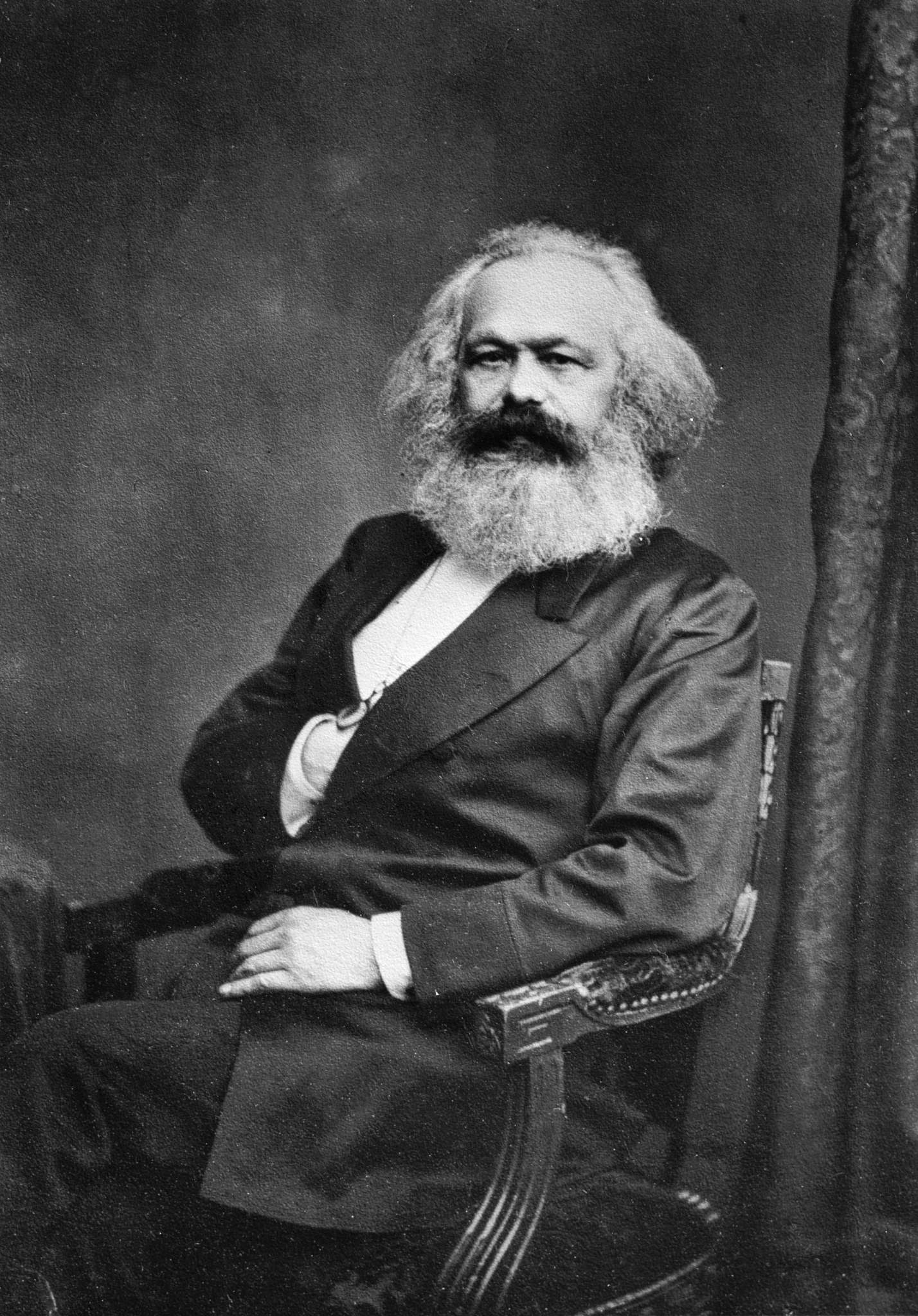
Karl Marx

I promised in a previous post to explain Marx. This can now be done. The price of a good or service (I will say "task") in the stationary state is called by Marx its "value" and by Adam Smith its "natural price". Again, in the stationary state technique, resources and factor cost is fixed for each firm. It is easily seen that in this case, aggregate output is solely a function of the quantity of employees hired. In addition, with fixed technology, a given level of employment for a given task fixes the return for that task. Since the price of a task is  simply the ratio of the total income each unit rewards to the count of units, price in the stationary state is solely a function of labor allocation. This is the "labor theory of value" stated in a fashion both simple and acceptable to anyone.

One can go further than this. In the stationary state, each child born is born to a given task. That, under capitalism, laborers beget laborers, and Irishmen Irishmen was unquestioned by Marx (he despised it, which is different than questioning its truth). This means that price was, in fact, a function of total population. One could not ask for a stronger labor theory of value than the value of every task being solely a function of total population!

Marx went so far as propose a theory that part of total population was left idle in the stationary state, what he called "reserve army of labor". This is no small achievement, it was probably the first quantitative theory of unemployment!

Leon Walras

What about the neoclassical economists? They fit into this scheme just fine. Let me explain. I think it is likely that the Smith-Ricardo-Malthus description of the stationary state that culminated in Marx is correct. Karl Marx also insisted constantly throughout his life (in all three volumes of Capital, for instance), that supply and demand determines the fluctuation of prices. (Wage Labour and Capital suggest that he had in mind something like a cobweb model in mind, but that is a digression)

What does this mean? From a mathematical point of view, Marx's thoughts are a special case. It holds when land, technique, resources and factor cost are all fixed and laborers will be distributed in a unique way between different industries. Marx would, if he were not in a nasty mood, agree whole heartedly! Marx's point is that the Ricardo-Malthus analysis (he would be upset to see Malthus there) is the economically central case. Not the more mathematically general or logically most important. Marx believed that this was a globally asymptotically stable equilibrium, the only results of the economic laws of gravity was to approach it. This is a perfectly logically consistent way of viewing the world. Marx would be pleased with his "critic" who would point out that we can also think of other societies that have different equilbria - that's why Marx was a communist after all!

Robert Solow

Recall that I said Adam Smith had two legacies. The classical economists expanded on his Humean analysis of two possible static equilibrium. But there was another, less developed but more original side to Adam Smith. This was the Adam Smith of supply and demand; the Adam Smith that noticed that England, the United States and probably all of Europe is nowhere close to a stationary state. The Adam Smith who was perfectly capable of noticing that demand curves slope down.

The early neoclassical models of Cournot, Alfred Marshal and Leon Walras were one period models. As a result, their relationship with the theories of Ricardo, Malthus and Marx were terribly unclear. Austrian economists had a particular interest in extending these models to many period, however this line of thought had its greatest culmination in an American economist - Irving Fisher. However, this only increased the murkiness of the relationship of neoclassical models to the Marxian stationary state. The reason was that the Fisher/Austrian models had "periods of time" (and therefore an interest rate), but no growth per se.

The first theory of stable, exogenous growth was proposed by Robert Solow and Trevor Swan in 1956. (I will ignore endogenous growth, which is irrelevant to Marx) Possibly the best introduction to the model and neoclassical thinking about it is here, but Solow's original paper is excellent. Finally we had a model that could accept changes in the supply of labor and the intensity of capital! The analysis of this model may seem to lead to a very Marx-esque solution, asymptotically only technical change produces growth. Since - as noted above - in the long run of Marx there is no innovation, this is okay. But as a matter of fact, this model, and virtually all modern growth models, propose a path of steady growth with no end in sight! There is no cap on the population, no steady state wage stagnation and capital can be accumulated unlimitedly! There are Solow models with fixed inputs, such as land, but the possibility of unlimited growth is baked into the analysis.

How is this possible? Where Marx set economic growth to zero in the steady state, Solow looks to a more economic and less mathematical definition. An economy's growth is called "balanced" if its capital stock divided by its total output is constant. That means each machine is asked to stamp goods at only a certain, reasonable rate. Holding a ratio still means that the numerator and denominator go to infinity - as long as they do so at the same rate. What makes Solow's analysis brilliant is that he is able to find mathematical meaning to that fact and get a quantitative model out of it! The result is clear: economic center of gravity is at infinity, and value in Marx's sense is simply unimportant.

Marx (and his hated enemy, Malthus) would think this analysis is foolish. The crash is going to come - either in population (Malthus) or capital (Marx). This brings us to the sunset of classical economics. As the years and generations - much more than a century - has gone by, this stylized fact and great prediction has failed and failed again. I don't say that the day is over for it, but its light is going out...

Wednesday, May 25, 2016

Kantian Origins Of Peircean Frequentism

Immanuel Kant

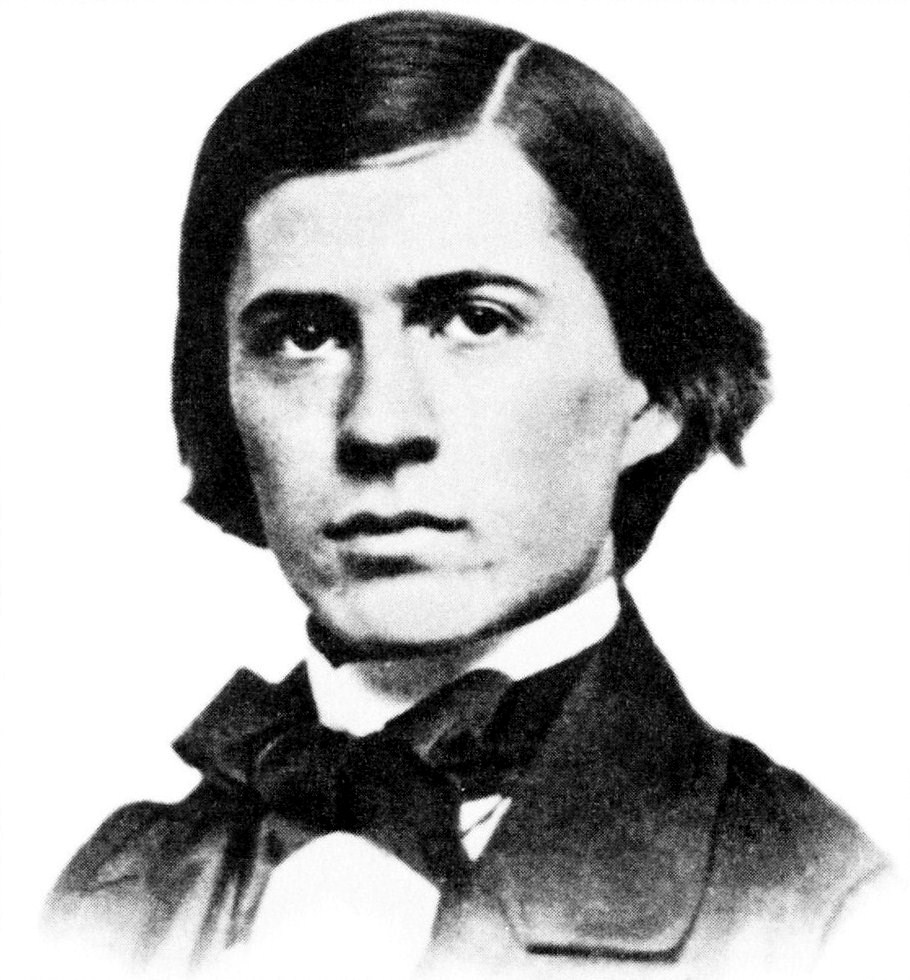
Charles Sanders Peirce was an early "evolutionary" philosopher. He believed that while our knowledge was now imperfect, correct science would - as a whole - learn to reduce those imperfections. He was a serious student of German Idealism (famously, he studied philosophy by reading one page of Critique of Pure Reason a day). He also helped found statistics, experimental psychology, modern logic and much else. Today, I want to look into how his interest in philosophy and statistics cross-bred.

CS Peirce

How much of an evolutionary philosopher was Peirce? He went so far as to define "truth" as the outcome of an ideal scientific process. For instance, imagine we didn't know Peirce's first name. We could look it up in a book, you say. That's the best scientific practice, therefore that's the truth. Let's be more extreme. Say that, for some reason, direct records of his first name had been lost. At first we would only know that his name is in a certain set. By our knowledge of human language we know that his name isn't "Hmxfrzt". By historical considerations we can eliminate "Cao Pei" and "Christina". Through long search and careful philological textual criticism, eventually we figure out it was probably "Charles". Therefore, it is true that Peirce's first name was "Charles".

This is eccentric because we normally think of "Charles" as being Peirce's first name because of actions done in the past (namely, his being named by his father), not because it is an outcome of actions of philologists of the future. This definition will even have an important effect in his statistical prescriptions.

Peirce's definition didn't come out of thin air. To recapitulate: On the one hand, he was an experimental scientist inspired by his work in physics, psychology, etc. On the other hand, he was a serious Kant-inspired philosopher. In particular, Kant's image of the sensible world of experience and the unknowable world of things-in-themselves was an inspiration to Peirce as a statistician. The world we can see, hear, smell, taste & feel is called the "phenomenal world" (as in, it's where phenomena occur), the deeper underlying world is called the "noumenal world" (we'll get to why in the next paragraph).

How do we gain knowledge of the noumenal world? Remember that this is the old days, before some young Germans questioned Newton & Euclid. So most people believed we did have knowledge of the underlying world-in-itself. Kant did not. Kant believed that the phenomenal world was basically psychological and sociological. Human beings evolved to perceive the abstract world-in-itself in Newtonian/Euclidean ways, he thought. We - our society - adopted conventions constrained by those evolved capacities. This mode of thought was further developed by Schopenhauer and I've covered it on this blog before.

Peirce (and, earlier, Hegel) disagreed with Kant. They hoped that perception of the things-in-themselves would turn out to be solid and objective rather than subjective and biological. Hegel defined truth as the outcome of a long social process - one which, unfortunately, only existed in his mind. Peirce defined, as we saw above, as the outcome of a convergent scientific process - processes that he then went out and tried to do.

In Peirce's theory, the real world-in-itself is a set of interacting (possibly/often non-measurable) facts and relations between these facts. These facts can be constants, such as the 19 parameters of the Standard Model, or they can be variables, such as the total population of a country or temperature. These facts can be basic, like energy, or "emergent", like temperature. That underlying world could only be approximated sadly phenomenal studies. Therefore, even crafty experiments surrounded the true values (of, say, the fine structure constant) with error bars. Pierce called these error bars the "probable error", today we call the equivalent notion "confidence interval". Peirce's work is, in many ways, the beginning of statistics.

Peirce first developed his statistical ideas when studying the experimental errors of using pendulums to study the acceleration due to gravity, but it is equally valid to consider coin-flips. The facts of a given sequence of coin-flips are statistically related to the underlying reality of governing the coin. In the case of coin-flips, we can appeal to Bernoulli's theorem to prove that the scientific best practice leads to The Truth, the coin-in-itself.

This is a mathematical version of the general example I gave above, when we learned Peirce's first name. You then might again notice that Peirce's definition of truth is eccentric. Mathematically, one must posit a true value and prove convergence toward it. I think Peirce would reply that this is a mathematical convenience and the truth was the reverse, a coin is known as fair from the throwing. Peirce developed this definition in scientifically relevant ways. For instance, he would say that Bayesian methods are not scientifically relevant unless paired with a robust convergence proof. One can construct instances in which a Bayesian procedure does not converge. From Peirce's point of view, this would mean that for such agents, the truth is meaningless.

So we see how philosophy affected statistics. Peirce's forward looking definition of truth ruled out Bayesianism, his love of Kant made Frequentism attractive. Notice that these are logically quite separate!

All this would have been by itself interesting, but Peirce actually went further. He gave a specific quantitative guide to such reason in his "Note on the Theory of Economy of Research". The essence of Peirce's reasoning is here. Peirce's discovery is even more remarkable because not only did he notice the parallel with the ratio of marginal utility - he also did so in 1879, making him the among the first important American Marginal theorists of any kind!

Given the importance of Marginalism in his thought, one should not be surprised when he says: "The truth is a kind of efficiency.". Surely someone who could say that can be called a pragmatist.

Though Peirce had a chance to become one of the great economists of his time, he didn't take it up. In addition to the above, he was also the first to state the axiom of transitivity of preferences (he had to be - he also invented relational algebra). Interestingly for the proto-frequentist, he was also the first to measure systemically subjective probabilities and among the first to rigorously define probability in terms of economic decisions. Unfortunately, he rarely took the time to find deeper implications of his economic thoughts (the above being the only exception to this rule). Certainly, his rival Simon Newcomb (interestingly, the rivalry, while well-attested, was unknown to Peirce...) would not have appreciated it.

Karl Marx

All that brings me to the next 19th century philosopher/economist to explain: Karl Marx.

Wednesday, July 16, 2014

Hume and Edgeworth

Or: The Consistency of The English Philosophy!
Hume has been called "one of the most important philosophers in the English language", his skepticism and empiricism inspiring - in positive and negative ways - whole swaths of philosophy starting in the 19th century and continuing to this day. Hume is best known for his attack on the connection between empirics and metaphysics. He argued that we have no way of demonstrating empirically that an event necessarily causes another event. This is of great importance, and both the conclusion and the argument are pregnant with possibilities. He would later clarify that we do have reason to act on the belief that an event causes another event, their (near) constant conjugation instills in a belief in (nearly) necessary cause. This positive solution - often ignored by philosophers - flowered into the associationist school of psychology, game theory, the Bayesian school of statistics.
Francis Edgeworth was an English economist, the author of Mathematical Psychics. In this book, he attempted to take the Jevonian gloss on Utilitarianism a firmer mathematical foundation. Modern economics, with its utility functions etc., is a descendent of this line of thought (which sprung in many places at several times) but is not intrinsically tied to it. Honestly, I haven't read Edgeworth's work in detail, but I have read a little bit of Mathematical Psychics and some of his stats papers for something I wrote on the history of statistics. In Mathematical Psychics, Edgeworth develops an ingenious device for thinking through bilateral trade now called the Edgeworth Box.

I will use this graphical method to illustrate a famous passage of Hume on co-operation. A modern thinker might think that it is obvious that a non-linguistic, behavioral definition of convention and co-operation was possible, and indeed since Lewis it has been standard to found the concept of linguistic meaning on pre-linguistic ideas of co-operation. In Hume's time, it was not so obvious. Hume had to explain "... [C]onvention is not of the nature of a promise: For even promises themselves, as we shall see afterwards, arise from human conventions.". Therefore, Hume gave this as illustration: "Two men, who pull the oars of a boat, do it by an agreement or convention, tho’ they have never given promises to each other.". This is a very important point! Not only do Lewis and Hume, and biologists following him, tell us that this is how meaning got into languages ("In like manner are languages gradually establish’d by human conventions..."), it was immediately used by Hume to explain how property got into society:

"Nor is the rule concerning the stability of possession the less deriv’d from human conventions, that it arises gradually, and acquires force by a slow progression, and by our repeated experience of the inconveniences of transgressing it."

These passages of Hume are pregnant with theory, and the modernity of the theory is sometimes surprising. Hume's theoretical stances - which are those of evolutionary game theory if I may be anachronistic - run deep. Property is, he says, some sort of evolutionary strategy, one with advantages and disadvantages. Hume, obviously, believes the advantages outweigh the disadvantages. This is a story about property that can extend beyond humanity (Hume was wrong to deny this), and it has been used - by Maynard Smith and others - to examine the phenomena of nesting in animals.

Let's analyze one of these pieces, with the more modern equipment of an Edgeworth Box. Two men, Mr Blue and Mr Green, pull the oars of a boat. They must paddle the same speed in order to avoid moving in a circle. Even if these men do not speak the same language, they can and will co-ordinate. We will ask more than Hume does explicitly here (he makes more assumptions implicitly elsewhere), we will ask that the men understand that you cannot go faster than the slower paddler (we don't assume that they know the others strength). The possible speeds they can go are a set of real numbers, setting up an axis:

That gives the following box as the range of possibilities:

Our assumption about their preferences gives them Leonteif indifference curves. For Mr Blue, his indifference curves are:

And for Mr Green:

Putting these together, we get:

Let's say they just start rowing at some speed. That means they get something like the following:

Anywhere inside the square of which that dot is the corner is better for both! A simple way to think about it is that the faster rower knows to slow down, but not slower than the slower rower, and the slower rower knows to speed up, but not faster than the faster rower. Eventually, the rowers will come to a corner on both curves. Here, neither rower can improve by himself. This is a stable situation! Here is one possible solution:

Edgeworth pointed out that this is not the only solution. In fact, there is a continuum of solutions called the "contract curve" or "core":

This is the Edgeworth analysis of Hume. Hume's correctness is not in doubt in this manner of thinking. Hopefully this shows both the depth of Hume's thinking and how it relates to modern ideas. I wouldn't mind if it helped one understand the modern ideas a little better too. There are more extensions that can be made (what happens as the quantity of rowers climbs? What if they can only imperfectly measure the others speed? What kind of equilibrium did we obtain?). Notice that Hume didn't make any explicit assumptions about the nature of their preferences, yet the Edgeworth explanation explicitly assumes convex preferences. Can non-convexity be made sense of here? What other interpretations of Hume are possible - do any of them attack the substance of this translation?

Incidentally, I had a devil of a problem making the images for this post. Matlab decided some of the lines I drew just weren't good enough for her. Awful thing it is, when I turned off the axis, the invisible axis was over the lines I actually drew. Goddamn thing. Some of these images are corrected, some not. The ones which were not may change if I come back later.

Sunday, July 13, 2014

Classical Thermodynamics From "Intuitive" Symmetries? Part 1

In my last post, I promised to talk about Paul Samuelson's paper "Conserved Energy Without Work Or Heat". Now I will do so. Even earlier I had earlier promised a post about Disney Princesses. While I have a variety of observations, I haven't yet put them together into a theme.

First, a word about our author.

P Samuelson

Paul Samuelson is one of the father's of modern economics. Even more than with more famous economists like Keynes or Friedman, one can divide economics into a pre- and post-Samuelson quite easily. Paul Samuelson's most important work was his dissertation, Foundations of Economic Analysis. In that book, he provided perhaps the first completely mathematically clear explanation of what it is economists where doing. When an economist says that, for instance, a given tax is good or bad, what he or she means is that changing something given, the rest of the economy will eventually adjust and where it will settle will be better or worse than where it is now. A good example (with applications to finance) can be found here - and in innumerable other places! Samuelson made many other advances in almost every area of economics. Much can be said about his "scientific personality". He considered himself a child genius well into his 80's. He was immensely concerned with every aspect of scientific work, empirical, theoretical, philosophical, historical and pedagogical. Unlike many economists of his stature and influence, Samuelson almost never outright dismissed an economist or an economic theory, always describing them as containing nuggets of truth - of course, truths that he himself has formally obtained. His scientific ideal was that of classical thermodynamics, where the foundations were clear, the applications enormous and the empirical validity impeccable. Some have objected to his appreciation for classical thermodynamics, but most of these complaints are ill founded. To the extent he was inspired by classical thermodynamics, classical thermodynamics is inspiring. (Aside: it is not at all correct to believe that just because pre-Samuelsonian economists mostly used geometry and post-Samuelsonian economists mostly used algebraic notation that one was less mathematical. J.C. Maxwell's Theory of Heat was written almost entirely with geometry, and this example can be multiplied.)

Now on to the paper itself. This paper has multiple goals. One is a slick derivation of deep aspects of physics (esp. thermodynamics) from a few qualitative empirical regularities. One is to present the argument that one could have - in an alternate universe - completely missed the deep connections of thermodynamics to Newton's Laws. I am going to play loose with language, sometimes I will say "amount of heat" and other imperfectly defined things in order to bring these ideas closer to everyday experience. If this confuses anyone, then I will do another version which I am more careful (or they can read Samuelson's original).

(Aside 2: This idea, in a loose philosophical way, might be connected to "microfoundations" debate economists sometimes talk about. If microfoundations can be seen to be like statistical mechanics, then macroeconomics is like thermodynamics. This paper would then be an example where a simple empirical regularity is all that is needed to establish deep economic laws, rather than investigation of the deepest parts of the consumer's psyche. This argument is unimpressive, and Samuelson would never have dreamed of making it, but you can think about it if you like.)

Now, on to the deep parts of the paper. The main empirical principle of this paper is that if you put two hot things in contact, then they will equilibrate. A cold drink will turn warm in the hot summer afternoon. This principle is purely qualitative, but quantitative measures will fall out of it. Notation will simplify things. Our Principle is that "The Temperature of System 1 and the Temperature of System Two go to the Equilibrium Temperature in System 1 and the Equilibrium Temperature in System 2.". This is a mite cumbersome. Instead we say \( (t_1 ; t_2) \rightarrow (t_eq ; t_eq) \). We assume that \(t_eq\) is a function of the initial conditions.

Brief considerations as to measurability of heat are given, but these are minor enough that the assumption that the only important conclusion is that the final temperature is to be a function of the initial temperatures. This paper is written as an alternate history past Carnot, so we aren't interested in chemical, gravitational, electromagnetic, etc forces (more on aside 2: one of the many arguments against the above aside is that one couldn't do this without "microfounding" heat. Is this true? Discuss.). We consider the effects of heat by itself.

A thought experiment. Consider a bowl of hot soup kept in contact with a container of cool apple sauce. The bowl and the container are strong, they do not melt or flex because of the heat. They are kept in a insulating lunch bag, so that they don't lose heat to the environment. A sort of drawing of this situation:
What will happen? By our principle founded on common observation, the substances will come to be the same temperature. Of course, there is more to consider than just the temperature. I drew the above as if the soup and apple sauce were in equal volumes, but if I had enormously more soup or enormously more apple sauce, then the one with enormously more volume would barely notice the change due to the other. There might be other dependencies, but Samuelson follows Carnot wisdom that the main action can be captured considering only the interaction of volume and heat - and sometimes heat alone! Symbolically: $$(t_1,v_1 ; t_2,v_2) \rightarrow (t_eq,v_1; t_eq,v_2)$$ $$t_eq = f(t_1,v_1 ; t_2,v_2)$$ The first part is read "The Temperature and Volume of System 1 and the Temperature and Volume of System Two go to the Equilibrium Temperature and Original Volume of  System 1 and the Equilibrium Temperature and Original Volume in System 2.". Obviously, this doesn't depend on how the apple sauce and the soup are oriented, since the bag is being thrown around all day anyway. This implies that \(f(t_1,v_1 ; t_2,v_2)= f(t_2,v_2; t_1,v_1 )\). Today, I will concentrate solely on what can be concluded from experiments of this type alone, but in Part 2 I will introduce a more complex experiment involving pistons.

These experiments can be compounded arbitrarily. For instance, we can put four substances together:
And the above reasoning still applies. The arrangement can be manipulated so that red and yellow equilibriate while orange and burgandy equilibriate, then those two are placed next to each other and the whole system is allowed to equilibriate. Alternately, the arrangement can be manipulated so that red and orange equilibriate while yellow and burgandy equilibriate, then those two are placed next to each other and the whole system is allowed to equilibriate. Either way, the system comes to the same temperature. It is easy to arrange the volumes (actually, specific volumes) to be the same. In this case we have the simple symbolic expression for the above: \(f(f(t_1,t_2);f(t_3,t_4))=f(f(t_1,t_3);f(t_2,t_4))\). It is read "The equilibrium temperature of the equilibrium temperature of the first two substances touching the second two substances is equal to the equilibrium temperature of the equilibrium temperature of the first and third substances touching the second and fourth two substance.". You can start to see why we invented this notation!

Now we add a couple new assumptions. These assumptions are unobtrusive and intuitive, but they might be wrong and must be stated. We have already extensively discussed the existence and symmetry of the function \(f \), which takes the system set up and gives the equilibrium temperature. We also assume that the function \(f \) has the property that if two substances have the same temperature, then the equilibrium temperature is that temperature. (more on aside 2: if we were interested in "microfoundations" right now, then this would be a statement about the nature of an equilibrium - namely that it is an equilibrium!) Otherwise, purely mental divisions could make physical changes. Finally, we assume that if you perform the same experiment, but you make one of the substances hotter before hand, then you always get a hotter equilibrium. It is these properties of heat, perhaps, that lead to the idea that heat was an independent substance!

These assumptions give a remarkable conclusion, the existence of a sort of energy function! Perhaps a better name would be a caloric function (this does not mean, of course, that there is any such physical substance!). A brief verbal argument can be made. I said before that the above that the latter assumptions make heat seem like a substance, since if you add more of it, more comes. The amount of that substance is the caloric. The equilibrium temperature is derived by averaging the amount of caloric in both substances (notice averaging, not summing. This becomes clearer when the mathematical argument is fully expounded). What is remarkable is the role of symmetry in the proof. If the function were not symmetric, we'd have no reason to think that the equilibrium temperature could be found by averaging equilibrium temperatures of partitions. It was this fact that is the foundation of this theory! By choosing references, one can convert this equation into a standard internal energy function. We have begun the battle of recovering classical thermodynamics from simple symmetry arguments.

Phew! I have covered much ground and only barely scratched the surface of this paper! I need to go through and show how this caloric function is found, give more examples, and there's a an entire second experiment! These posts will come every Sunday. If there's particular aspects of this argument that interest you, drop me a comment. Before I go, however, there are a couple things I would like to highlight. First of all, notice that we derived an energy function, but I didn't check anything about its form. For instance, I didn't make any assurances that it was always positive. It is this reason I prefer to call it a caloric function, even if I risk misinterpretation that this somehow vindicates the physical concept of caloric. More importantly, I want to highlight that this argument makes no reference to Newton's or Schrodinger's laws. Physicists have a deep rooted appreciation for the laws of thermodynamics, and it is arguments like these that gives substance to those feelings. No matter what the universe is like, the laws of thermodynamics will apply as long as those fundamental symmetries are observed. This does not establish that the laws of thermodynamics are universal, but a non-physicist might wonder why they are believed to be and arguments like this will help the intuition in that regard.

Finally, a social observation. The laws of thermodynamics are wildly misused in bad science, bad philosophy and even bad politics. I have seen irresponsible writers on the internet imply and argue that they make action on global warming impossible, often with naive importations into economics or politics. What I hope is that when reading this, you absorb some of the actual intuition of this science, rather than the slogans such people use. When someone claims an application of thermodynamics, check first to see if even first principles - such as these - apply. If it is not obvious how, then they are not obviously right. See you next week!