Showing posts with label Cowboy Bebop. Show all posts

Tuesday, June 14, 2016

Cowboy Bebop Review #7: Heavy Metal Queen


Space Truckin'! Goin' around space, hauling things! Decorating your cab! CB radio lingo! It's back, but this time in space!!!!

So, this is the first time I can say this: today's episode is not completely essential to the Bebop series. If you miss it, later episodes won't confuse you. This is good news for me, since it finally gives me a chance to breathe and bring in even more extraneous things that I've been wanting to say. And it gives me one more review before the next episode, which is a big deal for me personally. But for you, the viewer at home?

This episode is awesome! It's fun, funny, well written and packed with surprises. Like episode 5, this episode was written by heavy hitting writer Michiko Yokote, who did a great job fighting off cliches. I'll get back to her in a sec. It was directed by Takashi Okamura, the same director as the last episode. I still haven't seen Darker Than Black, so there. And the standout storyboards are from Kunihiro Mori, a long time Gundam vet.

Today's episode draws a lot more on Detective Story, the old Japanese P.I. comedy, than previous episodes. As I've pointed out in previous reviews, Spike's design takes a lot from that series star Yusaku Matsuda. The big difference is that Kudo was kind of lame, and Spike is made of cool.
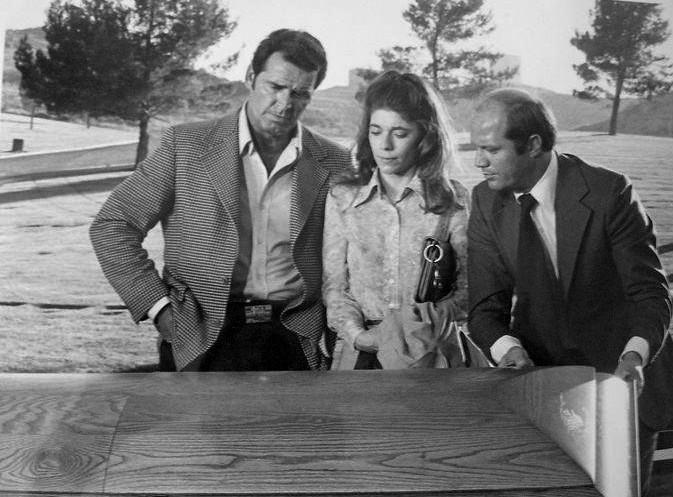
The Rockford Files

Instead of that actual connection, I'm gonna talk about a more spiritual connection. The Rockford Files is a show very similar "defective detective" type show. Lead character James Rockford was just cynical enough to qualify for the descriptor, called the police every time he got assaulted, kicked when they were down and always backed down from a fight when he could. He was played by a ninety nine foot (thirty three yard) pile of charisma named James Garner. The powers behind the show were co-creators Roy Huggins & Stephen J Cannell, James Garner himself, and de facto head writer Juanita Bartlett. I want to talk about her in particular.

What The Rockford Files and Cowboy Bebop share is powerful female writers, which gives them a leg up on other shows. In most sci-fi, the viewer isn't expected to think about why these young people are falling in love - it's just expected that main characters do that. Star Wars, of all things, was actually pretty good about it (in the first two movies anyway), but by and large most SF is vapid about love. Even talented writers - Delany, Gibson, Dick, etc. - did you ever come away from one of their books and think "I really liked that love story."? I'd really have to break my brain to find a straight SF story that even approaches the ironic kissing scenes in The Princess Bride (the book version). Spike Spiegel and James Rockford are believable as romantic leads. Not only are they physically tall, dark and handsome types, but they have a talent for saying exactly what needs to be said at exactly the right time. In the words of Orson Welles, they are only occasionally and only deliberately clowns. It's something that a mix gendered creative team can do more honestly and simply their monogendered counterparts.

Also, they have to be talented, which unfortunately knocks Sense8 out of the running.

Oh right, we're talking about The Wachowskis' inspirations, not their decline. Bebop is always finding ways of breaking up what could be the monotony of villain-of-the-week bounty hunting. In this episode, they do it by substitution - instead of the bounty being the focus of the episode, its another character they meet along the way!

Zeros and VT

Meet VT, a tough old broad who wears pants under her dress under her jacket, because in her day the layered look was in I guess. She has this weird running bet where people try to guess her name. She's also got a powerful kick, so don't mess with her. There are four named female characters in this episode - VT, Muriel, Faye & Ein - yes, I will always count Ein.

 Ein being fed bean sprouts

There's a lot of funny animation and ideas in this episode. Ein is fed bean sprouts, but even funnier I think is her "swimming" in place while Jet and the crew are arguing. Faye has some big funny reactions that unfortunately didn't take to still images very well. And the ostensible goal of the episode is to capture Woody Allen - er, Dekker

Dekker

which in light of what we know about Woody Allen, maybe takes a little bit of the humor off finding him in a restaurant aimed at little kids...

All kids should come to Woody's P! (...)

The episode begins with VT pulling into an asteroid way station. This kind of 2D/3D mix animation shot would slowly become the norm, perfected in shows like Futurama. VT and her cat zeroes go to Mac's, the local bite and fight. Outside some old timer is bragging about knowing some legendary bounty hunter named "Terpsichorde". Huh, what an irrelevant detail. Mac's is crawling with bounty hunters because of a tip that Dekker, an explosives smuggler, will be there. And who should be hung over in the bathroom but Spike Spiegel.

Space Hero

Some of the bounty hunters start to harass Muriel, the cute local waitress. When things start to escalate to "outright assault" levels of harassment, VT intervenes on Muriel's behalf. Muriel is this super-exaggeratedly anime girl. Her reactions are always huge and her eyes don't seem to focus right.

Why is she leaning here, in character? Because it makes for a hilarious set up!

When it becomes clear that they're not going to be able to beat her, they pull out knives. In this process, they bump into Spike, which makes him spill his hangover cure into his lap.

Very Tantei Monogatari-esque reaction

Needless to say, Spike wipes the floor with the jerks. Literally beaten, they run off and basically key his space ship behind his back. A simple example of real world life that never happens in SF outside of Bebop. When they meet on friendlier terms after the fight, we find out that VT loathes bounty hunters and is nostalgic for her ex-husband. Hm.

"Woody's P" has a vampire bat girl in a kimono, as expected

While all this is going on, Faye is chasing the less promising lead. In a wacky and not at all foreseeable turn of events - the less likely lead turns out to work out! There's a funny scene here where Faye misidentifies someone as Dekker and rips off his shirt to check his tattoo. Is this supposed to parallel/invert Muriel's troubles at Mac's? Maybe, maybe not. There are a lot of funny takes from Faye in this episode, but I just don't have room for them.

With Spike's ship damaged by the jerks and Faye's hit by one of Dekker's explosives, VT has to give them a ride back home. Faye gives as many details about Dekker as she can while VT blasts heavy metal.

This is a good time to talk about the music in this episode. There's only one real heavy metal song in the Bebop catalog, "Live In Baghdad". It's used really well a couple times in this episode. There are several remixes and rearrangements in this episode, but I neglected to name them all in my notes. As far as I know none of these have been released outside of what is seen here (they may be on Kanno's misc. album Space Bio Charge). How many other 26 episode series can release seven albums without repeats and have music to spare? And needless to say, all the music in this episode is amazing and used perfectly.


Back on the Bebop, Spike and Faye are still arguing about the uselessness of Faye's information. Spike is washing his clothes because he got egg on them, which is frankly just plain impressive continuity. Admit it, you thought the egg thing would have no consequences. One detail that Faye keeps repeating is that Dekker's truck has Saraswati painted on it.


And wouldn't ya know it, a friend of VT's got into a hit and run with the fleeing Dekker! I love how they gave all of the trucker's cabins such personality. They really make hauling cargo in empty space seem fun and impressive. They even get time units correct! VT uses her CB friends to track Dekker, who is hiding out in an old, unstable asteroid mine. VT informs our heroes and starts chasing him down.


They have no missiles and Faye's ship is outfitted with pinchers. I wonder if they'll need them in the climax? (They do.)


Linus Mine?

VT tries to corner Dekker at the ... Linus Mine, who tries to blow her up. Unfortunately, this causes the whole mine to blow, killing Dekker immediately. Oh well. Right around this time, them ol' Duke Bo... Spike & Faye catch up with her and they begin the process of worming their way out of the mine. What should happen but an obstruction? They have to use Dekker's explosives to blow their way out, which they manipulate with Faye's pinchers! See, told you they'd come in handy. Faye complains that she isn't the delicate cautious type and shouldn't be handling high explosives. Both are true. She calls Spike "Mr Perfect", in context this is in regards to his lightning quick reflexes but if you want to see it as a Freudian slip, I won't stop you.

They place the explosives into Spikes monoracer pod, which then shoots itself forward. Apparently, you can just make it do this, which is a convenient little macro. Spike however has to get himself out of that pod, which is not convenient. He misses VT on the first go, but with some quick thinking is able to get a second try. Luckily this show tries to respect Newton's Second Law - in a less well written SF, he'd be doomed.

More neat framing

While in VT's cabin, Spike takes a crack at the guessing game. He gets it right, which explains her bitterness at bounty hunters and her nostalgia. And, being Spike Spiegel, he ends the episode by saying exactly the right thing.

This episode was really good! Every series should have its inessential episodes at this level. This episode seems very different visually than the last, despite sharing a storyboard artist. Less fast cuts and more big takes. I presume that it is Watanabe's influence keeping style to what the script needs and allows. With a lighter script, they were able to do wackier things. They were willing to have characters upside down and sideways in the low gravity scenes and have a cat that loves to sit on Spike's head. The colors were, as always, amazing. Bebop doesn't really do limited palates, but it is able to prevent the colors from becoming too loud, which helps keep comedy episodes like this grounded. Verdict: you can skip this one, but don't!

Friday, May 20, 2016

Cowboy Bebop Review #6: Sympathy For The Devil


It's interesting how expectations can work. I kind of had memories of this one being mediocre, maybe even skippable but damn was I wrong. This episode has great use of music, a solid script by head writer Keiko Nobumoto,  great boards by Tensai Okamura and fine direction by Ikuro Sato. Tensai Okamura is a big time director now. His big series is Darker Than Black , which ... I've never seen. Ikuro Sato, like a lot of the Bebop crew, went on to do a lot of moving and shaking in The Big O, the cult classic giant robot series.

I haven't really talked about Bebop or its director Watanabe's enormous influence in the industry. Studio BONES was founded using money from the movie and was originally mostly Bebop production staff and their friends. Watanabe's next series, Samurai Champloo, was the first series made by Manglobe. Watanabe also directed both the first series and the first original series made by MAPPA (both series were also made for Fuji Television's prestigious noitaminA block). Though he's never been "famous" in Japan in the way Miyazaki or Anno is, he's a bona fide industry legend. I'll try to keep more track of Bebop's industry influence in future reviews.

Your Ramblings Bore This Fish

Oh, right, the episode! This episode has a plot that is a lot more obviously SF than the previous episode. So, being a crafty one, Nobumoto uses this as an opportunity to organically work in a few metaplot points. One is Spike's artificial eye, a metaphor so ingrained into my brain cells that I inadvertently talked about it last review in spite of the fact that a first time viewer won't know he even has an artificial eye until this episode. We don't learn what it symbolizes for him until much later. The presence of the eye in the falling montage from the last episode was for those rewatching. Bebop constantly reminds one of Gene Wolfe's definition of a great story: "One that can be read with pleasure by a cultivated reader and reread with increasing pleasure.".

The other is a bit of a spoiler for this episode. I'll get to it in a bit.

Wenn

"Oh Death, done stole my mother and gone"
- Charley Patton

Spike awakes from unpleasant dreams to find himself in a blues club. A kid, a child virtuoso is playing the harmonica masterfully. The song he is playing is called Digging My Potato,


I can't help but notice that Wenn is dressed like Lupin III. Interesting, since Spike himself is also influenced by Lupin. Why would they set up a parallel between these characters? Anyway, Spike and Jet are after a Yakuza looking guy named Giraffe. When they try to make their move, they notice their friend Fatty has shown up.

Fatty

It's such a weird, real moment. It isn't that they are upset to see Fatty, it's just that they didn't want to hang out right now. Look at his reactions too, he doesn't want to hang out with them either. We'll learn later that he's also hunting Giraffe. Maybe it's just me, but I found this part of the scene hilarious. I also love that Fatty makes a joke almost exactly like Jet's joke, so you can even see why they'd be friends. Also, Nobumoto keeps great control of the emotional movement in this scene. From Spike's nightmare to the joke about Fatty isn't whiplash from dark to funny (cue George Lucas: "It rhymes"). It's a control that I feel is lacking in many anime. Most anime go for one emotion - Comedy, Horror, Drama - and spend their entire running time trying to build it. Others, like Trigun, deliberately mix two, leaving thick globules of comedy in between layers of drama. Bebop much more skillfully stirs emotion together.

Ein & Faye

Faye eats dog food in this episode. That's a thing that happens in an episode where I felt it was appropriate to break out the Samuel Johnson. What's great about her eating dog food isn't just that she eats dog food because she's broke, but how she and Ein act about it. When she starts eating it, Ein reacts with stunned silence. Then Faye gives a whole speech about how, as a woman she needs to be pampered (with dog food). She calls Ein a "hunting dog", though Ein is a Welsh Corgi and therefore a herding dog (such depth of insight these reviews). This is another example of one of Faye's traits that I've mentioned before, her love of long-winded justifications for selfishness. A very human trait, one that I'll go into more detail when it is played more dramatically.

Ein could bring up that she is also a woman, but she is too polite and also a dog.


Spike hunts down Giraffe, who is stalking Wenn and his (SPOILER) "father". He catches Giraffe's falling body with the Swordfish II, which is impossible in so many ways that I can't even begin to describe them. Well, I'll mention one: physically. Still, the important thing is that Giraffe gives Spike a mysterious crystalline plot coupon.

Hmm ... mysterious crystal? That looks like a job for

The Bebop Universal Analyzer!

Yes, some universal analyzing gets done. Jet and Faye begin to do research on the Bebop as Spike goes after Zebra and Wenn. Jet gives a little speech about men being bound by iron codes of honor, Faye calls him out on this and his response - "I'm trying to believe it." - is perfect. Jet, Spike and Faye are all bearing burdens of their secret pasts. What is Wenn's burden? Spike finds out what he's in for his way, while Jet and Faye find this:


Faye recognizes that in this newspaper clip Wenn isn't with Zebra (hey, good thing we brought her along). This newspaper clip is actually a collage, little bit of formal experimentation on this episode's part. The sick man is supposed to be Vincent Gigante, who in our world faked mental illness to try to escape prosecution. His counterpart in Bebop's world really was paralyzed and - here's the catch - used by Wenn to construct a criminal empire.


Wenn is immortal due to the explosion of a hyperspace gate. Yeah, those things that open most episodes are actually pretty important to the the series. The explosion somehow made Wenn immortal. Jet is able to put together that Wenn does this repeatedly, using his immortality to attack violent organizations, taking them over to protect himself from being experimented on any more. This explosion has basically destroyed the Earth ecologically, economically, socially, etc.

The decimation of Earth has a deep alienation effect. Bebop is filled with ephemera inspired by American Culture, Chinese Culture, and so on. To it's original audience, those were foreign cultures. Part of the message of this is that there never will be an episode set in Japan, Japanese culture no longer exists. Bebop keeps trying to convince you to hold it at an arms length instead of inviting the viewer in. This is an important part of that.

In the series itself it's an important plot point in many ways. As you'll see, it's impacted many characters lives directly. There is no capital of the Bebop world, local governments float freely and bloat. There are no native cultures anywhere. It's even created a generation gap between those who remember the Earth and the hard-scrabble world of , even vaguely, and people like Spike & Jet who do not.

Well, back to this episode. Zebra and Giraffe used to be part of a vigilante group, which was attacked by pirates controlled by Wenn. Wenn crippled Zebra and took over the group. Giraffe tried to save Zebra, but Wenn killed him too - you saw that earlier.

Zebra & Giraffe

"He who makes a beast of himself gets rid of the pain of being a man."
- Dr Samuel Johnson

Wenn's immortality has forced him into immorality. Spike decides to do him a favor and take him out. Jet gets stuck with infodump duty. Beau Billingslea, Spike's English language voice actor, is a master of infodump. In Outlaw Star, he would do little speeches at the beginning of each episode to introduce a new concept in a way that wouldn't slow down the plot. Before Spike rides off to fight the invincible and immortal demon, Faye gives him her first "I'm glad you're dying anyway." speech. You'll see these a lot.

Faye brooding

Spike faces down Wenn, and needless to say the episode doesn't end with Wenn going supernova. Wenn's surreal life has an obvious reflection with Spike's past. They both live strange, unanchored lives after something that should have killed them. In another life, Spike could have descended to Wenn's level. Instead, he bears the pain of being a man. Spike throws Wenn's harmonica in the air and mimes shooting it. An effective ending (and one that will echo through the series) to a powerful story.

This was a really good episode! Episodes 5-8 are the power trio era of Bebop, and this episode is one of the stand outs - not just in the show, but in all of anime. The lion's share of credit has to go to Keiko Nobumoto's powerful script. And it certainly helps that Yoko Kanno's music really is good enough to make Wenn's emotional outlet through music believable. If I had to make a complaint, every scene in this episode seemed like a slow pan. Ikuro Sato seemed to be trying to add dynamism but only had one trick up his sleeve. That said, there weren't as many blatant off-model moments as episode 3 (there are a few times they deliberately give Faye weird expressions). A solid episode that will continue to be heard through the rest of the series.

Monday, May 9, 2016

Cowboy Bebop Review #5: Ballad of Fallen Angels

Personal Note: Yeah, I haven't blogged in a long time. During this time I had to do a lot of attention consuming work, navigate several international bureaucracies and generally put my life in order. Reviewing Bebop has also inspired me to try to get back into art, and I'm trying to learn animation from the good ol' Preston Blair book. I'm returning because I want to though, and so you should expect more activity.

"I'll play it and tell you what it is later."
- Miles Davis

So, this is a difficult review. Somethings are so legendary that they say more about you than you can say about them. Citizen Kane, for instance. It's a great movie and there is a ton to say about it - how it used simple special effects to hit way above its budget, how it inspired so many different filmmakers to believe that you didn't need a ton of extras to make a movie, its brilliant writing/acting/music...

But that's all been said. There are plenty of other examples - Miles Davis's Kind Of Blue, Super Mario Bros. 3, the best Shakespere plays, the best cartoons of Bob Clampett - things that just stand above everything else in a manner so natural that it is strange that they used to not exist. When you try to critique Shakespere, you just end up condemning yourself. SMB3 is just how good platformers feel damn it all! And so on.

Session #5 of Cowboy Bebop, "Ballad of Fallen Angels" is like that. Written by Michiko Yokote, storyboarded by Shinchiro Watanabe, directed either by Watanabe himself or Tetsuya Watanabe (both are credited), this episode is one of the all time classic episodes not just of Bebop but of anime. I once said of Relaxin' With The Miles Davis Quartet that if you don't like it, jazz probably isn't your thing. There's nothing wrong with that - find something you do enjoy! If you don't like this, probably don't bother with anime - at least not at the more dramatic stuff. I don't mean that in an exclusive way, you were game, gave it a shot and you can now live your life without regrets.

Spike Spiegal

Now, technically, the story of today's episode stretches all the way back to episode one. The montage of violence episode was the first glimpse of The Spike Spiegal Story, which is the Official Main Plot Of The Show (TM). Bebop is at its most interesting when riffing far beyond the normal routes, but it does to set up what is going on. The OMPOTS comes back again today

Vicious

That this episode is going to concern Spike's story is actually a twist in the cold open - one of several. Sorry about that. The episode starts with Mao Yenrai of the Red Dragons and Carlos of the White Tigers signing some sort of peace treaty. The Red Dragons are a powerful Triad and Mao is happy to have finally made peace. As you can see above, a character named Vicious ruins it - blowing up Carlos's ship and personally murdering Mao. Mao's dying words reveal that Spike, Vicious and Mao have a long history. This is a very well made scene with lots of big, neat shots and good use of editing.

We've talked about Spike, so let's talk about The Black Bird. Vicious's black bird is obviously inspired by Captain Harlock's similar pet. The overall concept of Cowboy Bebop was influenced by Lupin III and it doesn't take a detective to realize that Vicious evolved out of Goemon from that series - especially if you know that Goemon was originally one of Lupin's enemies. Similarly Spike is somewhat based on Lupin, Faye has some similarity to Fujiko and Jet has a couple of Jigen's traits. None of these resemblances are very close. For instance, when Goemon was a bad guy, he was a hot blooded over-actor just like all of Monkey Punch's characters. Vicious is a stone cold, stone faced killer, we've already seen this. We don't know much of his personality yet but I'll leap ahead a bit and tell you that Vicious is obsessed with betrayal and Darwinian conflict. He is very much for both.


Back on The Bebop, Spike & Jet discuss the situation. The Bebop is a boat/spaceship like the Arcadia, but less awesome. This is the first time that Spike & Jet have a serious confrontation. Yes, they disagree constantly, but this is less jovial. Jet wants out of the latest bounty scheme - he smells a trap. The information is too easy, if such big money was such low hanging fruit somebody would have scooped it by now (he doesn't say this, but it is implied). He's right, of course, but he doesn't know about Spike's connection to -

Oh hey, it's Faye. She has a bunch of bags, clothing bags. She walks in on the fight and tries to get caught up on what is going on by asking perfectly reasonable questions - which annoys everybody, including herself.


 Watanabe's storyboard/direction involves a lot more acting than others, there's a lot of complex non-model sheet expressions in this episode. Faye is particularly funny here. After the boys leave, she gets a hot tip from a violinist tells him that Mao is going to see a showcase at a theater. Faye wasn't present for any of the research that was done, but decides to gamble on swiping the bounty from her "comrades" after drawing a lucky card from a deck that Spike was playing with at the beginning of the scene.


The theater has a bunch of great stuff! First Faye parks like a complete jerk, then when she goes inside we see a great array of new background characters


The fat cat with the cigar is very Lupin III, and look at the neat dress on the purple girl to the right! This show spoils us. Faye is deliberately acting annoying on the theory that if she does people will assume that she has a reason to. Unfortunately, as Jet pointed out earlier, this is an obvious trap. Perspective is used very well in the scene on the balcony. Several shots are made from the perspective of what we already know to be Mao's corpse, which doesn't make sense. Only after the scene shifts to Faye's perspective and we see where Vicious is standing to the other shots make sense from a perspective ... perspective. They were what Vicious was looking at! This is obvious, of course, but it makes you realize how much less thought out shots are in other shows.


As Faye walks into Vicious's trap (in her defense, she was kept out of the loop that would have made the trap more obvious) Spike goes to meet a contact. Some kids try to shoplift dirty magazines from a store. Interesting trivia, the black kid's character design was recycled from an early concept for one of the leads! A character that hasn't been introduced yet, though. The dirty magazine girl is labelled Judy. Though the "Judy" character from Big Shot has blond hair and the girl in the centerfold has brown hair, I wouldn't be surprised if they weren't trying to imply she was an ex-gradol. It would be typical of Bebop's subtlety.


I don't know to what extent I can or should continue recapping the plot, since it becomes very suggestive here. Spike and his contact Annie talk, but they know each other and don't feel the need to expodump for the audience's sake. For the plot of the episode, the only important thing is that Annie knows that Mao has been murdered, foiling Vicious's plan to flush Spike out by leaving a bread crumb trail into traps. Meanwhile, Faye is captured.


That Shinchiro Watanabe can't do anything without tying someone to a cross. Well, you'll know that if I ever finish these reviews and go to his other stuff. Faye doesn't take the whole kidnapping thing seriously - in fact, she reacts pretty much how Fujiko does in Lupin III. She gets kidnapped a lot, Fujiko, but - HUGE SPOILER ALERT - Faye doesn't make so much of a habit of it. Faye asks for help and to her shock gets it. It makes you wonder what was going through her head. Did she really think Spike would leave her there? Well, they don't know each other very well yet...


You remember I was typing just a few paragraphs ago about how imposing this episode was to review? How much of it has become iconic, not just of the series but of the genre? Well, in particular the rest of this episode is like that. It's so big that it can be difficult to write about. Perhaps I should talk about the color, which is more stylized here. It is interesting, Bebop is such a well colored show that nobody ever bothers to mention it. It's stylized and often dark, but never does it succumb to what John K calls "piss & shit color" syndrome. In other words, it doesn't dull the colors down. Look at the church above, it's purple! Real churches aren't purple, but it matches the scene so beautifully. Go back to the part where I talked about the guy with the cigar and look at how that opera house is painted. The biggest anime of 1998, the year Bebop came out in Japan, was Cardcaptor Sakura - based on the hit CLAMP manga. It looked like this:


Well, it doesn't usually have YouTube crud around it. But look at how much more flat the colors are compared to all the other screenshots of this post! I don't mean to pick on this show. If you want a cartoon to watch with a little girl that doesn't make you want to kill yourself, Cardcaptor Sakura should be high on your list (other choices: Powerpuff Girls, Unico, I've been told My Little Pony is better than it sounds...). The manga is the best thing CLAMP ever did and they know it. What I want to say is that this what a show with a good budget and large audience looked like - colorwise - in 1998. Oh, and there are limited palette flashbacks coming up, they're real neat.

Oh, and the music. When Spike approaches the church, knowing it is a trap a song plays called "Rain". It's actually a demo version - the intended final singer has a throatier voice and more gospel interpretation, but Shinchiro Watanabe and Yoko Kanno seemed to decide that the purer voice was more appropriate. Yoko Kanno's first musical memories were of playing an organ in church. Obviously she's playing the organ on this track, but she's also - through the miracle of multitracking - the choir on the even more iconic "Green Bird" that ends the big scene.

So, Vicious and Spike talk for a bit and one of Vicious goons tries to talk down Spike by using Faye as a hostage. Spike, channeling Dirty Harry in Sudden Impact doesn't deescalate the situation. In a waaay later situation, we'll see an even more obvious homage to that scene. Then, right on the last organ note of "Rain", right where Sergio Leone taught us to put all gunpla

BLAM
And the network complained this show was violent...

So, this sets up a huge shoot out in the church, John Woo style. Once again the production team comes up with numerous interesting faces and characters where they really could have just had generic thugs. I particularly like gangster Black Jack here:


Of course Spike takes these guys out and then fights Vicious. Faye escapes and calls Jet, who is taking care of his small forest of Bonsai trees. He seems to actually get the message of Bonsai and leaves to help them. Then, the most famous montage in anime history happens, capping the most iconic part of this most well known of episodes. When Spike is falling, attention is paid to his right eye - which has symbolic significance to him, but the first time viewer won't know why yet...

Yeah, there's those limited palates

I won't say much about the flashbacks. One is that there is only the one tall blond woman in the flashbacks and you will learn her name, Julia, later. I once had a friend that was completely confused until I realized that he thought all the blond women were random people in Spike's life. The other is that similar flashbacks are in every episode in the form of the end credits. Knowing this will probably help you get a pretty good grip on that pesky OMPOTS despite Watanabe's "show, don't tell" aversion to adding too many words to things.


Spike survives this confrontation with Vicious, presumably scraped off the ground by Jet. Faye is waiting by his bed. Usually this is played romantically, but Faye ruins it by demanding to be thanked for her presence and Spike double ruins it by complaining about her presence. Faye's attempt at not-stomping while stomping off after this is hilarious. The episode ends with Spike contemplating the same ambiguous card Faye drew earlier.


Obviously, this episode ranks as one of the all time greats, not just in the series but in the entire genre. With a well thought out plot, naturalistic acting, great action, brilliant art and wonderful music how could it miss? One of the great things about Bebop is its restraint in keeping its hands off the OMPOTS to keep its lead genuinely mysterious. So we aren't going to see Vicious or the enigmatic Julia again until the halfway point of the series. Well, if you think that overly detailed narratives are the hallmark of high art, well there's always Bleach for you. Still, I'll give a quick preview of what to expect. For the next three episodes, Watanabe explores more early Bebop - mostly bounty driven episodes around the core power trio of Spike, Faye & Jet. Some people think Session 8 is where the show really found its voice. That might be true, but the cast won't fill out completely until Session 9. Beyond that lies an even more interesting and artistic series. I hope to bring it to you soon!


Wednesday, March 23, 2016

Cowboy Bebop Review #4: Gateway Shuffle


Earlier I made reference to the famous anonymous quote "Writing about music is like dancing about architecture.". This excellent episode presents this dilemma at an even higher level. Sure, it features a couple obviously writerly elements - the Ganymede Sea Rat as an SF parallel to whale hunting - but what really makes it interesting is its directing. It was unit directed & storyboarded by Yoshiyuki Takei, a utility infielder for Watanabe (and Sunrise more generally). He delivered an episode that is simply a masterpiece of controlled montage. He uses a lot montage and wacky angles, but never loses control of those most important questions: "Whose perspective are we looking from?" and "What are we looking at?".

This episode also features tons of great acting from the subtle reserve of Spike, to the pants-on-her-head insanity of this week's bounty "Twinkle" Maria Murdock. Further, it contains a healthy dollop of interesting writing from the perspective of having witty lines and from the perspective of having an interesting plot. This week's session introduces important wider plot elements, such as the explaining more about the gates and - this bit is important - bringing Faye Valentine in as a permanent member of the crew.

And it does all this while keeping a slick, carefully controlled pace!


Today's adventure begins with the luckless but wily Faye Valentine out of gas, drifting around Jupiter. It's funny that she should be out of gas. It's almost like she isn't used to spaceships or something...


Anyway, a spaceship flies past, and then is destroyed. This gives us our first chance to see the monosystem that makes the core of small spaceships in Bebop. A dying man gives her a mysterious package inside. Of course, the best use of this plot device was The Good, The Bad And The Ugly, but it was old even then. It's funny how Faye lies to herself even when there's no one else around to hear her.


Meanwhile, Spike & Jet have tracked a bounty into a fancy restaurant. He's wining and dining a harem of young women and he orders "Ganymede Sea Rat". Jet describes it as disgusting, barely edible meat that is "enjoying" a spurt of popularity as a pseudo-delicacy. The obvious parallel is, as mentioned before, whale meat. Not particularly suited for Japanese tastes, whale meat was once only consumed by desperate fishing villages. Someone had the bright idea of claiming it was fancy solely on the grounds of it being old, and now Japan still hunts whale. There is really no logical reason to keep hunting these sea rats, gaudy rich people will move on to a new delicacy soon anyway.

Maria Murdock is so old she has lines on her neck

But just because a position is logical (whatever that means in politics) doesn't mean its espousers are. And that's how we meet the cult of "Twinkle" Maria Murdock. Ms Murdock introduces a new kind of bounty-of-the-week. Asimov was a simple-minded thug, Abdul Hakim was a tough-as-nails pet thief and Faye Valentine was a slinky con-woman. They were all very different, sure, but importantly they all had the same motivation - money and its promise of freedom. Asimov - and more importantly Katerina - was going to use the money to escape Tijuana. Abdul Hakim was in a tense, difficult place with his fence and therefore probably many people. Faye has massive debts that brutal, corrupt, not-exactly-boundary-respecting casino owners can use to control her. Well, Murdock isn't like that.

Also, it probably ought to be said that Bebop sure has plenty roles for women! There's been important female roles in all episodes and not one has been similar to another: desperate dreamer Katerina, the matronly pet shop owner, the devious Faye Valentine and now Maria Murdock. Basically no similarities in design, character traits or plot role. Pretty interesting! Having a female head writer probably helped in this department. There will be more good roles for women and girls as time goes by.


So, "Twinkle" Maria Murdock's cult/environmental terrorist group goes absolutely apeshit on the guy for ordering Ganymede Sea Rat. This is told in a montage of guns firing, people dying and Murdock dancing around maniacally. Spike captures Murdock, who - uniquely - doesn't put up a fight. This scene is also very well designed, as you can see above. This is just a good shot, it answers those two basic questions and still looks cool. In a lesser show we might see this scene from Spike's perspective - isn't he the main character? Here Spike is to the side and in the background, a mysterious and dominant figure. Murdock isn't reacting to his presence, she's standing straight up and down. She's got steel in her spine, you have to give her that. And you gotta love how much depth is in this composition - the closest cultist is on the camera man's foot, Spike & Murdock are halfway into the background.

"We like PORK!"

So, Murdock is on The Bebop and Jet goes over her background. In the establishing shot of The Bebop, it moves from the top of frame to the bottom, instead of left to right as Star Trek taught us. Just a little extra effort to keep the episode visually interesting. The thing that makes Bebop great is making sure these extra moments are always there.

The Sea Warriors used to be a fairly mainstream, though sometimes tactically pushy environmental group that opposed overfishing the Ganymede Sea Rat, industrial pollution, etc. They even ate pork! But their tactics got more and more extreme and Murdock began taking over, leading to an exodus of sane members. This left Murdock with a solid core of True Believers, but not much else. Why is she so confident that Spike & Jet won't be collecting the sizable bounty on her head?

Carbonation humor, never fails

As it turns out the government of Ganymede is run by complete pussies who cave to Murdock's terroristic demands. But Murdock is no mad dog killer, she is after something. What does she have on the Ganymede government that makes her so invincible?


Perhaps it is related to that doodad that Faye got from that guy? No points if you guess this one. So Faye bumps her head

Why should she be so awkward in spaceships?

and comes aboard the Bebop, where she is welcomed with customary grace.

More really good staging here.

The scene where Faye asks for help really reminds me of Fujiko from Lupin III. For those that don't know, Lupin III is a very long running series about a clowning super thief who is the grandson of Arsène Lupin (a character from French media very popular in the 30's). Lupin III was obviously a huge influence on Cowboy Bebop, but more on the edges than directly. Spike is vaguely like Lupin himself, in that they are both beanpoles with sticky fingers. But where Spike is mature and emotionally guarded, Lupin is completely immature and wacky. Jet is like Jigen - but where Jigen is a bushy haired ex-con, Jet is a bald ex-cop. Faye here is actually very similar to Fujiko, but we'll learn about how different they are in the fullness of time. I don't want to exaggerate, Bebop isn't reducible to Lupin in any sense. For one, there's a lot more variety in Bebop. In the original comics, naming all the women "Fujiko" was a running gag based on artist Monkey Punch's inability to draw more than one sexy-female body shape. In fact, in the latest Lupin series, The Woman Called Fujiko Mine (directed by Watanabe protege Sayo Yamamoto), it's come to the point that Spike is a bigger influence on Lupin than Lupin ever was on Spike.

Thinking about it, there seems to be no parallel to Goemon. Did you know in the original comics Goemon and Lupin were enemies? I wonder if this will come up later...


So, the plot. Jet ascertains that there will be no bounty from his friend Bob, a vaguely corrupt police friend of his. As Jet argues with Bob, Spike tries to break open Faye's doodad. This is a great sequence as Jet and Spike get more and more frustrated. The camera cuts around, following Murdock's increasingly worried eyes as tries to maintain a blank expression. The acting is really good in this scene and the montage approach highlights it.


With no bounty on their way Spike & Jet decide to let Murdock go. But what's odd about this scene is that the way its composed is focused on Spike. And not in the sense that we're looking from Spike's perspective at Murdock, its more like we're supposed to be looking at Spike. And he's got this oddly ambivalent look on his face. Is he up to something?


While Spike & Jet monitor Murdock leaving The Bebop, Faye manages to escape on her own. She is a crafty one. This scene sets up Faye & Ein's odd relationship. Faye's relationship with Ein mirrors her relationship with the rest of the Bebop crew. For the next few episodes, Ein and Faye are the only female members of the crew (admittedly, that makes the crew half female).


Well, the government is shocked to discover that the mass murdering terrorist is not 100% on the level, but not so shocked that she is moving around without a hefty military tale. Anticipating this, Murdock totally Han Solos the ISSP, first moving in one direction, then drifting out in emergency pods through chaff she laid down to a net she had laid in advance. After a bit of waiting, she and her cult move take off, able to carry out their plans hassle-free. In addition to being a cool sequence in its own right, this sets up the reason that only Spike & Jet are in the vicinity to stop them.


This sets off a cool sequence where we get to see Spike's ship - the Swordfish II - use its beam weapon for the first time. Spike's ship's design is based on a WWII torpedo ship, this is the equivalent to its torpedo. Faye comes in to save the day, snagging a sweet deal to 60% of Murdock's bounty. The government decides to seal up the Murdock cult in hyperspace, leading to an epic race to escape before they get sealed in. Spike and Faye get out.


If I didn't do all this hint dropping, it really wouldn't be obvious that this scene was more than an infodump excuse/joke.

This was a very good episode, featuring excellent writing, great performances and terrific direction. I had to leave out many of the smaller things that I noticed in order to keep the length under control. This is the kind of episode that helped create the Bebop legend. It was the first episode to let Spike fade into the background, hinting that Bebop would be much more than The Spike Spiegel Show. It's amazing to think that something this good could be one of the smaller, not particularly well remembered episodes. And the next episode, well, let me tell you, that isn't one of the smaller episodes. But that's a bridge we'll have to cross later. For now,