No review today. I have to be at the immigration office ASAP to turn in proof of insurance. If I go at 5 AM I can get a good spot and have time to take a nap. In the meantime we can dream of a world without bureaucracy:
Wednesday, January 20, 2016

Tuesday, January 19, 2016
Steven Universe Segments 7 and 8: All New, All Similar Steven Universe

Influence mongering is a weakness of critics. You see, if a show is a sum of influences, then criticism of those influences is sufficient to criticize the new show. After all, original thought is difficult enough that it should always be avoided by a critic. Plus, claims of influence are a dangerous speculation onto the innards of a strange human's mind. I recall writing a story once, a story about a man who turned off all the lights in his house. When I looked back on it, I could see through the poorly worded garbage the influence of Edgar Allen Poe, Nicolai Gogol and Joseph Conrad. I had read all those works, but when I wrote I didn't think of them once. Are they an "influence"? What does that even mean?
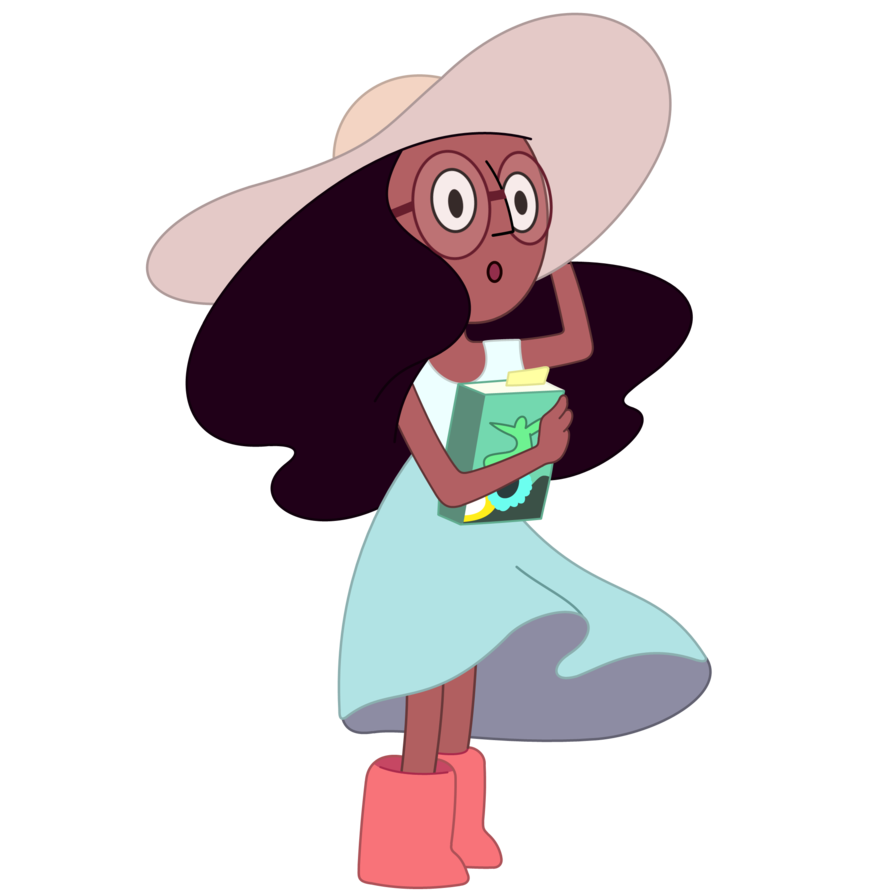
That being said, the obvious biggest influence on Steven Universe is The Simpsons. Steven Universe is too original (uh oh) to just be The Simpsons, but with more action, but the point remains. In this episode, we meet the young woman who seems to be in the Lisa Simpson mode, Steven's first love interest Connie. I say all this hoping that long time fans are laughing.
Connie
Okay, even if The Simpsons is the biggest influence on Steven Universe, and it is, Connie could be just as influenced by Khannie from King of the Hill. I don't know. She's obviously going to be Important (TM), because she is given such prominence in the opening credits. I suppose of I'm gonna be a hack reviewer, I might as well go full hack and give an overview. In this episode, Steven inconveniences his love interest Connie briefly but is so sweet about it that she forgives him.
.jpg/revision/latest?cb=20150531231913)
Simple descriptions don't imply simple writing. This episode had to jump through so many hoops its amazing they could fit it in 11 minutes. This episode had to: advance the metaplot (meeting Connie, establishing that yes all the monsters have a gem, introducing Steven's bubble), have a coherent internal plot ("Steven inconveniences his love interest Connie briefly but is so sweet about it that she forgives him"), have a straightforward emotional thrust (Connie learning to trust Steven) and maybe even some comedy ("funky flow"). If Steven Universe has a weakness, then it is that in stretching out to do so much, comedy is often sacrifice. This episode should have been full of physical humor and I was in a mental state likely to appreciate physical humor. Yet this episode fell flat. Connie seems like a nice girl, but she isn't quick with a quip and this episode isn't any quicker with laughs. This isn't a murder mystery, we are meant to laugh at Steven's ineptness. But there just ... isn't that much to it. The episode looked good, the music was alright... But why? Did these people really have to work so hard to make this?
Serious Steven
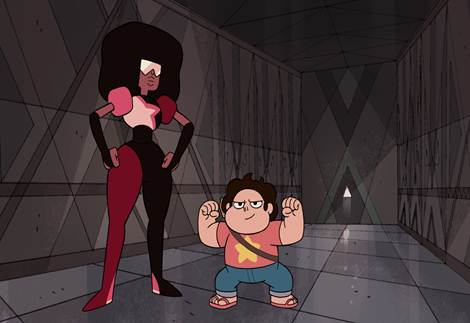
Segment 2 was "Serious Steven", a Steven and Garnet episode. Steven and the other Gems find an dungeon they have to defeat in a strawberry field. Yeah Beatles. Garnet is usually a font of hilarity, what could be funnier than someone who takes our absurd world seriously? This episode suggests "Anything" as an answer to that, it is as funny as buggery.
Of course, buggery is pretty funny and this episode provides a couple laughs. The characters in this episode claim that this is Steven's first mission. Apparently the superior episode "Cheeseburger Backpack" just doesn't count. My guess is that these were written out of order and "Serious Steven" was supposed to be a precursor to "Cheeseburger Backpack". The lesson here is identical: Steven's unorthodox POV is actually helpful on a mission in small doses. One could argue this episode makes that lesson sticks better by giving Steven and the other Gems a straight ending, if you liked to be wrong. The ending of "Cheeseburger Backpack" cut through the treacle, "Serious Steven" lies at the bottom of the Dormouse's treacle well.

Albert Einstein
Also, why couldn't the other Gems notice they were in a non-inertial frame of reference? Are they just supposed to be so tough they don't notice the forces around them? And the strawberry fields were very over-the-top, but Pearl implies this is part of Earth. Do strawberries just grow as big as watermelons in the SU Earth?
.png)
Princess Zelda, Navi the fairy and commoner adventurer Link
I did like the set piece in "Serious Steven". It was an inverted pyramid that worked according to Legend Of Zelda logic, but with puzzles that aren't quite so creative. Is Steven like The Hero Of Time? Probably not, I couldn't imagine Steven going around stabbing folks as is the main occupation of our man Link. Steven and Garnet solve these puzzles non-conventionally, but not so non-conventionally as to be independently interesting. I guess it is nice to know that Garnet is over-leveled for these missions.

The reviews for these segments are overly negative. They were the first segments to just be kind of okay, which makes them look bad in comparison to - for instance - "Cheeseburger Backpack". Really, I shouldn't intervene in SU's funky flow. As the number of constraints on these episodes goes down, the episodes themselves will likely improve. Though I'm not giving numerical ratings, I think you can tell I didn't like these as much as the last ones. What can I say but "strawberry fields forever~"
Monday, January 18, 2016
Jimmy Rushing & Dizzy Gillespie
Taking it easy today. I had a busy day, and that last post took a lot more work than its shoddy craftsmanship suggests. Have some music instead.
Sunday, January 17, 2016
Cowboy Bebop Review #1: Asteroid Blues
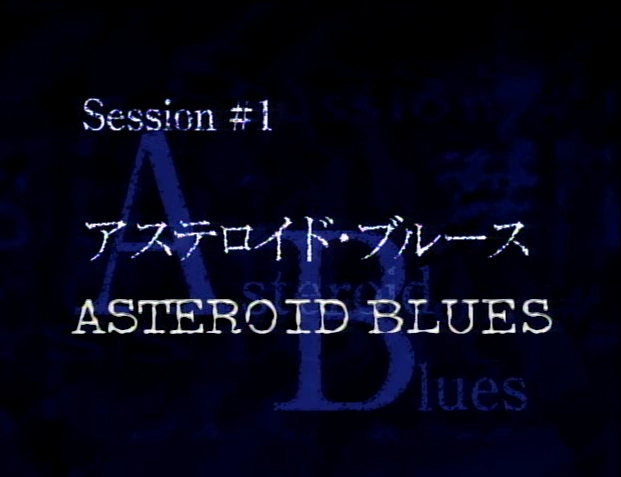
"Asteroid Blues" was designed as an advertisement for the rest of the show. It was to be shown on a talk show instead of the scheduled time slot. The voice actors were to be interviewed, a whole production.
The talk show nixed the whole thing. Too violent, they said. The entire show was in jeopardy from day one.
Again.

Miles Davis
That being said, "Asteroid Blues" is a perfect introduction to Cowboy Bebop as it is misleading as hell. This episode lets you know what Bebop aims for beautifully, but it uses a lot of misdirection over how it plans to go about it. You see, this episode pitches the show as a violent show for adults interested in animation like AKIRA or Ghost In The Shell, but with a cool, hip attitude. Aiming for cool, real, Miles Davis cool, is an unusual goal in animation. Nobody had ever done it before. Sure, GITS was emotionally detached, but that's because Oshii can't act (I love the guy but as a fan, you know it to be true), not because it was playing it off legit. The episode begins with not one, not two, but three music montages. The first is a wordless, sepia toned sequence that condenses every Yakuza movie into one minutes as "Memory" plays on a Celeste.
Memory
... Yes, I recognize the original songs. I kind of like this show. There's also a ballad version with vocals, because Yoko Kanno ain't no half-stepper.
The second musical montage is the world famous, genre defining, amazing opening credits. For once, I'm not being ironic. This features the song that became the series signature - "Tank!". This song is an homage to Charles Mingus or I'll eat my damn hat. It features a frankly oversized big band with an extra bongo player, electric keyboardist and I'm pretty sure that's two bass players. The main bass line is awesome by the way, as befits an homage to one of the world's great bassists. Like many Mingus songs, the music is call and response style, each call and response getting bigger and more out of control until the frentic solos come screaming at you. This is an edited version, so there's only a short Sonny Terry burst at the end, but the spirit is still there.
Hey, while we're talking about the opening credits, let's mention "series creator" "Hajime Yatate". Yatate does not exist. Instead "he" is the manifestation of the Bandai marketing department. If ideas come out of marketing, Hajime Yatate gets credited. We can all remember Yatate's one word contribution to this series. Actually, Sunrise has had to credit Yatate for several series that were largely the idiosyncratic creation of one man to the mythical marketer. The most important of these step-children is Mobile Suit Gundam, in many ways the first giant robot show that tried to be anything but glorified pro-wrestling.
I ought to talk about the postmodern typeface that litters the opening credits, since when compiled it is hilariously Engrishy and also gives a fair assessment of the show's goals. Unfortunately, I can't find a version with all the Engrish except my old DVDs in America. I'll reproduce the declaration of purpose here anyway:
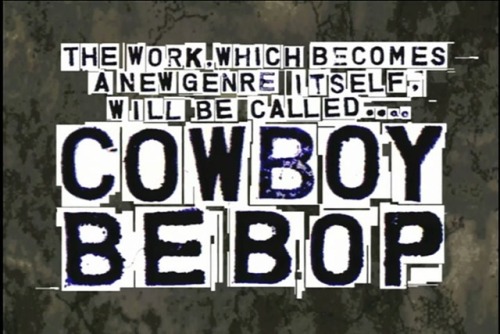
"Once upon a time, in New York City in 1941... at this club open to all comers to play, night after night, at a club named "Minton's Play House" in Harlem, they play jazz sessions competing with each other. Young jazz men with a new sense are gathering. At last they created a new genre itself. They are sick and tired of the conventional fixed style jazz. They're eager to play jazz more freely as they wish then... in 2071 in the universe... The bounty hunters, who are gathering in the spaceship "BEBOP", will play freely without fear of risky things. they must create new dreams and films by breaking traditional styles. The work, which becomes a new genre itself, will be called... "COWBOY BEBOP"
Okay, this is postmodern typeface, meaning it isn't meant to be read but rather is meant to be part of the artistic piece overall. But the declaration of purpose is clear. Cowboy Bebop is gonna be a show that creates a new artistic level for animation in the same way that Charlie Parker/Dizzy Gillespie/Thelonious Monk/Bud Powell/Max Roach/etc. created the original bebop. It wasn't about cutting Louis Armstrong or anything, it was about making ones own kind of music. For series creator Shinichiro Watanabe, who risked his career several times over to make this show, it was a declaration of purpose. This was gonna be the kind of show you risked your career on...
What did you expect from the episode "Asteroid Blues"?
After the delicacy of "Memory" and the hard charge of "Tank!", we get the third and final music montage. This time, it's the heartbreaking folk-blues of "Spokey Dokey". As the harmonica gently weeps, there's a montage of various gargantuan space objects over Mars. We see our heroes careening through space, cooking dinner and training.
Okay, so I need to say this before I move on to the plot. Editing is really hard. Timing in animation is really hard. This episode does it so masterfully that it is easy to forget that it is a really non-trivial task. The great director Friz Freleng would time out gags on a music sheet, and he had the advantage of a fully original score on every episode. On Cowboy Bebop - and most modern shows, likely - Watanabe had to time out the scenes not just so that they worked, but they also had to work with the music. The timing of the scenes and the dialog had to fit. You can't end a song in the middle of a bar unless you're doing it for effect. You can't match the beat too closely or you'll look as phony as a hacky french mime (old cartoons are often funny because they break this rule so ignorantly). It requires incredible planning and expert timing to make these montages look natural.
No, I'm going somewhere with this, I swear
To explain why that is hard in an abstract way, I've conveniently linked "I Can't Help Myself (Sugar Pie Honey Bunch)" above. In this Motown classic, The Four Tops tightly perform a song that requires to do many things. I want you to think of the background singers in particular. Most of the time, they just do stuff like "In and out my life (In and out my life)". They can wait for a cue from the main singer or the band. But there are also times like at 0:45 where they have to come before the singer. That way they end the line "I can't help myself" at the same time as the lead singer's line "I'm tied to your apron string". Notice, they can't be cued, because the melody isn't doing anything interesting yet. And they have to hit the beat exactly, because they are three people in close harmony and if one is slightly late the whole thing is gone. This means they have to sing a fairly complex song (they aren't singing the same hook every time, but a sequence of hooks in a pattern), but they also have to dance and count. Try to do it with them, hit every entrance and exit perfectly. Even though you've heard this song a million times, you probably will take several times to do it.
Editing is like doing that all the time.
I want to say this not just because these scenes are masterful that they seem like they couldn't be edited differently, just like The Four Tops make "I Can't Help Myself" seem like it is spontaneous emotion being pouring out of a man whose love is out of control. This needs to be said because it goes to show just how much Watanabe had faith in Yoko Kanno. Her changing a song was a non-trivial thing. It meant that the show was going to be harder to make. But her music was worth it.

Is there gonna be some kind of blues on an asteroid or...
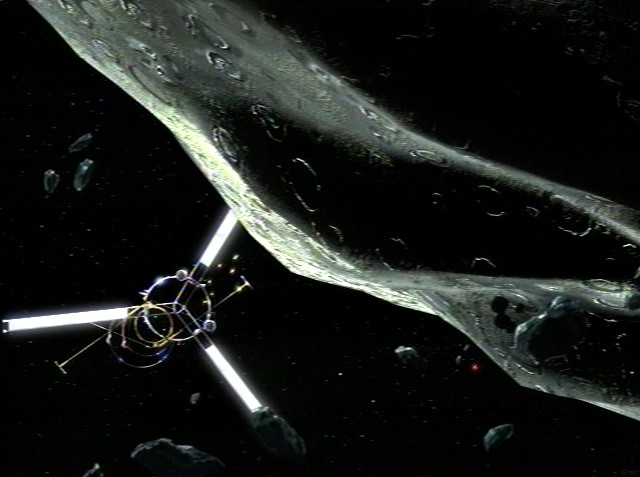
Okay, okay. I won't do as much scene by scene analysis, since even I know that is hack reviewing. In the "Spokey Dokey" montage we're given a lot of information. One, this is the future and we are in space. Two, Mars is gonna be important. Three, this belongs to the genre of used futures, like Philip K Dick or Foundation after the fall of the Empire or ... okay, most written Sci-Fi. The first on the screen SF to use the used future idea was Star Wars. George Lucas used to muddy up the Death Star floors to look like an army walked on, only to have the crew try and clean them! It's amusing now, but at the time it had never been done. In the 22 years between Star Wars and Cowboy Bebop, plenty of used futures had been on screen. You see this and you know this is gonna be more cynical SF.

We meet our main characters, training and cooking breakfast as I said. In classical cinematography, whose perspective is the first question you ask. Here we're looking at lead character Spike from the perspective of Jet. Jet just made his special ...

Spike Spiegel
Oh, I guess I should talk about Spike, shouldn't I? In these first few episodes, Spike is the unquestionable lead character. The episodes are about things that happen to and around him. This is one of the aspects that is misleading about the first episode. In fact, Bebop has a great ensemble that it takes its sweet time introducing. It would be like walking into Minton's and hearing this new cat Dizzy play, then on the second set some drunk looking alto player showed up. Spike is a complicated man and no one understaaaands him but his ...
Anyway, Spike is a genuinely complex character. Maybe if I talk about him in contradictions it will help. On the one hand, he plays it cool as ice in almost every situation (dude, he gets mad at one point in the first two parter and it is scary as hell), but he's impulsive and reckless. Yeah, impulsive and reckless enough that his propensity for destruction is explained and well demonstrated in this episode, yet he's also a very perceptive and gentle person. He's quite good at seeing through the lies that people build around themselves. We know he has a tragic background, but to the other characters he's as mysterious as the stars themselves. He's a bounty hunter - a loose kind of lawman - who is obviously some sort of ex-thief. Most surprisingly, he is all this without being a walking bundle of angst and contradictions (this became the cliche after EVA). Instead, he wears all these as naturally as his green frizzy hair.
Even in design he's an oddity. He was designed with iconic Japanese comic thief's Lupin III's outfit, but has the original Japanese defective detective Shunsaku Kudo's face. For those not up on their 70's Japanese Dramas, think of Shunsaku Kudo as a Japanese Jim Rockford. Spike's got Bruce Lee's body and philosophical outlook, but stretched out into a beanpole like he's gonna take on Captain Harlock. Yeah, Spike's all that and a bag of quips all right.
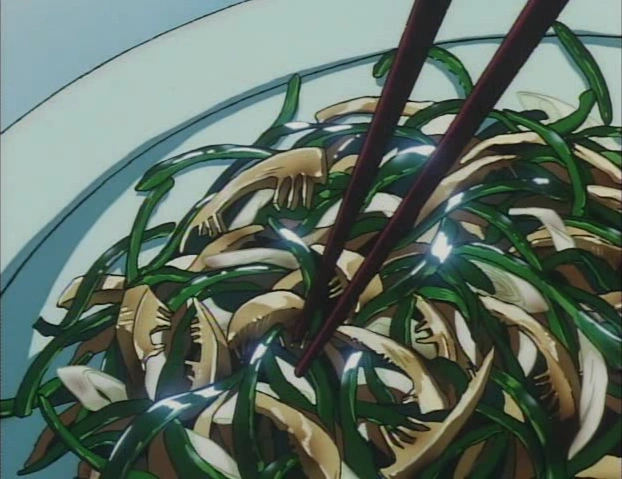
Bell Peppers and ... "Beef"
So anyway, because Jet is a responsible adult who takes care of business he makes Bell Peppers "And Beef" for breakfast before discussing tomorrow's work. Bell peppers and beef are, of course, eaten with chopsticks. Beef is expensive in Asian countries. This scene sets up the contradictions of Jet's character. He insists on getting the job done honorably even when he really shouldn't. The editing in this scene is worth mentioning. It keeps the characters in their own frame when they are having different conversations and then shows them together when Spike finally forces Jet to acknowledge the unsaid. We'll have to give this guy his own intro. Maybe next episode.
Funny story, the whistling Spike does was actually improvised, at least in the original Japanese. I should have said before that I'm generally going to be watching the iconic US dub, and I am so there. Actor Koichi Yamadera, now in his first day of his first starring role, was actually very nervous improvising a melody in front of musical prodigy Yoko Kanno. Spike's english language voice actor Steve Blum was also nervous. At the time he considered himself a musician dabbling in non-union voice acting and now he was being asked to take on a serious role. Luckily he nailed it. We'll come back to these guys later.

Old Man Bull & Spike
So, after a ... "breakfast", Spike takes off to meet with Old Man Bull while Jet scrounges a police contact. Old Man Bull is a Sioux mystic of some sort (probably Lakotan, because all native Americans are Lakotan). Giving roles to non-Japanese characters was actually a major goal of this series. The ethnicity of the leads is unclear, but I'll mention the clues when I get to them. Old Man Bull (full name: Laughing Bull) says the sooth and gives some nice foreshadowing. You probably know how the series goes, but I'll play it coy and say that it turns out part of the foreshadowing is for the series and not just the episode.
So, I'm not a political person, but I guess I should say it out loud. Is Laughing Bull a stereotypical Injun Chief? I'd say no, but that's more subjective than we like to admit. There's a fine line between what one might call "representation" and what one might condemn as "stereotyping". Old Man Bull close to that line and might bother you if you want to be bothered. I don't know how much writer Keiko Nobumoto researched this character. He asks Wakan Tanka to guide Spike, which suggests she knew something about the Lakota, but I don't know if the sand thing was just to look cool or what. The show was still finding its way at this point, later episodes will continue to diversify.
I will say this: I think that if every time a native character shows up some white guy says its problematic, there's gonna be a lot less jobs for native actors.
Also, my hero Johnathan Joss (TV's John Redcorn) is an awesome guy in person and should have his own talk show it would be so great.
Oh, and Cowboy Bebop!

No, I'm going somewhere with this, I swear
Meanwhile, in Space Tijuana (this is a serious show for serious people), baddy of the week Asmiov and his "sweet thing" Katerina try to unload the drugs. I'm gonna give it away, Katerina ends up stealing the episode. People talk about "gaze" a lot, because academics like me are too stupid to actually do design, but smart enough to talk about politics (so double stupid?). As shown above, Katerina is gazed at - which is stereotypical direction. Okay, the above shot actually isn't quite fair to call "stereotypical direction", since she is purposefully making fun of the old men, but come on, this is totally a shot of boobs, not some post-avant-feminist statement. As the episode goes on, you realize that the real plot is actually from her point of view. The walls are closing in around her and Asimov, and his addictions are driving him absolutely ape.
The constantly arguing old guys come back and just get better. And yes, he does always say the same thing when he's losing.

Its shots like this kept the show off the air. This is reflected in the victims glasses.
It's a pitched shootout between Asimov and the Mexican... Space Mexican Mob and Asimov wipes the floor with them. The space meth he's dealing makes him superhuman even as it makes him spiral into paranoia and condemns him to a world were everyone but Katerina wants to kill him. Even Katerina doesn't seem to care about him so much as what his ambition represents - escape from this backwoods asteroid.
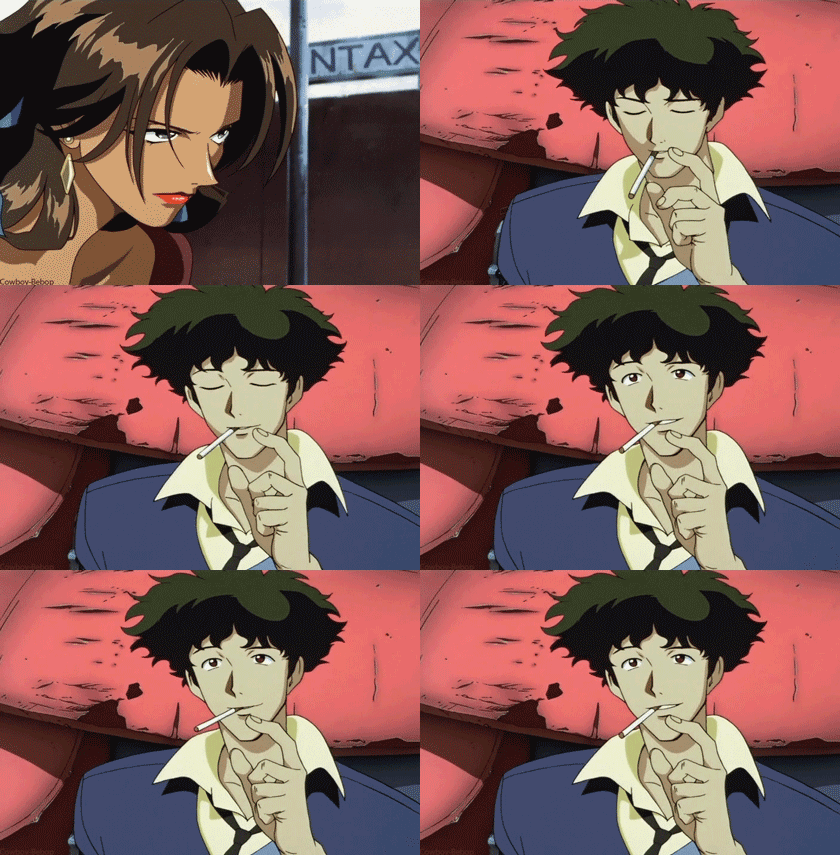
Spike and Katerina's first and (obvious spoiler) only actual meeting, we see several more sides to them both. Spike, we discover, has fast and sticky fingers, as we'd expect from a guy partly based on Lupin III. But he also is better at listening that it might appear, and he sees through Katerina like an X-Ray. Katerina's ambition to leave Tijuana to go to Mars is the only thing left in her life. Spike, who was born there, can see what a Quixotic dream it is. This is a big part of Spike's cool - he can see what drives you, but you can't tell whether he's joking or not.
But then Asimov chokes him for talking to his "sweet thing", Spike dies right there and the series ends.

It turns out these guys are the leads!
Okay, no, that doesn't happen. She talks Asimov down and they leave. As you can see from this shot, the design is changing. Increasingly we are looking from Katerina's perspective at things. The last thing we see before the eyecatch is Spike's just lit cigarette. Spike is lying unconscious in a way that the cigarette couldn't be seen. The cigarette was the last thing Katerina saw.

Those are the ISSP - the space police. We'll talk more about them later.
When we come out of the eyecatch, we see that the ISSP have set up a blockade for Asimov. At this point we know it is over for them. Even if they could unload the space yayo, they'd be murdered at the border.

Once the red-eyed coyote appeared at the Zona Norte at the far end of town, we get the first action scene of the series, and it's a big one. The Spike vs Asimov fight is just a taste of what the series has to offer. After building up Asimov as an unbeatable god of death for the whole episode, Spike utterly dominates this fight in a way both awesome and cathartic. Words and stills can't capture the awesomeness of this fight, it's truly poetry in motion. Also, the jazz has come back to the soundtrack, which is always a good sign!

Free storyboarding tip: if you wanna add some dynamism to your scene, have a character not quite stumble. It turns out, paradoxically, to be way more visual interesting to acknowledge that a character's crazy stunt is hard than to have them pull it off perfectly. Hayao Miyazaki in Future Boy Conan used this trick constantly to make Conan's superhuman movements even more visually impressive. Watanabe is more restrained in his use, but it is a cool trick that really works, I swear.

Okay, this shot might not be the perfect illustration but we are looking with Katerina at Asimov. He's become an object due to going insane.
Anyway, as things go from bad to worse for Asimov & Katerina, his mental state regresses. Eventually, he's so stressed and high that he's incapable of rational thought and just runs for the border. At this point, we've fully become Katerina from a visual storytelling point of view. The end of her story is the narrative's real end.
This episode had a lot of work to do: bring in the lead characters, establish the world, have epic fights and awesome music, all while telling a sensible story and having a comprehensible emotional thrust. Watanabe's greatest skill has always been to make complete characters out of materials that others wouldn't even notice. It accomplishes more than this by making it truly Katerina's sad story, a character who easily have been dismissed as background cheesecake - or even left out entirely. Spike might be the lead, but at this point he's still a complete mystery. This episode didn't plumb his soul, instead it showed him seeing into someone else's. He was sympathetic, but there wasn't much he could have done. And you'd have to have a heart of stone not to want to see the space cowboy again.
As I said before, this was a wonderful, misleading first episode. The villain-of-the-week Asimov is knuckle dragging thug whose only vision in the world is physical and monetary power. In the episodes to come - and even within this episode - it would turn out that Katerina is closer to the heart of the series than he is. If you felt today's episode was a little thin, stick with the show. Cowboy Bebop has a lot more magic in it than this cynical, violent episode would suggest. For reasons stated elsewhere on this blog, I am not going to give numerical grades to this or any episode of any show. But I will give you a time: right now. That's when you should check this show out.
Saturday, January 16, 2016
Steven Universe Segments 5 & 6: Reckless Power And Father Stuff
If it was pretentious for me to have a Review #0 for Cowboy Bebop, I'll make up for it by starting several episodes into Steven Universe. This means I'm not going to do a post explaining who the characters are, or the setting or ... you know all that "review" stuff. I'm going to pretend it's all been done and start with episode 3. Maybe I'll make a background review eventually, but no promises.
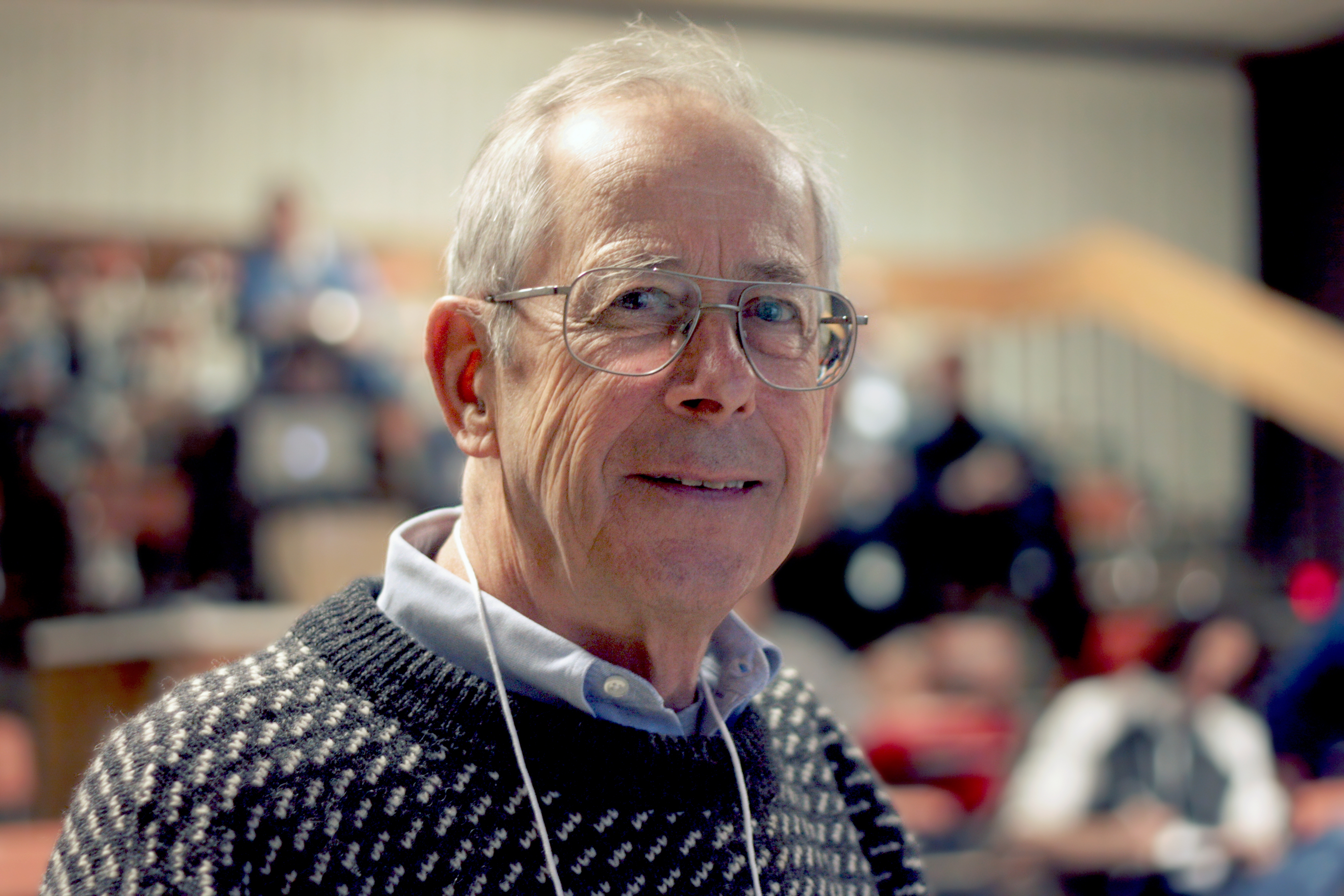
I'm also going to apologize in advance, I am barely capable of typing "Steven". My fingers always want to describe the nonexistent show Stephen Universe, which would likely be a BBC docudrama about the beginnings of data driven astronomy. In the many times I will type the simple and common English name Steven wrong, you can sit in silent judgement of me and PJE Peebles.
The segments I saw today are "Frybo" and "Cat Fingers". (Incidentally, I in no way promise a two segment review every day) These episodes combine in an interesting way. It's dangerous to speculate on artistic motives - on the one hand it takes an incredible amount of thought and energy to make even the dumbest cartoon, on the other human beings are boundless in their ability to hallucinate patterns. Plus, I have no idea if anyone controls the order the episodes come out in - it might be one of those cosmic structures I keep reading about. But given that today's episodes have the common themes of recklessly used and misunderstood power and paternal misunderstanding, I assume that they were meant to be seen together. The humor is getting sharper, but the episodes groan under the weight of their multiple goals. These episodes have to introduce complex characters, forward a metaplot, have a coherent internal plot, have a straightforward emotional thrust and be funny. These episodes feel like the zing at a billion miles an hour to try and hit all those gongs.

The first segment is "Frybo". Reckless power: a gem that brings clothing to life / Paternal misunderstanding: What little boy wouldn't want to wear such an adorable costume?. We met the Fryman family back in one of those segments I didn't review, but this one introduces Peedee (P.D.?), who is Steven's age and therefore more interesting. Peedee has an amusingly serious world view, and rambles in an adorable way about the oppression and necessity of being a wage slave. Steven purposefully ignores this, just as he accidentally ignores Pearl earlier and uses a dangerous magical crystal (meant to be an instant soldier by animating armor) to help Peedee get out of his job. At the end we discover that Frybo means a lot to Peedee's father (which nobody understands), which explains the parental misunderstanding. In Mr Fryman's mind, being put inside Frybo is an honor. I like to imagine that Peedee gets his dark world view from his mother, who hasn't been introduced.
As you can see above, Frybo looks kind of like a fusion of Frylock and Master Shake from Aqua Teen Hunger Force. Coincidence? Or is it ... Memorex? Also, the Fryman family has blond, fry-like hair. Ha! Peedee's brother also runs a blog called "Keep Bay City Weird", a parody of the pro-local business slogan "Keep Austin Weird". I know somehow that he's a conspiracy nut, another reference to Austin culture. Being so Austin-oriented doesn't make sense in the context of the show, but if he starts playing blues guitar, I'm gonna laugh like a drug-crazed Austinite!

The second and final segment was "Cat Fingers". Reckless power: Shapeshifting / Paternal misunderstanding: Surely someone is helping my son with these bodily changes. Crystal Gems have the power to shapeshift. In these early episodes we're going to be spoonfed their powers in an organic way, because the show is 11 minutes long and there's no time to have an "introducing out powers" episode. The series is probably better off for it. This episode introdu-SWEET SNACK CAKES, IT'S JOEL HODGSON!!!!

"I'm not paying you guys for father-son bonding!", haha, classic Mystery SsssssssssTeven Universe. Yes, this episode features the comedian, magician, actor, special effects advisor, writer, creator of Mystery Science Theater 3000, The TV Wheel and many others, yes, TV's own Joel Hodgson in an award winning, scene stealing - okay he's in the episode for like a second.
It's also good that Peedee is dour in his new job, even though he does respect it more. It's tough to have character evolution without turning it into hackneyed box checking. On a lesser show, getting out of the Frybo costume would have cured all Peedee's ills. On this one, he still finds ways to be put upon, because that's who he is.

I feel the art direction is not as good as the previous segment. The sunset that ended "Frybo" was beautiful. It brought pathos to one character and bathos to the others, which was great. The comically small Crystal Gem Sloop was amusing, but I think maybe going for impressive would have been better? I look forward to seeing them use that sloop constantly, until a crazed monster breaks up the people's trunk and eats all of Steven's corn. Okay, okay, I know they probably won't use the sloop much more, but I'll wait for it. Don't worry, comically undersized sloop, you'll get your day in the sun, just hang in there. Yeah, hang on sloopy!
Wait right there, I want to do this forever.

Today's episode was very good. I'm not going to give numerical ratings, because a work of art's qualities are a complicated vector and using scalars privileges one choice of utility function over others in a way I'm nor comfortable with. Plus, I haven't seen enough of the series to know how to adjust if it turns out they start getting 100 times better (or worse) at episode ten or something. I will say this: of the segments of Steven Universe I've reviewed so far, these are the top two.
By the way, no I have nothing against P J E Peebles, who is a great physicist.
I'm also going to apologize in advance, I am barely capable of typing "Steven". My fingers always want to describe the nonexistent show Stephen Universe, which would likely be a BBC docudrama about the beginnings of data driven astronomy. In the many times I will type the simple and common English name Steven wrong, you can sit in silent judgement of me and PJE Peebles.
You can take the standard cosmological models and shove 'em!
The segments I saw today are "Frybo" and "Cat Fingers". (Incidentally, I in no way promise a two segment review every day) These episodes combine in an interesting way. It's dangerous to speculate on artistic motives - on the one hand it takes an incredible amount of thought and energy to make even the dumbest cartoon, on the other human beings are boundless in their ability to hallucinate patterns. Plus, I have no idea if anyone controls the order the episodes come out in - it might be one of those cosmic structures I keep reading about. But given that today's episodes have the common themes of recklessly used and misunderstood power and paternal misunderstanding, I assume that they were meant to be seen together. The humor is getting sharper, but the episodes groan under the weight of their multiple goals. These episodes have to introduce complex characters, forward a metaplot, have a coherent internal plot, have a straightforward emotional thrust and be funny. These episodes feel like the zing at a billion miles an hour to try and hit all those gongs.

Frybo
The first segment is "Frybo". Reckless power: a gem that brings clothing to life / Paternal misunderstanding: What little boy wouldn't want to wear such an adorable costume?. We met the Fryman family back in one of those segments I didn't review, but this one introduces Peedee (P.D.?), who is Steven's age and therefore more interesting. Peedee has an amusingly serious world view, and rambles in an adorable way about the oppression and necessity of being a wage slave. Steven purposefully ignores this, just as he accidentally ignores Pearl earlier and uses a dangerous magical crystal (meant to be an instant soldier by animating armor) to help Peedee get out of his job. At the end we discover that Frybo means a lot to Peedee's father (which nobody understands), which explains the parental misunderstanding. In Mr Fryman's mind, being put inside Frybo is an honor. I like to imagine that Peedee gets his dark world view from his mother, who hasn't been introduced.
As you can see above, Frybo looks kind of like a fusion of Frylock and Master Shake from Aqua Teen Hunger Force. Coincidence? Or is it ... Memorex? Also, the Fryman family has blond, fry-like hair. Ha! Peedee's brother also runs a blog called "Keep Bay City Weird", a parody of the pro-local business slogan "Keep Austin Weird". I know somehow that he's a conspiracy nut, another reference to Austin culture. Being so Austin-oriented doesn't make sense in the context of the show, but if he starts playing blues guitar, I'm gonna laugh like a drug-crazed Austinite!

Cat Fingers
The second and final segment was "Cat Fingers". Reckless power: Shapeshifting / Paternal misunderstanding: Surely someone is helping my son with these bodily changes. Crystal Gems have the power to shapeshift. In these early episodes we're going to be spoonfed their powers in an organic way, because the show is 11 minutes long and there's no time to have an "introducing out powers" episode. The series is probably better off for it. This episode introdu-SWEET SNACK CAKES, IT'S JOEL HODGSON!!!!
Joel Hodgson
"I'm not paying you guys for father-son bonding!", haha, classic Mystery SsssssssssTeven Universe. Yes, this episode features the comedian, magician, actor, special effects advisor, writer, creator of Mystery Science Theater 3000, The TV Wheel and many others, yes, TV's own Joel Hodgson in an award winning, scene stealing - okay he's in the episode for like a second.
Hey, did you know some TV shows have plots now? For instance, this segment has one of them! Earlier I mentioned that the writing of Steven Universe, while very, very good, are sometimes pulled apart by having so many goals to reach. I gave as examples: Metaplot (meeting Mayor Bill Dewey, played by JOEL HODGSON, MAN AMONG MEN - oh and introducing the fact that Crystal Gems can shapeshift), have a coherent internal plot (Steven begins using his shapeshifting powers, but without guidance finds that he lacks control), have a straightforward emotional thrust (Steven's father coming through for him despite being way outside his comfort zone) and comedy (this episode is just ... kitten around!). This episode screams forward at a crazy fast pace to hit all those notes, and it has to be admitted - they play a beautiful chord. The Brundle-Fly-esque transformations Steven takes on are great. I like the idea that kids will watch this in 20 years and realize it was actually kind of disturbing. But it isn't cheap disturbing like we see so often nowadays, what with all those kids on my lawn. It's perfectly PG Cronenberg.
It's also good that Peedee is dour in his new job, even though he does respect it more. It's tough to have character evolution without turning it into hackneyed box checking. On a lesser show, getting out of the Frybo costume would have cured all Peedee's ills. On this one, he still finds ways to be put upon, because that's who he is.
Background from "Frybo"
I feel the art direction is not as good as the previous segment. The sunset that ended "Frybo" was beautiful. It brought pathos to one character and bathos to the others, which was great. The comically small Crystal Gem Sloop was amusing, but I think maybe going for impressive would have been better? I look forward to seeing them use that sloop constantly, until a crazed monster breaks up the people's trunk and eats all of Steven's corn. Okay, okay, I know they probably won't use the sloop much more, but I'll wait for it. Don't worry, comically undersized sloop, you'll get your day in the sun, just hang in there. Yeah, hang on sloopy!
Wait right there, I want to do this forever.

Steven Universe
Today's episode was very good. I'm not going to give numerical ratings, because a work of art's qualities are a complicated vector and using scalars privileges one choice of utility function over others in a way I'm nor comfortable with. Plus, I haven't seen enough of the series to know how to adjust if it turns out they start getting 100 times better (or worse) at episode ten or something. I will say this: of the segments of Steven Universe I've reviewed so far, these are the top two.
By the way, no I have nothing against P J E Peebles, who is a great physicist.
Friday, January 15, 2016
Cowboy Bebop Review #0: Get Ready 3, 2, 1 - Let's Jam
The advantage of 1) is that since it is my own experience, I can recall - or fabricate - every detail the best. It's the most personal, and even minor real experience can be worth a metric ton of high-carbon reflected life. The disadvantage is that at the time I was living a pretty dull and comfortable early teen life. I would have hated to have to live with bombs falling on my head, but it would certainly made my decision to watch cartoons late at night in some way interesting.

The original Adult Swim line-up
I can only remember the decision to watch Adult Swim in an unclear way. It was conscious, though I don't remember where I found out there was going to be a thing called Adult Swim. Possibly/probably a commercial. I was a fan of the Williams Street show Space Ghost Coast To Coast from the first moment I heard the Sonny Sharrock theme. Revisiting that, I realized that it was a lot more hit-and-miss than I thought. It's obvious in the first season or so they didn't feel comfortable abandoning the "talk show" element for little things like "comedy". But eventually, they'd abandon it for garden clippings just to have the excuse. They did a stupid little special Brak Presents The Brak Show Starring Brak, but I could forgive them for that. Besides, now they were going to have their own block! I had to check that out. In retrospect, it's obvious that the line up wasn't supposed to have any anime on it. It was 84% comedy, and mostly Williams Street originals. Besides, that was what we had Toonami for. But Bebop didn't fit on the old Toonami, it's a show that needed night. Jazz is night music. Bebop is a night show.
Maybe a lot of the famous Williams Street animosity to anime comes from that feeling that they gave anime an inch with Bebop, and they took a mile... Oh hell, for old times sake, let's go through the line-up as I saw it.

Home Movies
I didn't see home movies when it was on UPN. Almost nobody did - UPN was dying and everyone knew it. It was strange, UPN seemed to be a network so desperate that it would greenlight anything - but nobody ever watched anything but Star Trek. It's too bad, Home Movies is a very good and original show that does a style of humor that is supposed to be unanimatable. Animation is all about control and structure that looks loose and natural - much like Jazz. Genuinely unstructured things - like the highly improvised Home Movies or rock - are a threat to the core identity. Animation proved to be able to keep itself intact despite the worries, and so did jazz for that matter (is In A Silent Way the best fusion album? yes.). This was the show where we learned that H Jon Benjamin could not avoid being funny. I think the funniest interaction is when Melissa, self-appointed good girl that she is, respects the authority that Coach McGuirk technically has as both an adult and a soccer coach. McGuirk always manages to abuse this tiny smidgen of authority farther than one would think possible.
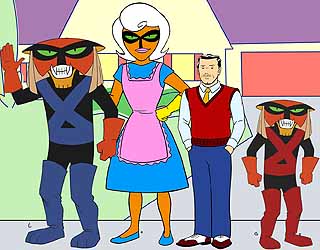
The Brak Show
This was the most direct spin-off of SG:C2C, which starred break out annoyance Brak. The Brak Show was ostensibly a parody of Leave It To Beaver, with Brak as Beev and Zorak as Wally. The joke was that Leave It To Beaver was an ancient relic long past parody even when this came out 15 years ago, so this was really just an exercise in being as extreme and bizarre as possible. Did it work? ... Sort of. The Brak Show was the most forgettable show on the line up. It wasn't as weird as Aqua Teen Hunger Force or extreme as Sealab 2021, it didn't mine a new kind of comedy like Home Movies or Harvey Birdman, it was just The Brak Show. Still, it was fun while it lasted, and I still sometimes end conversations with "some say he grew a beard and still lives here... But that's a damn lie!".

Aqua Teen Hunger Force
Aqua Teen Hunger Force was probably the worst show that night. It's not that it was horrible, ATHF just took a while to find the right formula. The first episode is still half pretending to be an adventure show, but soon they would start completely and wisely ignoring the title. The relationship between Shake and Frylock doesn't work as a result. Intelligent, magically empowered Frylock treats Shake as the leader because ... that's what the script says. Later episodes would get a more interesting dynamic - Shake would insist the script proclaims him leader, despite all evidence that it proclaims Frylock. This episode uses a bunch of backgrounds from the Powerpuff Girls pilot, which I found amusing at the time. I remember being disappointed that they didn't keep cannibalizing stuff from other Cartoon Network shows, like the Stooges used to do with Columbia sets. Maybe it was only funny to me.

Sealab 2021
Adam Reed and Matt Thompson's show Sealab 2021 is the secret father of modern comedy. I don't know if that is a compliment - have you seen modern comedy? I also know that the official father of modern comedy is The Simpsons, but years of alcohol abuse have left that show impotent. Sealab 2021 has an obvious parentage - it is Space Ghost: Coast To Coast's child. Space Ghost was weird, but rarely dark. Also, Space Ghost was a slow show, where comedy often came from beats rather than punchlines. No, the rapid-fire, dead baby, low artistic appeal comedy was invented right here in beautiful Sealab, Underwater. It was a breath of fresh water - I drowned laughing. Everyone was perfect. Even Erik Estrada was so funny that you could believe that he thought he was Erik Estrada De C.H.I.P.S. - just like Adam West fooled audiences into thinking he took Batman seriously. Family Guy went from doing Joyce DeWitt jokes to abortion jokes. The Simpsons abandoned comic tightness forever. Ugliness became holy writ. Sealab 2021 lasted too long and it knew it, but at its prime it was this strange, dark, hilarious joke machine.
Personal note: I own a Sealab 2020 board game. It is in America, though.
Space Ghost: Coast To Coast
The final Williams Street show was their classic - Space Ghost: Coast To Coast. I remember exactly which episode aired - "Knifin' Around" with Thom Yorke and Bjork. This is the series at its height, and "Knifin' Around" is the best episode of Space Ghost. Every line slays. "Those aren't children, they're packets of cream cheese.", "He's living on our couch, with the urine.", "I do this because ... I am special" and "We're just talking about ... dragons.". Bjork's innocence and Icelandinc confusion with the English language matches perfectly with Space Ghost's arrogance and inability to speak. Thom Yorke is monosyllabic, yet his dismissive "Yeah." or "No." are some of the episodes best and harshest reactions. Is Space Ghost's song on iTunes? "CutCutCutCutCutCutCutCutCutCutCut".
In retrospect, I should have gone to bed at this point. I had seen all the shows I wanted, including the best episode of Space Ghost that would ever be made. But, I stayed and watched and ... the next show was something special. The other shows were comedies, this was a drama. The other shows flaunted their negative production values, this one was gorgeous just on a technical level. The other shows had loose, ironic rhythms, this one kept a vice like grip on its pacing. The other shows had some background music if it felt like - often intentionally grating. This one put true musical art at the core of its existence. I've seen people talk about hearing The Beatles the first time, how it transformed them. For others, The Velvet Underground. For Patton Oswalt, it was Van Gogh's The Night Cafe. This was an artistic awakening being broadcast to unsuspecting teens. It is probable people even younger saw it and felt naughty for watching TV-14 shows. That was 15 years ago. The intended audience is now in it's mid-30's. Nine days later, the World Trade Center in New York, killing nearly 3,000 - by far the deadliest terrorist attack in history - instantly ushering in a new era in the most horrible possible way. Bebop, which was produced in 1998, has nothing to do with the mass death. But I wonder if any of the younger kids who watched this new, more mature show late at night and thousands of non-combatants immolated instantly had their world views darkened. Did the corrupt but beautiful world of Cowboy Bebop speak to young people who were overhearing the Bush Doctrine when their parents had control of the TV in the way the Beats spoke to the kids hearing the Truman Doctrine?
Maybe it was only me. Maybe I shouldn't have been shocked. After all, I had seen anime before, on Toonami for instance - but this was different. It wasn't a giant robot show or a martial arts contest. It was something new. And this great work, which became a genre unto itself was called
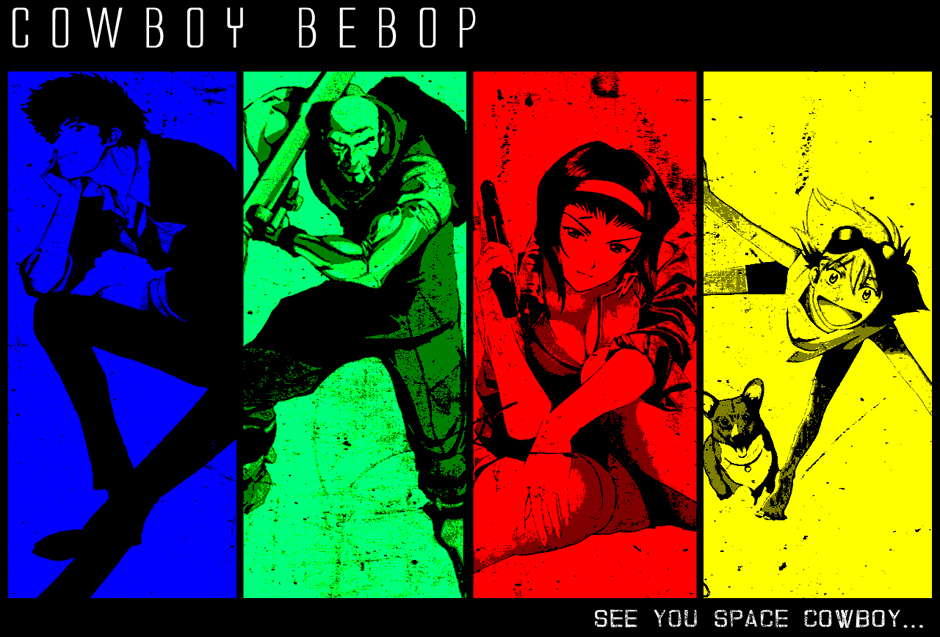
Cowboy Bebop
To bring back the original thread of this post, how did this very different kind of show get made? Cowboy Bebop is personal, groundbreaking, noncommercial and original - how did get on the air? We all know, though we don't like to admit, that most anime is an advertisement for other, more profitable media (toys, manga, etc.). Why did they let a man who had never helmed a show before make a show that would never ship merch? As you can imagine, it was an arduous journey and it almost didn't happen. Unfortunately, very little of this has been recorded. Despite super-director and creator Shinichiro Watanabe being every bit the equal of Hayao Miyazaki or Hideaki Anno, the latter two were only famous anime directors in Japan at the time. Even Anno, the protege of Miyazaki, with all his awards for Gunbuster (surely that won some awards? It's so awesome!), had to end the 80's with a Nadia, a bake-braking effort he was barred from bringing any originality - and was legally impossible to make a profit on. EVA, Macross Plus, and Ghost in the Shell all played an direct role in showing that hegemony was not necessary.
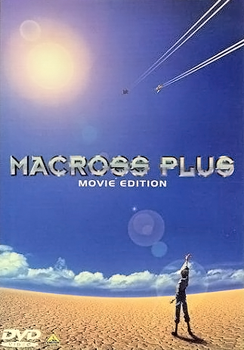
Macross Plus
To know how Cowboy Bebop got made, it's necessary to know a bit about its core creative personnel. The most important person behind Bebop was series director Shinichiro Watanabe. Earlier I said that he never helmed a series - this is actually only partially true. He had co-directed the instant classic Macross Plus, with Macross creator Shoji Kawamori, who also played several minor but important roles in Bebop as well (such as writing Speak Like A Child, one of the best episodes of television in any genre). I know little about Watanabe's pre-Macross career, and from what I have seen it doesn't seem like he was allowed particular creative leeway by Sunrise. I imagine that the animation is littered with geniuses that could reinvent animation if given the chance - and just as many fools who think they could. I don't begrudge Bandai for not giving him special treatment. Nobody knew.

Shinichiro Watanabe
Watanabe was approached to make a series after the success of Macross Plus. Perhaps EVA, the weird new show that was climbing up the charts, was making studios aware of the idea of a creator driven series, but it was the marketing department of Bandai Visual that approached Watanabe with the idea. And what was the brilliant idea that the marketers came up with?
"Spaceships.".
As long as it had space ships, they said, they could sell toys and make a profit. And Watanabe was asked to bring that ... "idea" to the public. Watanabe made the show he wanted to make: a show where the main characters were down and out, a show where people drank, used drugs, got violent - even a show that included plenty of non-Japanese characters. He conceived of a two-part epic centered on a transgendered person. The marketing department was furious. "But", he explained, "It has spaceships!".
Cowboy Bebop was not picked up.
Suddenly, out of nowhere, Sunrise swooped in and offered him the chance to make the show if he could start right away. He was to be given a talk show push for the first episode and a prime spot on TV Tokyo. I don't know if anyone told him that he was replacing Kodocha, a show aimed at young girls, but I like to imagine that was kept in the dark. Production was still going on as the series began airing. As we get into the episodes, I'll talk more about the disastrous TV Tokyo run - suffice to say Watanabe was screwed by the network hard enough that he can say "Firefly who?".
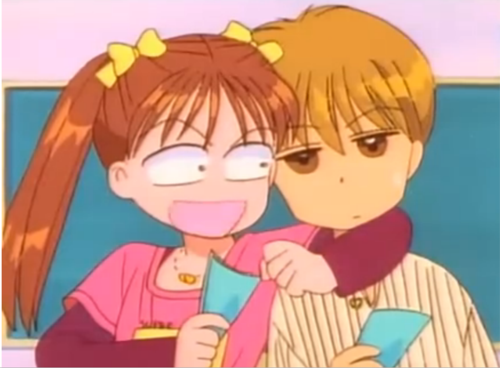
Kodocha is actually really good, but ...
So, what is working with Watanabe like? For a guy whose style depends so heavily on tight timing, Watanabe runs a lax ship. I remember wunderkind composer Yoko Kanno description of the Bebop production:
"On most shows, everyone is always shouting. Stuff like, 'The hero should do this!' or 'The heorine would never say that!'. But on Bebop everyone was quiet. Sometimes I'd be looking for somebody and thinking 'Are these people actually at work?'."

Yoko Kanno
Speaking of Yoko Kanno, Macross Plus was also where Watanabe first worked with her, whose genre defying, kaledescopic music would play more than a major role in Bebop (trivia: actually worked with Kanno on the music of Macross Plus, to the point that Kanno didn't recognize Watanabe when they first met to work on Bebop!). Macross Plus put her on the map. The music crossed genres and reinvented idioms. It must have been brutal work - she did all the arranging and orchestrating herself.
Kanno did more than write the music for Cowboy Bebop, her playful spirit and incredible genius inspired Watanabe to retool one of the main characters, "Radical" Ed, to resemble her. Watanabe gave her enormous leeway. She was allowed even to question the writer and director's instructions as to what kind of music to compose. Suggesting that is a instant fire-worthy offense in a normal show. But Watanabe had that much faith in her skill. He was richly rewarded. World hopping Yoko Kanno called in a lot of favors (there are literally hundreds of musicians on the Cowboy Bebop soundtracks, many of whom were given creative roles) and gave Bebop the score of a movie many, many times its budget.
Yoko Kanno was a child prodigy. She began playing keyboard in kindergarten, where she organ behind hymns (she went to a Catholic school). Her parents encouraged her classical keyboard skill very early and she began participating in contests in second grade. In her memory, she was fiercely competitive as a child. The composer son of Ryunosuke Akutagawa (who wrote a little story called "Rashomon") was the first to give her the advice of avoiding pointless virtuosity. In middle and high school, she was in a brass band, where she 1) learned to arrange for brass and 2) developed a dislike of performing standards. She went to Waseda University to study literature (her idea of rebellion against the strict world of classical music), and for her summer break took a bus tour of the US to experience its music. I think that is why her music works so well for Bebop. For Kanno, Jazz and US music is world music. It makes sense to her to bring in more percussion. That world music/space music vibe makes the Bebop music unique even in the Jazz world it often draws from.
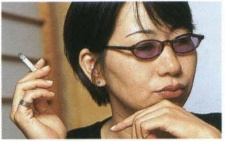
Keiko Nobumoto
Hey, who is this "writer" that Kanno felt she could musically overrule? That would be the incredibly talented Keiko Nobumoto, head writer for this series as well as Wolf's Rain and co-writer of Tokyo Godfathers. While extremely talented, Nobumoto is too slow for most producer's tastes, preventing her from developing a large filmography. On the other hand, it means everything she writes is impressive. On Bebop, she could count on Watanabe's confidence, but I'm sure the producers were pulling out their hair as the deadlines fast approached. She is one of the more mysterious of the creators, I can't find any interviews with her at all.
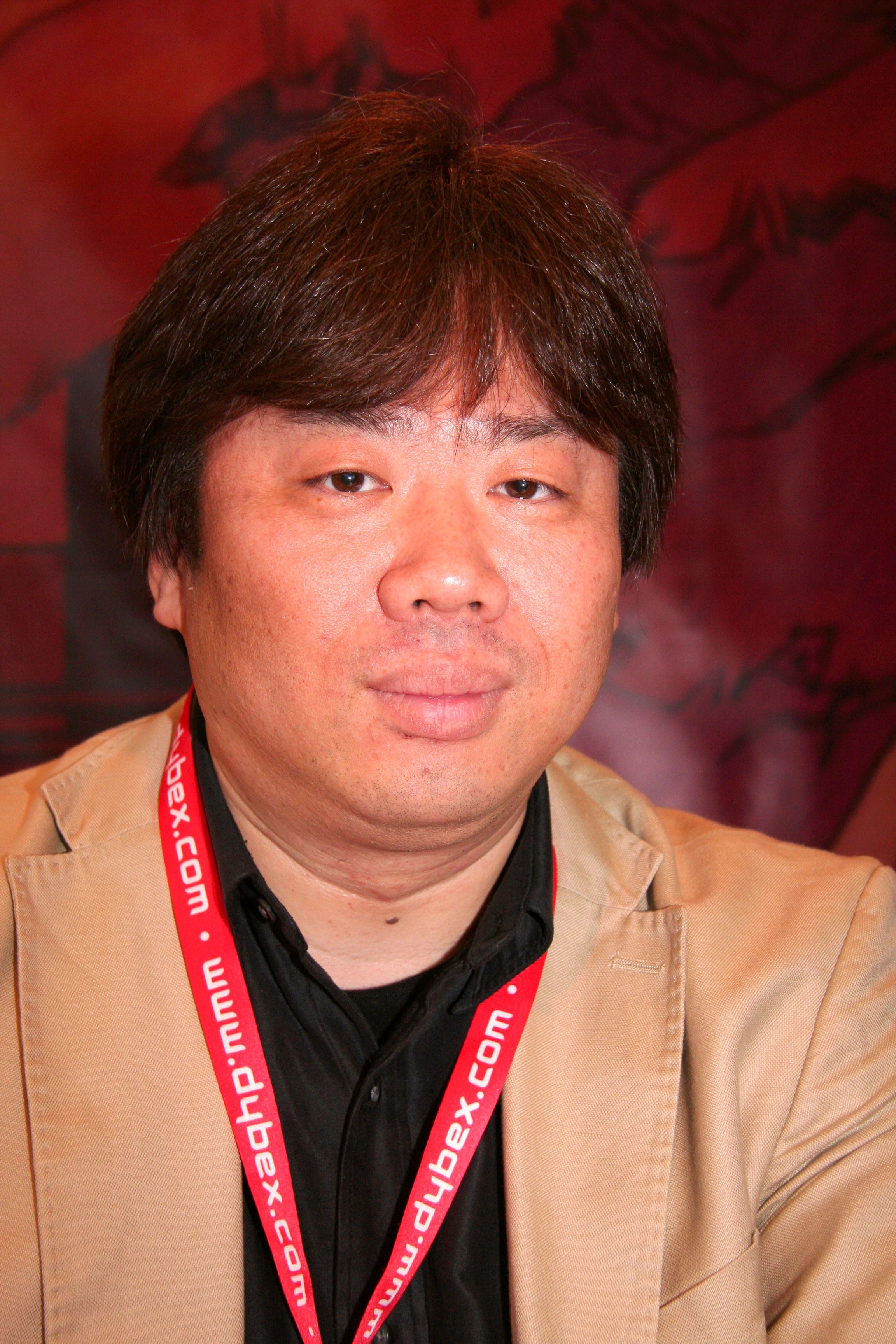
Toshihiro Kawamoto
Character designer Toshihiro Kawamoto was brought into the production after it was greenlit by Sunrise, so fairly late in the process. He also did most of the promotional artwork, so you know he's a very talented and stylish artist. In addition, his artbook is a key behind the scenes resource for me. I'll be talking about his approach to character design a lot, but I'll wait until the characters show up. Kawamoto would go on to found Studio BONES in 1998, using money earned from Cowboy Bebop The Movie with two other Bebop employees to create a more artist oriented studio. BONES made Space Dandy, which to me seems to return the favor.
Now that we have met much of the core creative team and reflected the way it came to me, it is obvious that only the third choice could work. I have to dive in and see Bebop myself. And I will...
Next time. See You Space Cowboys!
Thursday, January 14, 2016
Back In The Republic Of Poland
Anyway, now that I've offended my Polish neighbors (yes, i am aware that Poland has been independent for decades now), it's a good time to start blogging again. It wasn't obvious from the way that I wrote, but I did a lot of research for the last posts. I think I need to blog a little more lightly for a bit to get back into a rhythm. I was on a roll for a while.
.jpg)
Navel Gazing
Personally, I'm annoyed right now. I can't get into contact my landlord, who has my mail. Even when I reach her, it's still going to be hard to convey I want my mail - I don't speak Polish. I don't have a lot of free time, but I also don't have a lot of distractions. I'm not playing tomcat anymore and I don't have a TV. So I have more time than I would have had back home. Also, I'm having a hard time nailing down a sleep schedule in the Warsaw winter. I really enjoy the winter though. I like the snow and the cold. It's invigorating!

Steven Universe
A friend who knows that I like animation recommended that I try the animated shows Steven Universe and Gravity Falls. I chose SU because it looks a little bit more like Space Dandy. I've watched the pilot and the first two episodes now. They were all good! Sometimes it seemed like they drew "wacky faces" because they weren't confident in what emotion to convey. Also, every episode has a difficult balancing act of having a coherent plot, reveal new things about the 'verse (as hep cats say ... we still say that right?), hit the right emotional notes, look cool and be a comedy all in 11 minutes. Sure, Space Dandy can pull off a balancing act like that, but it 22 minutes and was directed by Shinchiro Watanabe. Still, the show seems fun. I will probably be blogging my reactions to future episodes as a way to get back to producing content. People can point and laugh for my ignorance at the show, also they can mock me for being an adult watching a kids show. This content is going to be daily, so that I get used to coming this blog. Expect the first entry Saturday or even tomorrow (depending on how a planned meeting with a friend goes - if it goes well, Saturday).
:format(jpeg):mode_rgb():quality(96)/discogs-images/R-422614-1346030723-2470.jpeg.jpg)
This was drawn by the character designer. Watanabe gave him the instruction "Draw it as if it was one of those foreign movie posters made by someone who has clearly never seen the movie.".
Furthermore, I'm going to be rewatching my favorite show, Cowboy Bebop. These reviews will be more in depth, scouring all the English language resources I can to give a total picture of this great work of art. Character designer Toshihiro Kawamoto's Bebop art book is translated and has a lot of behind the scenes information, like the factoid posted above. Plus, The AV Club's retrospective stinks on ice. No schedule for this series.

If I finish that, maybe I could do Ren & Stimpy, the great proto-punk cartoon. John K is an inspiration for me, he's why I took up drawing as a hobby. I even bought the Preston Blair book, which I love by the way. But we have to look at the real show with all of its flaws, not the Platonically perfect one that exists in his soul (otherwise Glen Or Glenda? would be the greatest movie of all time).
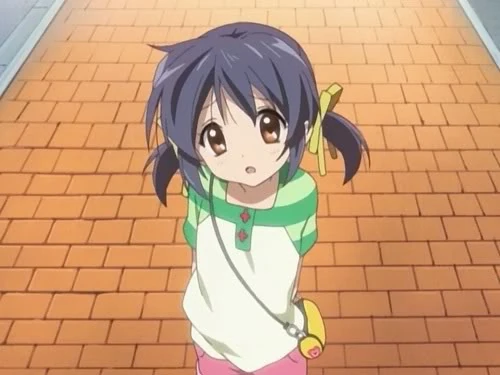
"But, what about IIATSTIEPW, CT?"
Thanks for asking. I'm gonna try and promote that to a weekly series starting next Saturday. I work this weekend (yay), but if I plan a little and do the research (which is really just checking to see if I have the math I don't write correct) before I write instead of writing it in a huge marathon, it'll be less taxing. Yes, real physicists, I know what I was writing was trivial. But I needed to be sure it was correct in every detail - especially the ones I elided. It's a quirk (and why I can't work as an economist :P).
I have many other detailed ideas for posts. A critique of Ronald Coase (brilliant, but devious) and a comparison of a paper by Armen Alchian and one of Paul Krugman on evolutionary economics are two. The critique I have of Coase is really obvious, but I've never seen anybody make it, which makes me wonder how many people are actually reading these papers. Am I the weirdo? Maybe it is because Coase is so obviously right on some things and so completely blind on others. Anyway, big carefully thought out posts are always and everywhere on no schedule, got me? Always and everywhere.
Future plans: I'll be in Portugal this summer for the COST Action Flowing Matter conference! I'm going to try to take a train, I've never done that! How exciti-... wait, that's the zloty/euro exchange rate? Oh travel, you never fail to be overcomplicated.
I have no plans to write better so feel free to continue to not read.
Be Seeing You!
Subscribe to:
Posts (Atom)