Monday, May 9, 2016

Cowboy Bebop Review #5: Ballad of Fallen Angels

Personal Note: Yeah, I haven't blogged in a long time. During this time I had to do a lot of attention consuming work, navigate several international bureaucracies and generally put my life in order. Reviewing Bebop has also inspired me to try to get back into art, and I'm trying to learn animation from the good ol' Preston Blair book. I'm returning because I want to though, and so you should expect more activity.

"I'll play it and tell you what it is later."
- Miles Davis

So, this is a difficult review. Somethings are so legendary that they say more about you than you can say about them. Citizen Kane, for instance. It's a great movie and there is a ton to say about it - how it used simple special effects to hit way above its budget, how it inspired so many different filmmakers to believe that you didn't need a ton of extras to make a movie, its brilliant writing/acting/music...

But that's all been said. There are plenty of other examples - Miles Davis's Kind Of Blue, Super Mario Bros. 3, the best Shakespere plays, the best cartoons of Bob Clampett - things that just stand above everything else in a manner so natural that it is strange that they used to not exist. When you try to critique Shakespere, you just end up condemning yourself. SMB3 is just how good platformers feel damn it all! And so on.

Session #5 of Cowboy Bebop, "Ballad of Fallen Angels" is like that. Written by Michiko Yokote, storyboarded by Shinchiro Watanabe, directed either by Watanabe himself or Tetsuya Watanabe (both are credited), this episode is one of the all time classic episodes not just of Bebop but of anime. I once said of Relaxin' With The Miles Davis Quartet that if you don't like it, jazz probably isn't your thing. There's nothing wrong with that - find something you do enjoy! If you don't like this, probably don't bother with anime - at least not at the more dramatic stuff. I don't mean that in an exclusive way, you were game, gave it a shot and you can now live your life without regrets.

Spike Spiegal

Now, technically, the story of today's episode stretches all the way back to episode one. The montage of violence episode was the first glimpse of The Spike Spiegal Story, which is the Official Main Plot Of The Show (TM). Bebop is at its most interesting when riffing far beyond the normal routes, but it does to set up what is going on. The OMPOTS comes back again today

Vicious

That this episode is going to concern Spike's story is actually a twist in the cold open - one of several. Sorry about that. The episode starts with Mao Yenrai of the Red Dragons and Carlos of the White Tigers signing some sort of peace treaty. The Red Dragons are a powerful Triad and Mao is happy to have finally made peace. As you can see above, a character named Vicious ruins it - blowing up Carlos's ship and personally murdering Mao. Mao's dying words reveal that Spike, Vicious and Mao have a long history. This is a very well made scene with lots of big, neat shots and good use of editing.

We've talked about Spike, so let's talk about The Black Bird. Vicious's black bird is obviously inspired by Captain Harlock's similar pet. The overall concept of Cowboy Bebop was influenced by Lupin III and it doesn't take a detective to realize that Vicious evolved out of Goemon from that series - especially if you know that Goemon was originally one of Lupin's enemies. Similarly Spike is somewhat based on Lupin, Faye has some similarity to Fujiko and Jet has a couple of Jigen's traits. None of these resemblances are very close. For instance, when Goemon was a bad guy, he was a hot blooded over-actor just like all of Monkey Punch's characters. Vicious is a stone cold, stone faced killer, we've already seen this. We don't know much of his personality yet but I'll leap ahead a bit and tell you that Vicious is obsessed with betrayal and Darwinian conflict. He is very much for both.


Back on The Bebop, Spike & Jet discuss the situation. The Bebop is a boat/spaceship like the Arcadia, but less awesome. This is the first time that Spike & Jet have a serious confrontation. Yes, they disagree constantly, but this is less jovial. Jet wants out of the latest bounty scheme - he smells a trap. The information is too easy, if such big money was such low hanging fruit somebody would have scooped it by now (he doesn't say this, but it is implied). He's right, of course, but he doesn't know about Spike's connection to -

Oh hey, it's Faye. She has a bunch of bags, clothing bags. She walks in on the fight and tries to get caught up on what is going on by asking perfectly reasonable questions - which annoys everybody, including herself.


 Watanabe's storyboard/direction involves a lot more acting than others, there's a lot of complex non-model sheet expressions in this episode. Faye is particularly funny here. After the boys leave, she gets a hot tip from a violinist tells him that Mao is going to see a showcase at a theater. Faye wasn't present for any of the research that was done, but decides to gamble on swiping the bounty from her "comrades" after drawing a lucky card from a deck that Spike was playing with at the beginning of the scene.


The theater has a bunch of great stuff! First Faye parks like a complete jerk, then when she goes inside we see a great array of new background characters


The fat cat with the cigar is very Lupin III, and look at the neat dress on the purple girl to the right! This show spoils us. Faye is deliberately acting annoying on the theory that if she does people will assume that she has a reason to. Unfortunately, as Jet pointed out earlier, this is an obvious trap. Perspective is used very well in the scene on the balcony. Several shots are made from the perspective of what we already know to be Mao's corpse, which doesn't make sense. Only after the scene shifts to Faye's perspective and we see where Vicious is standing to the other shots make sense from a perspective ... perspective. They were what Vicious was looking at! This is obvious, of course, but it makes you realize how much less thought out shots are in other shows.


As Faye walks into Vicious's trap (in her defense, she was kept out of the loop that would have made the trap more obvious) Spike goes to meet a contact. Some kids try to shoplift dirty magazines from a store. Interesting trivia, the black kid's character design was recycled from an early concept for one of the leads! A character that hasn't been introduced yet, though. The dirty magazine girl is labelled Judy. Though the "Judy" character from Big Shot has blond hair and the girl in the centerfold has brown hair, I wouldn't be surprised if they weren't trying to imply she was an ex-gradol. It would be typical of Bebop's subtlety.


I don't know to what extent I can or should continue recapping the plot, since it becomes very suggestive here. Spike and his contact Annie talk, but they know each other and don't feel the need to expodump for the audience's sake. For the plot of the episode, the only important thing is that Annie knows that Mao has been murdered, foiling Vicious's plan to flush Spike out by leaving a bread crumb trail into traps. Meanwhile, Faye is captured.


That Shinchiro Watanabe can't do anything without tying someone to a cross. Well, you'll know that if I ever finish these reviews and go to his other stuff. Faye doesn't take the whole kidnapping thing seriously - in fact, she reacts pretty much how Fujiko does in Lupin III. She gets kidnapped a lot, Fujiko, but - HUGE SPOILER ALERT - Faye doesn't make so much of a habit of it. Faye asks for help and to her shock gets it. It makes you wonder what was going through her head. Did she really think Spike would leave her there? Well, they don't know each other very well yet...


You remember I was typing just a few paragraphs ago about how imposing this episode was to review? How much of it has become iconic, not just of the series but of the genre? Well, in particular the rest of this episode is like that. It's so big that it can be difficult to write about. Perhaps I should talk about the color, which is more stylized here. It is interesting, Bebop is such a well colored show that nobody ever bothers to mention it. It's stylized and often dark, but never does it succumb to what John K calls "piss & shit color" syndrome. In other words, it doesn't dull the colors down. Look at the church above, it's purple! Real churches aren't purple, but it matches the scene so beautifully. Go back to the part where I talked about the guy with the cigar and look at how that opera house is painted. The biggest anime of 1998, the year Bebop came out in Japan, was Cardcaptor Sakura - based on the hit CLAMP manga. It looked like this:


Well, it doesn't usually have YouTube crud around it. But look at how much more flat the colors are compared to all the other screenshots of this post! I don't mean to pick on this show. If you want a cartoon to watch with a little girl that doesn't make you want to kill yourself, Cardcaptor Sakura should be high on your list (other choices: Powerpuff Girls, Unico, I've been told My Little Pony is better than it sounds...). The manga is the best thing CLAMP ever did and they know it. What I want to say is that this what a show with a good budget and large audience looked like - colorwise - in 1998. Oh, and there are limited palette flashbacks coming up, they're real neat.

Oh, and the music. When Spike approaches the church, knowing it is a trap a song plays called "Rain". It's actually a demo version - the intended final singer has a throatier voice and more gospel interpretation, but Shinchiro Watanabe and Yoko Kanno seemed to decide that the purer voice was more appropriate. Yoko Kanno's first musical memories were of playing an organ in church. Obviously she's playing the organ on this track, but she's also - through the miracle of multitracking - the choir on the even more iconic "Green Bird" that ends the big scene.

So, Vicious and Spike talk for a bit and one of Vicious goons tries to talk down Spike by using Faye as a hostage. Spike, channeling Dirty Harry in Sudden Impact doesn't deescalate the situation. In a waaay later situation, we'll see an even more obvious homage to that scene. Then, right on the last organ note of "Rain", right where Sergio Leone taught us to put all gunpla

BLAM
And the network complained this show was violent...

So, this sets up a huge shoot out in the church, John Woo style. Once again the production team comes up with numerous interesting faces and characters where they really could have just had generic thugs. I particularly like gangster Black Jack here:


Of course Spike takes these guys out and then fights Vicious. Faye escapes and calls Jet, who is taking care of his small forest of Bonsai trees. He seems to actually get the message of Bonsai and leaves to help them. Then, the most famous montage in anime history happens, capping the most iconic part of this most well known of episodes. When Spike is falling, attention is paid to his right eye - which has symbolic significance to him, but the first time viewer won't know why yet...

Yeah, there's those limited palates

I won't say much about the flashbacks. One is that there is only the one tall blond woman in the flashbacks and you will learn her name, Julia, later. I once had a friend that was completely confused until I realized that he thought all the blond women were random people in Spike's life. The other is that similar flashbacks are in every episode in the form of the end credits. Knowing this will probably help you get a pretty good grip on that pesky OMPOTS despite Watanabe's "show, don't tell" aversion to adding too many words to things.


Spike survives this confrontation with Vicious, presumably scraped off the ground by Jet. Faye is waiting by his bed. Usually this is played romantically, but Faye ruins it by demanding to be thanked for her presence and Spike double ruins it by complaining about her presence. Faye's attempt at not-stomping while stomping off after this is hilarious. The episode ends with Spike contemplating the same ambiguous card Faye drew earlier.


Obviously, this episode ranks as one of the all time greats, not just in the series but in the entire genre. With a well thought out plot, naturalistic acting, great action, brilliant art and wonderful music how could it miss? One of the great things about Bebop is its restraint in keeping its hands off the OMPOTS to keep its lead genuinely mysterious. So we aren't going to see Vicious or the enigmatic Julia again until the halfway point of the series. Well, if you think that overly detailed narratives are the hallmark of high art, well there's always Bleach for you. Still, I'll give a quick preview of what to expect. For the next three episodes, Watanabe explores more early Bebop - mostly bounty driven episodes around the core power trio of Spike, Faye & Jet. Some people think Session 8 is where the show really found its voice. That might be true, but the cast won't fill out completely until Session 9. Beyond that lies an even more interesting and artistic series. I hope to bring it to you soon!


Wednesday, March 30, 2016

Learning, A Physical Metaphor And An Economic One


One can say honestly that the vast majority of learning is linear or nearly so. But there are also points, one might call them "phase transitions", where suddenly progress becomes suddenly easier - or suddenly much harder. I remember reading a story about a jazz musician (I don't care to look up the source so I will not give his name, even though it is Charles Mingus) who was learning to improvise for the first time. It was himself on a cello and his sister with a piano playing a song of his own composition. His part was a single note - a pedal point. Suddenly, at the end of the song he had a break and played notes and notes that had never been written. His mind was empty except for the sound of the notes he played. It was hours of work - not hours but days and weeks - to culminate in what was probably thirty seconds of improv. But it was a phase transition, he was a different being afterward.


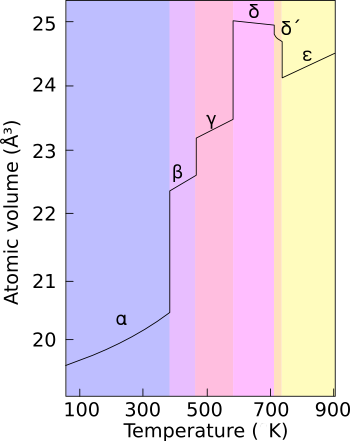
Learning is multidimensional, of course. At some points, altering in one dimension is pointless. In the above graph, one can see that at 1000 K, plutonium will not change phase at any reasonable pressure. Even in common sense you can see that if the temperatures is low enough, ice will not melt or sublimate whatever the pressure is. Moving constantly in the same direction can be a trap.

So it is with learning. After "phase changes" one finds that practice in one sense no longer might help. A beginning artist might learn much from copying other artists - even tracing them. Albert Ayler was called "Little Bird" because he was constantly practicing Charlie Parker solos. He got to know them so well that he could literally play them backwards. This was probably good practice for the young Ayler, but I doubt he was doing it in 1964.

Friedman-Savage Utility

Milton Friedman was originally interested in micro-economics. He, and the great Bayesian Jimmie Savage, tried to solve two economic problems with one stone. They worked together a great deal and wrote this classic paper. First was the question "Why do people buy insurance and lotteries?", the second was related to the distribution of wealth in society. This is a brilliant paper that everyone capable of understanding it should read.

Friedman and Savage proposed that the level of risk tolerance is dependent on wealth in a non-monotonic way. There were to be two inflection points - "phase changes" one might say. The poor would be risk-averse in order to sustain their lives, the wealthy would be risk averse out of lack of need to be otherwise. The middle class would be risk loving, perhaps out of a desire to get up to the upper class. This is only the simplest of possible Friedman-Savage functions, one can drop unlimitedly many phase changes in order to create as lower, upper and even middle income traps as desired.

There is an obvious similarity between this and learning. Wealth is perhaps practice time, Utility perhaps skill. In Silver Screen Fiend, Patton Oswalt describes stand-ups that remained in Virginia, telling the same stale jokes every week. It's a low skill-level trap. They were too risk-averse to take a bet that might make them mediocre - or perhaps even great. George Starosin - as clear eyed about old pop music as any man should want to be - defending, while defining his utility function, the idea that no great band would make a truly bad album. He is defending the idea of a high skill trap - if such a thing is a "trap" (don't the romantics tell us it is the more painful one?).

These are two metaphors for learning. I want to develop the ideas more carefully, maybe make some testable proposals. But it is nice to say it out loud and write it down - even if just as a check against madness...

Wednesday, March 23, 2016

Cowboy Bebop Review #4: Gateway Shuffle


Earlier I made reference to the famous anonymous quote "Writing about music is like dancing about architecture.". This excellent episode presents this dilemma at an even higher level. Sure, it features a couple obviously writerly elements - the Ganymede Sea Rat as an SF parallel to whale hunting - but what really makes it interesting is its directing. It was unit directed & storyboarded by Yoshiyuki Takei, a utility infielder for Watanabe (and Sunrise more generally). He delivered an episode that is simply a masterpiece of controlled montage. He uses a lot montage and wacky angles, but never loses control of those most important questions: "Whose perspective are we looking from?" and "What are we looking at?".

This episode also features tons of great acting from the subtle reserve of Spike, to the pants-on-her-head insanity of this week's bounty "Twinkle" Maria Murdock. Further, it contains a healthy dollop of interesting writing from the perspective of having witty lines and from the perspective of having an interesting plot. This week's session introduces important wider plot elements, such as the explaining more about the gates and - this bit is important - bringing Faye Valentine in as a permanent member of the crew.

And it does all this while keeping a slick, carefully controlled pace!


Today's adventure begins with the luckless but wily Faye Valentine out of gas, drifting around Jupiter. It's funny that she should be out of gas. It's almost like she isn't used to spaceships or something...


Anyway, a spaceship flies past, and then is destroyed. This gives us our first chance to see the monosystem that makes the core of small spaceships in Bebop. A dying man gives her a mysterious package inside. Of course, the best use of this plot device was The Good, The Bad And The Ugly, but it was old even then. It's funny how Faye lies to herself even when there's no one else around to hear her.


Meanwhile, Spike & Jet have tracked a bounty into a fancy restaurant. He's wining and dining a harem of young women and he orders "Ganymede Sea Rat". Jet describes it as disgusting, barely edible meat that is "enjoying" a spurt of popularity as a pseudo-delicacy. The obvious parallel is, as mentioned before, whale meat. Not particularly suited for Japanese tastes, whale meat was once only consumed by desperate fishing villages. Someone had the bright idea of claiming it was fancy solely on the grounds of it being old, and now Japan still hunts whale. There is really no logical reason to keep hunting these sea rats, gaudy rich people will move on to a new delicacy soon anyway.

Maria Murdock is so old she has lines on her neck

But just because a position is logical (whatever that means in politics) doesn't mean its espousers are. And that's how we meet the cult of "Twinkle" Maria Murdock. Ms Murdock introduces a new kind of bounty-of-the-week. Asimov was a simple-minded thug, Abdul Hakim was a tough-as-nails pet thief and Faye Valentine was a slinky con-woman. They were all very different, sure, but importantly they all had the same motivation - money and its promise of freedom. Asimov - and more importantly Katerina - was going to use the money to escape Tijuana. Abdul Hakim was in a tense, difficult place with his fence and therefore probably many people. Faye has massive debts that brutal, corrupt, not-exactly-boundary-respecting casino owners can use to control her. Well, Murdock isn't like that.

Also, it probably ought to be said that Bebop sure has plenty roles for women! There's been important female roles in all episodes and not one has been similar to another: desperate dreamer Katerina, the matronly pet shop owner, the devious Faye Valentine and now Maria Murdock. Basically no similarities in design, character traits or plot role. Pretty interesting! Having a female head writer probably helped in this department. There will be more good roles for women and girls as time goes by.


So, "Twinkle" Maria Murdock's cult/environmental terrorist group goes absolutely apeshit on the guy for ordering Ganymede Sea Rat. This is told in a montage of guns firing, people dying and Murdock dancing around maniacally. Spike captures Murdock, who - uniquely - doesn't put up a fight. This scene is also very well designed, as you can see above. This is just a good shot, it answers those two basic questions and still looks cool. In a lesser show we might see this scene from Spike's perspective - isn't he the main character? Here Spike is to the side and in the background, a mysterious and dominant figure. Murdock isn't reacting to his presence, she's standing straight up and down. She's got steel in her spine, you have to give her that. And you gotta love how much depth is in this composition - the closest cultist is on the camera man's foot, Spike & Murdock are halfway into the background.

"We like PORK!"

So, Murdock is on The Bebop and Jet goes over her background. In the establishing shot of The Bebop, it moves from the top of frame to the bottom, instead of left to right as Star Trek taught us. Just a little extra effort to keep the episode visually interesting. The thing that makes Bebop great is making sure these extra moments are always there.

The Sea Warriors used to be a fairly mainstream, though sometimes tactically pushy environmental group that opposed overfishing the Ganymede Sea Rat, industrial pollution, etc. They even ate pork! But their tactics got more and more extreme and Murdock began taking over, leading to an exodus of sane members. This left Murdock with a solid core of True Believers, but not much else. Why is she so confident that Spike & Jet won't be collecting the sizable bounty on her head?

Carbonation humor, never fails

As it turns out the government of Ganymede is run by complete pussies who cave to Murdock's terroristic demands. But Murdock is no mad dog killer, she is after something. What does she have on the Ganymede government that makes her so invincible?


Perhaps it is related to that doodad that Faye got from that guy? No points if you guess this one. So Faye bumps her head

Why should she be so awkward in spaceships?

and comes aboard the Bebop, where she is welcomed with customary grace.

More really good staging here.

The scene where Faye asks for help really reminds me of Fujiko from Lupin III. For those that don't know, Lupin III is a very long running series about a clowning super thief who is the grandson of Arsène Lupin (a character from French media very popular in the 30's). Lupin III was obviously a huge influence on Cowboy Bebop, but more on the edges than directly. Spike is vaguely like Lupin himself, in that they are both beanpoles with sticky fingers. But where Spike is mature and emotionally guarded, Lupin is completely immature and wacky. Jet is like Jigen - but where Jigen is a bushy haired ex-con, Jet is a bald ex-cop. Faye here is actually very similar to Fujiko, but we'll learn about how different they are in the fullness of time. I don't want to exaggerate, Bebop isn't reducible to Lupin in any sense. For one, there's a lot more variety in Bebop. In the original comics, naming all the women "Fujiko" was a running gag based on artist Monkey Punch's inability to draw more than one sexy-female body shape. In fact, in the latest Lupin series, The Woman Called Fujiko Mine (directed by Watanabe protege Sayo Yamamoto), it's come to the point that Spike is a bigger influence on Lupin than Lupin ever was on Spike.

Thinking about it, there seems to be no parallel to Goemon. Did you know in the original comics Goemon and Lupin were enemies? I wonder if this will come up later...


So, the plot. Jet ascertains that there will be no bounty from his friend Bob, a vaguely corrupt police friend of his. As Jet argues with Bob, Spike tries to break open Faye's doodad. This is a great sequence as Jet and Spike get more and more frustrated. The camera cuts around, following Murdock's increasingly worried eyes as tries to maintain a blank expression. The acting is really good in this scene and the montage approach highlights it.


With no bounty on their way Spike & Jet decide to let Murdock go. But what's odd about this scene is that the way its composed is focused on Spike. And not in the sense that we're looking from Spike's perspective at Murdock, its more like we're supposed to be looking at Spike. And he's got this oddly ambivalent look on his face. Is he up to something?


While Spike & Jet monitor Murdock leaving The Bebop, Faye manages to escape on her own. She is a crafty one. This scene sets up Faye & Ein's odd relationship. Faye's relationship with Ein mirrors her relationship with the rest of the Bebop crew. For the next few episodes, Ein and Faye are the only female members of the crew (admittedly, that makes the crew half female).


Well, the government is shocked to discover that the mass murdering terrorist is not 100% on the level, but not so shocked that she is moving around without a hefty military tale. Anticipating this, Murdock totally Han Solos the ISSP, first moving in one direction, then drifting out in emergency pods through chaff she laid down to a net she had laid in advance. After a bit of waiting, she and her cult move take off, able to carry out their plans hassle-free. In addition to being a cool sequence in its own right, this sets up the reason that only Spike & Jet are in the vicinity to stop them.


This sets off a cool sequence where we get to see Spike's ship - the Swordfish II - use its beam weapon for the first time. Spike's ship's design is based on a WWII torpedo ship, this is the equivalent to its torpedo. Faye comes in to save the day, snagging a sweet deal to 60% of Murdock's bounty. The government decides to seal up the Murdock cult in hyperspace, leading to an epic race to escape before they get sealed in. Spike and Faye get out.


If I didn't do all this hint dropping, it really wouldn't be obvious that this scene was more than an infodump excuse/joke.

This was a very good episode, featuring excellent writing, great performances and terrific direction. I had to leave out many of the smaller things that I noticed in order to keep the length under control. This is the kind of episode that helped create the Bebop legend. It was the first episode to let Spike fade into the background, hinting that Bebop would be much more than The Spike Spiegel Show. It's amazing to think that something this good could be one of the smaller, not particularly well remembered episodes. And the next episode, well, let me tell you, that isn't one of the smaller episodes. But that's a bridge we'll have to cross later. For now,


Tuesday, March 15, 2016

Two Recent Deaths

We recently saw the deaths of two men whose impact on 20th century thought has been profound but relatively unsung. Philosopher and mathematician Hilary Putnam and mathematician/economist Lloyd Shapely were men whose penetrating and patient analysis provided the solution for many deep problems.

Hilary Putnam

Hilary Putnam was a student of the logical positivist Hans Reichenbach and from him brought many of the subjectivist, syntactical tools beloved of the Vienna Circle. However, his great mentor was the American philosopher Willard Quine. Like Quine, Putnam sought to use "pragmatism" to escape the subjectivist straight-jacket of the logical positivists. Pragmatism, in Putnam's sense, means that we commit ourselves to believe in the objects we talk about. Even if there is, in some "strictly physical" sense, only atoms & void/quantum fields/strings, this is only a factoid about some wacky definition of existence, not a deep fact about the world. In fact, we act as if we believe in tables, chairs, brains, minds, money and perhaps even justice. To a pragmatist, this "acting as if" is more real belief than philosophical handwaving. Putnam's great contribution in this area was also getting out of Quine's behaviorist straight-jacket. We act as if minds exist, so we ought to believe they do. Putnam argued that the mind could be understood as a cluster of machines in various states with complicated functions, and therefore could happily be allowed into a sensible world-view without inviting in spooks.

Through his interest in pragmatism, Putnam became very interested in forms of philosophy beyond the small analytical circle he was raised in/helped raise. The logical positivists were after an austere world view, a small number of subjective percepts could be held to exist and everything else was metaphysical. The American Pragmatists provided Putnam a way into a richer world. Through enriched world view, Putnam hoped to communicate with philosophical traditions ignored by pure positivism, even including religious thought.

This richer world extended into his teaching. Putnam's relative friendlyness to so-called metaphysics certainly provided his student David Lewis with a friendly place to develop his formal approach to metaphysics. Putnam's other students include the great logician and logicist George Boolos, the potent structuralist Paul Benacerraf and the pugnacious Jerry Fodor.

Hilary Putnam believe that philosophy should not be a quiet academic exercise separate from the sciences and from real life, and as befitting a pragmatist, lived out that belief. He was active in politics, played a key role in proving Hilbert's 10th problem undecidable and co-developed the logic checking album that was used to design the very computer you are reading this on.

Lloyd Shapely

The brilliant mathematician Lloyd Shapely was one of the fathers of cooperative game theory. In a cooperative game, groups of players can work together or against one another. In the board game Key To The Kingdom, the goal is to get the key and go to a specific square. All the players can cooperate to harry the player with the key - but such cooperation only works until one of them successfully steals the key...

It doesn't take much thought to realize that many situations are equivalent to cooperative games. Rousseau believed all of society was based on cooperative games. He asked us to imagine that we were a pack of men, women and/or wolves out to hunt meat. We could all eat hares separately and sleep with stomachs half empty. Or we could all work together and take down a stag and eat like kings. Akela, the wise wolf, wants his pack to be healthy and strong. How can he analyze this problem?

What he needs is a function from coalitions onto reward. Let's say that there are four wolves: Mom, Dad, Son, Daughter. We'll call this the set of players \( P \). Then the possible coalitions are:

$$ \emptyset \textrm{ - nobody}\\
\{ Mom \}, \{ Dad \}, \{ Son \}, \{ Daughter \} \textrm{one member}\\
\{ Mom, Dad \}, \{ Mom, Son \}, \{ Mom, Daughter \}, \{ Dad, Son \}, \{ Dad, Daughter \}, \{ Son, Daughter \} \textrm{two members}\\
 \{ Dad, Daughter, Son \}, \{ Mom, Son, Daughter \}, \{ Mom, Dad, Daughter \}, \{ Mom, Dad, Son \} \textrm{three members}\\
\{ Mom, Dad, Son, Daughter \} \textrm{four members} $$

This set is traditionally called \( 2^P \), or the power set of \( P \). The amount of delicious venison we eat is a function \( v: 2^P \mapsto \mathbb{R} \). This is called the Shapley Value Function. Analysis of this function allows Akela to organize the pack by - for instance - offering extra meat to those who contribute more, etc. With his infinite wisdom, Akela always finds a stable distribution. Note that these equilibrium distributions can obviously be unequal, as discussed before. For instance, if Father Wolf is strong and Mother Wolf is stealthy, Akela may deem it unnecessary to allocate extra meat to Daughter and Son Wolf.

The Shapley Value Function is very general. On the Wikipedia page linked above, it is used to construct a crude model of a firm. It can also be used to model a general market. The function can even be extended to when the set of players is very large so that no individual player has an effect on the whole game. This is modeled by making the set of players continuous. Integration theory then gives the fascinating result that the cooperative game optima are exactly the market optima! But this isn't just another way of writing Adam Smith's invisible hand. Combining continuous workers with discrete employers can become a model of oligopoly in hiring and much more besides. Such models are used by, for instance, Krugman & Fujita to model the spatial development of economies.

The fact that venison/utility can be easily reallocated between the wolves makes this game one of "transferable utility". Shapely also did foundational work in cases where "utility" cannot be transferred. Shapely famously this particular great contribution to economics on an afternoon dare. His colleague David Gale asked him if there was a way of marrying a number of men and women given their preferences and that the marriages had to be "stable" - no (man,woman) pair would divorce to get one another. Gale expected that if the number of men & women was large, then there would be no solution. After an afternoon's thought, Shapely showed that there always were completely stable patterns and gave an efficient algorithm for finding them! (allowing gay marriage makes the algorithm slightly more complex, but the result is the same)

Though stated in a silly way, this problem is very deep. Your computer bandwidth right now is allocated using this algorithm. The Gale-Shapely Algorithm brought Shapely into the world of "Mechanism Design", the development of markets and other methods for distributing in a stable way. This research would eventually net Shapely a Nobel Memorial Prize in Economics!


Anybody's death is a loss to humanity, but a part of them can live in our minds and our hearts. I hope that these men will be among those who will live in your mind forever.

Tuesday, March 8, 2016

Steven Universe Segments 9 and 10: The Cats Meow

These segments both sort of involve cats, but not the kind that meow.


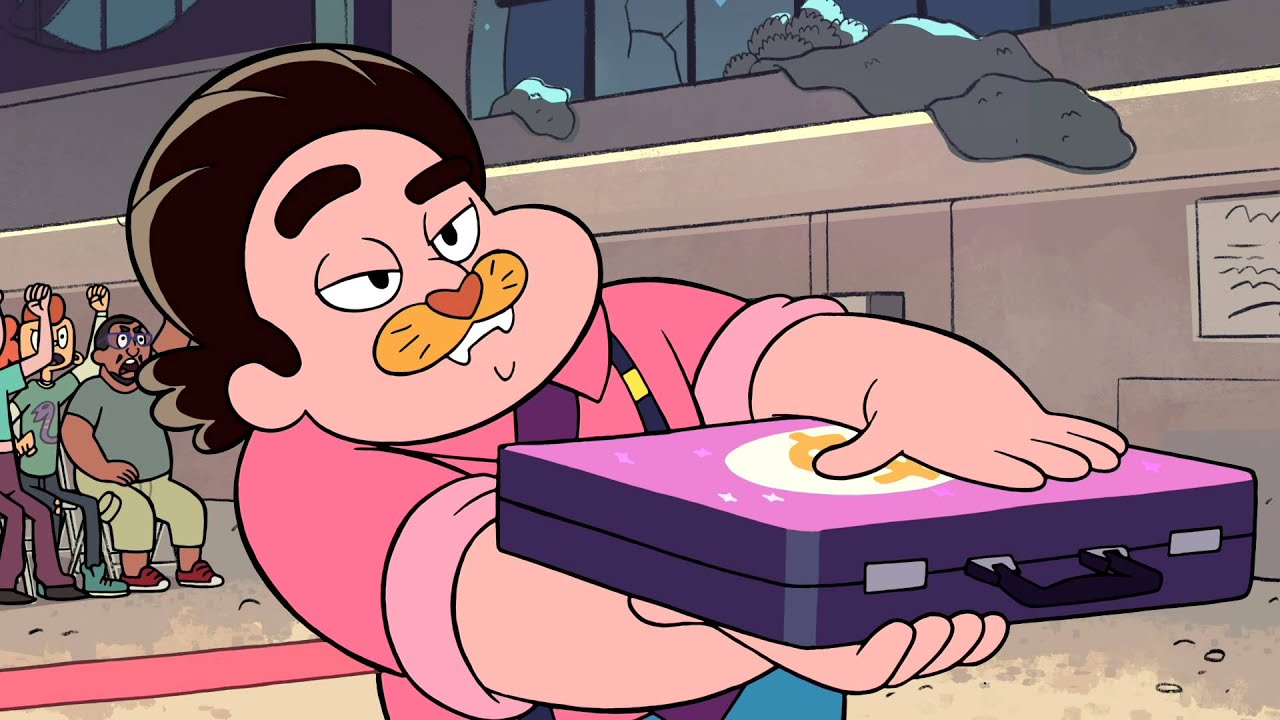
The first segment is "Tiger Millionaire", a pro-wrestling spoof. The plot is very basic. Amethyst feels oppressed so she takes it out in secret underground pro wrestling. In the end everyone reconciles and feels better. It's not readily apparent that anyone on the production team "knows a wristlock from a wristwatch" as the old saying goes. This illegal underground wrestling organization is so cheap that they can't even afford two announcers. I say it's illegal because it is taking place in an abandoned factory, but is it? Why would Sadie attend an illegal bloodsport? If it isn't illegal, why isn't it somewhere normal, like a gym or a high school?


Steven's wrestling persona is Tiger Millionaire, who is sort of a fusion of Tiger Mask and the Million Dollar Man. Well, mostly he's an under-the-top version of The Million Dollar Man (wrestling doesn't do the subtlety thing). Amethyst is the Purple Puma, who has no personality whatsoever (which is ironic). The majority of the episodes run time is spent with Steven and Amethyst pursuing the tag team belt, which is a mistake since Amethyst is omnipotent and invincible so there's not exactly much of a build up. Why should we root for them, aren't they gods taking advantage of mortals? We can't even root against them because the Purple Puma has no meaningful rivals!

Also, Steven isn't a tag team partner, as he's never tagged in. Tiger Millionaire is actually an interfering heel manager. Also, I hate to spoil the episode too much, but I couldn't get over the fact that it ends with 1) A speech referencing backstage events that the audience couldn't expect to understand, 2) faces and heels losing all definition and working to give an overpushed wrestler the belt and 3) getting the belt off of a ladder. This plot works for the viewer, but imagine all you were in the audience, you'd be totally confused. There's actually a wrestling booker named Vince Russo who used to be infamous for having matches a lot like that. It's kind of amusing if you think about it.


He did this twice a week for his adult life

The fight choreography is lackluster for an episode that is all about ridiculous fighting. Amethyst/Purple Puma's style never goes beyond striking except exactly once (she bear hugs somebody) and Tiger Millionaire never wrestles at all. Nobody has any fancy finishing moves, and considering the work Steven puts on making his character that's kind of surprising. I mean, look at Tiger Mask or The Million Dollar Man's finishers. Wouldn't it have been cool to see Amethyst do something like that. One of the beautiful things about animation is that you don't have to worry about safety or reality, isn't it? You could do spots that would make Sabu look like a wimp. Not only would it have been cool to see Amethyst or Steven do a Phoenix Splash, but also seeing Amethyst no sell someone's finisher would have been a good point to make on the whole emotional arc.

Dainty Step~

Maybe the fight choreography would be more impressive if I wasn't also watching Cowboy Bebop, one of the most impressive series of any kind in the field of fighting, but I digress. There actually is a lot of good, funny animation in this episode. Most of it involves Pearl being a drama queen. Above Pearl and Garnet are stepping onto a platform and Pearl does this goofy, exaggeratedly dainty step. It makes me laugh, but it's hard to describe in a screenshot.


The episode's biggest laugh come at the end after Pearl and Garnet find out about the wrestling thing (if you can't see that coming, I would recommend an eye exam). At one point Pearl makes the really exaggerated stance pictured above. It's hard to explain with stills why this is so funny. Reviewing animation reminds me of the old joke of "dancing about architecture".

This episode doesn't have the rushed feeling of the others, but it also feels like more of an idea for an episode than an actual episode. It hits all the emotional buttons, but it is obvious nobody really cared about the path between them. Fun but disposable.


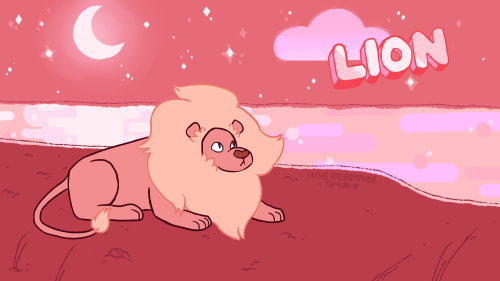
"Steven's Lion" is the second segment in this episode and Steven gets a lion. So many of the characters of Steven Universe are drama queens (Pearl, Steven, etc) that it makes you remember how funny deadpan can be. Steven's lion is a good reminder of that. The lion often seems actively annoyed at his and The Gem's sillyness.

This has nothing to do with the review, but my screenshots all came out weird, so I can't illustrate this segment really well. Just imagine there's a picture of a desert here.

At the beginning, Steven & The Gems go to the desert to do a mission. The Gems leave Steven at a small dune in the shape of a semisphere, which is impossible but not important. More important is why do The Gems leave him halfway between home and the mission. Garnet says he is safe where he is, but he could be safe anywhere in the damn world!

So anyway, here Steven meets a giant pink lion. From what I have heard, with desertification there are actually lions in the desert now, which is sad. The Gems come back having captured a gem that made a sort of temple in the desert. Apparently this is a Bad Thing, but nobody explains why this is. We just have to rely on instinct. The sandstone objects it creates remind me of the desert stage in Mario 64, and that was bad guy stuff. So we know this thing is bad. They're kind of surprised to see Steven with a giant pink lion in the desert, but they're also magical alien gems, so what you gonna do? However, the Gems note that the lion is a wild animal and therefore cannot be domesticated. But, in a twist that forever changed A Boy And His Pet fiction, the lion ... followed him home!

If the thing was working, you would see a picture of Steven and his lion in front of his house. The "some kid selling auto insurance line" was funny.

So anyway, it turns out that Amethyst didn't protect the gem they collected and Steven moronically and melodramatically throws it on sand despite having been told that is a bad thing. Nobody even mentions that Steven is being a complete idiot here, but he wouldn't be able to if Amethyst arbitrarily decided to also be stupid. Amethyst is a complete plot device in this episode. She's so mentally checked out that it's like the firebrand punk of the last episode was replaced by Jeffery "The Dude" Lebowski. Despite the fact that they defeated the gem by themselves just fine earlier, The Gems can't defeat it now. It's up to Steven and his lion to save the day!

Here there would have been a picture of Onion being really mad. This is a transition to the next paragraph.

I skipped over the time Steven goes to the pizza place because it is pointless and only serves to introduce the fact that there exists a pizza place. The funniest thing in the episode is Onion's over-the-top reaction when he thinks Steven lied to him in the pizza place scene, but it could have been cut to make room for a better reason for Amethyst to not demonstrate basic competence.

This episode is more like the previous one in having a lot of notes to hit. It hits three separate metaplot notes loud as it can: 1) there exists a pizza place whose owners are friends with Steven 2) Steven is gonna totally gonna have a lion and 3) Amethyst is "adopted" (I don't know in what sense, but it's really obvious). Unfortunately, this overreach causes the writing to squish the characters into plot devices. The episode is really carried by the lion, who provides all the best comic and action sequences. Unfortunately, he can't carry the plot and the more you think about it, the less sense it makes.

These are the main composers for Steven Universe.

I haven't been mentioning it, but there's a lot of really good music in this series. Not to the level of Bebop, but still very good. One of the songs in one of the segments was a really cool drum thing, sort of like what they did with Birdman, or M'Boom. You can hear it here. I'm glad the creator of this show decided to give music an important part. See you next episode!

Saturday, February 27, 2016

Cowboy Bebop Review #3: Honkey Tonk Woman


Warning: There are no honky tonks in this episode. Honky Tonk fans will not be dissapointed long - there is one in the episode 6.

So, this series now officially has no schedule. Being sick for a week made me realize that was gonna happen sooner rather than later. Deal with it.

For the first few episodes of Bebop, it's a much more ordinary show than the legendary series would become. I should say that it didn't seem that way at the time. Each episode seemed to be a revelation in new and different ways. But at first, every episode would have a bounty and Spike would be our unambiguous lead. This is the first episode to chafe at that structure. In addition, it is the first episode not to be hand unit directed/storyboarded by Watanabe himself - which means we're gonna finally see some off-model fun!


I wonder if this character will be important

Okay, so it's no spoiler to say today's bounty of the week is going to join the crew. She's in the damn opening credits! But it is interesting to note a few things about her intro. First off, we re-establish that Mars is the Chinese planet, as a mysterious femme fatale strolls into a traditional Chinese medicine curio. This character is Faye Valentine, today's bounty. Faye is introduced in a series of cuts that shows her body but not her face. The first time we see her face, she's turning around to fire a Heckler & Koch straight at where we were as the camera. Consider this scene from a storytelling/gaze point of view. Who are we? We aren't the Chinese medicine man, as we never have a shot from his perspective (behind the counter). We are always looking at him looking at Faye. We aren't the gangsters, as again we see them being shot at. The answer is that this scene is from Faye's perspective, just as in the last episode the opening was from Abdul Hakim's perspective. We saw in several scene's that Hakim's plans were crashing around him. We're gonna see a lot more of Faye's perspective than Hakim, and she is a much tougher nut to crack.

In the future, we will forget about overpenetration

Okay, after Faye is captured by gangsters, we meet the actual villain of the week, Gordon. Gordon is a phenomenally wealthy casino magnate/gangster/creep and he's got big plans...

Gordon's spaceship has a golden G on it. Like Trump's Ts.

Anyway, Faye is taken to Gordon's spaceship who has a cryptically threatening conversation with her. He calls her 'Poker Alice', after an Elizabeth Taylor movie (you aren't missing anything). Faye dismisses the insinuation, if Poker Alice were real she'd be more than 200 years old. First time viewers will fall for Faye's poker face - they don't know what Gordon does after all. Gordon reminds Fay of her reputation and debts stretching from Mars to Tijuana. Finally, Gordon threatens to take her to the police for her debts if she doesn't cooperate and promises to pay off her debts if she does. He makes these big promises while he gets grabby, and he's a cruel, greedy casino magnate/gangster, so maybe we have reasons to doubt his sincerity.

"Excuse me, but I'm still using that buttock."

Gordon's casino is called the Spiders From Mars, which makes more sense if you don't speak English. Spike and Jet are going to Spiders From Mars casino because Jet had a dream about Charlie Parker. Charlie said to Jet "Only hands can wash hands. If you want to receive you have to give.". Jet and Spike seem to deliberately ignore any idea that Bird thinks they should be more charitable, though I doubt charity toward Gordon or Faye would be a good idea, honestly. Maybe Parker was thinking of Ein.

Gordon is too rich to spell check the elevators.

This episode again establishes that Spike is a master of sleight of hand (or in this case, sleight of tongue) and a troll when bored. Jet doesn't let Spike gamble because ... I think a wise man once said "Spike is a master of slight of hand and a troll when bored.". So Spike wanders around the casino in hopes of finding a plot.

Odd, Jet doesn't seem the one-armed bandit type...

Are you aware that Cowboy Bebop is an amazing show? The sequence that follows is an amazingly packed smorgasbord of unique character designs and detailed backgrounds. This casino is amazingly well thought out, to the point that the slots have fully written instructions. Further, it's packed to the gills with unique characters designed to be from all over the world. It is really obvious that Spiders From Mars is a very successful casino. There are more detailed background characters in this scene than there are characters in most shows. My favorite is the German looking woman with the big nose, but pausing at any random scene here you will find fully realized characters all around you. It's amazing, but what's more astonishing is that this show keeps this up through the whole series. It's this kind of wordless storytelling, the true "show" in "show, don't tell", that keeps us coming back year after year.

In the future, we will use analog displays. Refresh rate for the win!

Okay, I've been playing good cop so far, but now I'm gonna come out and say it. Two major elements of the plot of today's episode are really weak. The plot at this point frankly hinges very heavily on Gordon just not providing a clear picture of the person who Faye is to collect this item from. There really should have been a reason Faye made this mistake beyond "Oops", but unfortunately that would have taken up precious run time. The episode is well-written enough that you might not notice this out of sheer momentum, and the mistaken identity thing doesn't last for more than a scene, but these weak spots make this episode not the series's strongest teleplay.

 Most of the off-model is minor stuff like this, but there is one instance at the end of the episode that's funny

Anyway, based on the scrambled image, Faye assumes Spike is going to hand her the episode's MacGuffin. Spike, obviously, doesn't/can't play along, so he's confused when Faye confronts him. This is strange enough, but when casino security comes in, they clearly have no idea who they're messing with. Needless to say, Spike wipes the floor with the goons and all parties decide it is time to get out of dodge. Spike and Jet run right, Faye runs left. This visual language sets up the twist that


Surprise! Spike actually planned to use Faye's escape to get out clean!

Also, Casino Spiders From Mars has a big spider on it. That's pretty cool.

So, the bad guys are really mad about this deal going south, going as far to beat and murder their courier. And somehow, I don't know how, in the negative space of offscreen time, Spike and Jet managed to talk Faye into taking them to their ship, subdue her and handcuff her to the toilet. This is the other major plot point that the show just tries to slip past you. I really don't know how Spike and Jet managed to do this. Faye may not be the physical powerhouse that Spike is, but she isn't exactly a cream puff. Again, the show relies on the emotional momentum that you believe that the characters will fall into the right place, and because Bebop is so well written in general, the strategy mostly works. I've literally never seen anyone else point this out even in critical reviews. I don't want to be too hard on the episode, which is a lot of fun. These aren't plot holes or contradictions. Obviously a 30 minute with commercials show can't be expected to show every single hoofbeat from every single angle. These are just weak points in the episode's narrative that it would be dishonest to ignore.


In Futurama, Zapp Brannigan uses the laundry room as impromptu brig. Spike & Jet use the toilet. For your next assignment, write about the strengths and weaknesses of each choice.

Faye obviously wants to be let out of the bathroom and is happy to blather anything to see what gets a reaction from Spike & Jet. She spills the beans about the chip being important. Not being born yesterday, they feed her nothing. At one point, Faye even claims to be Roma, and lets out a freedom howl and Ein joins in because that's what dogs do. It's such a real dog moment. Faye's ancestry claims are somewhat contradicted by the slightly more reliable Big Shot, which lists her date and location of birth as unknown. Finding out she has a bounty (placed by Gordon himself) relaxes the crew. Jet recalls his dream "Follow your dreams and you'll find your dream girl, Spike.". Like much of Bebop, this sentence is loaded with many layers of irony.

I will point out every time the Universal Analyzer is used, which is a lot.

Her other claim about the chip proves more reliable, when Jet pulls out the old Universal Analyzer to do the science.

"It's a chip!" he says.
"We know it's a chip." says Spike.

It's little moments like this and Ein's howl that bring humanity to the series. A baby can be loud all the time, it's dynamics that matter. Good writing is similar. Faye manages to get a communique to Gordon. She's slippery. Gordon tracks down the Bebop and crashes into it, which causes Faye to bump her head. This will become a running gag.

 It's almost like she's not familiar with spaceships or something... naaaaah

Jet negotiates a transfer of the chip back to Gordon. Obviously Gordon tries to betray them immediately. The space scenes in Bebop are always great. They convey weightlessness with real grace and use good direction to keep the general 3Dness of space in mind. I don't think I'm giving away much when I say Faye manages to slip her cuffs and escape on her own, or that Spike and Jet don't get the millions they negotiated for.

In my notes, I call this Spike's "Ted Danson Face". I loved Becker.

In the final account, Spike have nothing but the poker chip from earlier and they decide to gamble it away. A fitting in to a good episode.


And this is a genuinely good episode, despite it's flaws. Sure, it might have a bit of a complex plot for its run time, but not so much so that it rips itself to shreds or can't find time to breathe. Faye Valentine is our first bounty to not be tragic  (Katerina) or desperate (Asimov and Abdul Hakim). Whereas Asimov and Abdul Hakim couldn't think of a way out of a situation not involving violence, Faye has an entire arsenal of tricks up her sleeve. Whereas Katerina had to rely on others to make her dreams come true, Faye is self-reliant and seems to have no dreams. Though devilishly clever, she often found herself in situations she couldn't bluff her way out of. Yeah, she has the luck of a Bebop crew member alright. As we will see, the many invisible hints and innuendos in this episode will pay off as we see Ms Valentine and the rest of the Bebop crew more often.