Sunday, February 26, 2017

Vive Le Difference: A Review of From Bacteria to Bach and Back

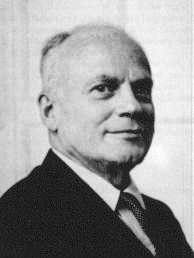
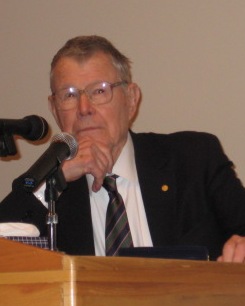
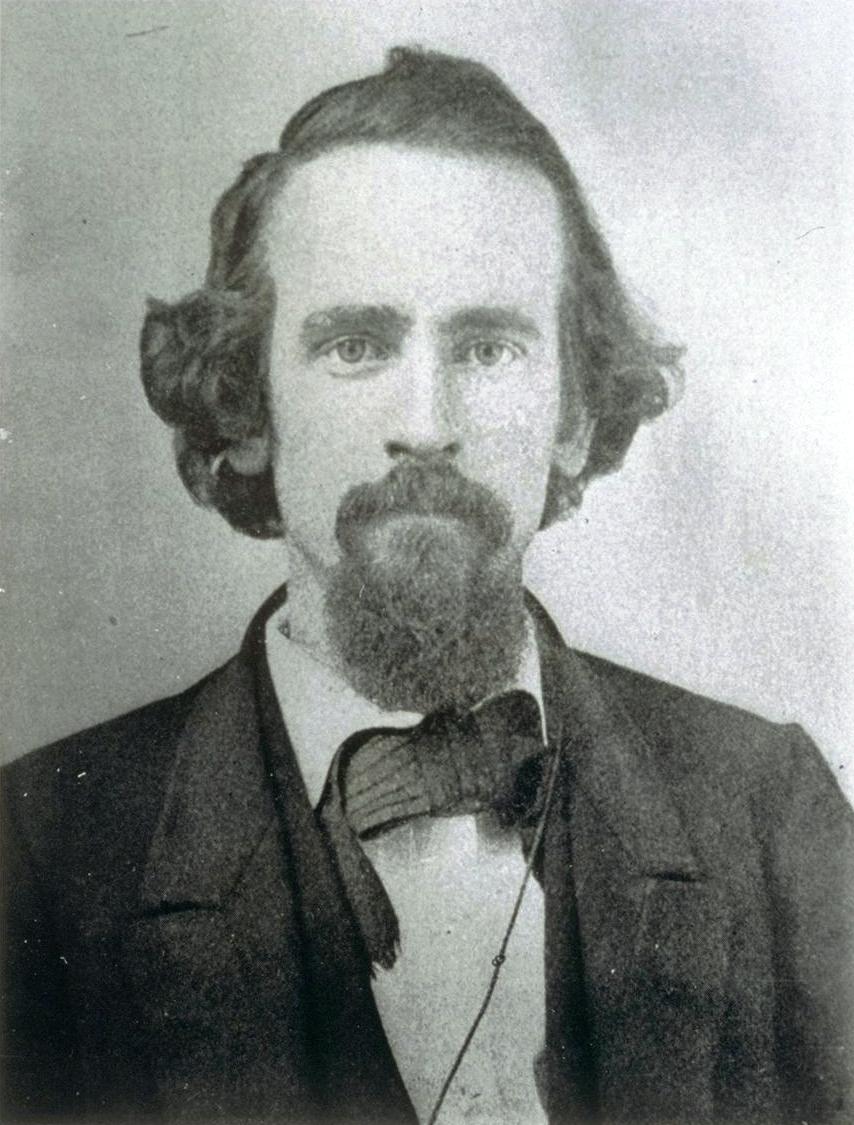
Daniel C. Dennett

In this intelligently designed book, philosopher Daniel Dennett retraces the themes of his philosophical and scientific research & speculations which have afforded him so much acclaim over the past four decades. He develops a definitive version of his account of how human culture went from blind variation - "bacteria" - to extremely intelligent design - "Bach". Dennett also takes the time to extend, revise, correct and edit his thought, engaging fruitfully with many of his critics and admirers (not distinct sets to be sure). Luckily for the reader, all of intellectual heavy lifting is set out in Dennett's characteristic immaculate prose - which alone would be sufficient for me to recommend the book highly.

You may be asking "Who is Daniel C. Dennett and why should I care about his philosophical nonsense?". The most pressing reason is that Dennett's subject: consciousness. Dennett's purpose is to protect consciousness from her suitors - both those that treat her roughly (such as the Churchlands) and those who treat her with suspicious reverence (such as David Chalmers).

Dennett's methods and tools are much like Father Brown's in "The Absence Of Mr Glass", which contrasts Father Brown's uncommon common sense with the deductive powers of a certain (in both senses) Dr Hood. Dr Hood, incredibly brilliant but primed towards certain reactions by his background, looks at an improbable scene and "sees" a murder - a single thing of great moral importance. Father Brown looks at this same scene and "sees" a series of unlikely events, each of which has no moral importance but the accumulation of which is, after all, a man's life.

In the same way, Chalmers looks at Le Penseur and sees him "thinking" - a singular act of great moral importance - but Dennett looks at Le Penseur and sees him wheeling through an enormous number of possible activities. Dennett sees that Le Pensuer might be visualizing, sounding out ('murmuring syllables under his breath' in Ryle's unforgettable essay), doing simple algebra or arithmetic, deploying models of other minds ('What would Jesus do?' or 'When my father was young, he had it worse.' or 'Batman wouldn't be afraid.') or even attempting to be deliberately mentally random in order to shake his thoughts in new directions (like the dadaists in one direction or the Chan Buddhists in another). Each of these activities may or may not have any "moral importance" for its own sake. I would be sad to lose my memories of my parents and other mentors - they have moral importance to me - but I would not be so sad to forget an obscure scrap of algebra, real analysis or biology - I have books to grab these tools should I need them. I think that Dennett's point of view - that the thick, morally drenched world is made of the thin merely physical world - is not only substantially right but even right in most details. So let's get to discussing it.

Anyone who has read Dennett knows that though he is well-versed in philosophy, he considers many of its traditions to be shackles - as full of tricks and traps as it is of useful goods. Still, it is useful to see how Dennett sits in the philosophical traditions that spawned him. Further, anyone who has even heard of Dennett knows that "evolution" (whatever that is) plays an important role in his philosophy. This has to be gone over is some detail. Finally, anyone who engages critically with Dennett can sense that his affection for "memes" are the weak link - I share this view so I want to develop what Dennett means by "meme" and what are the holes in his exposition. And because I'm polite, I'll even do this in that order.
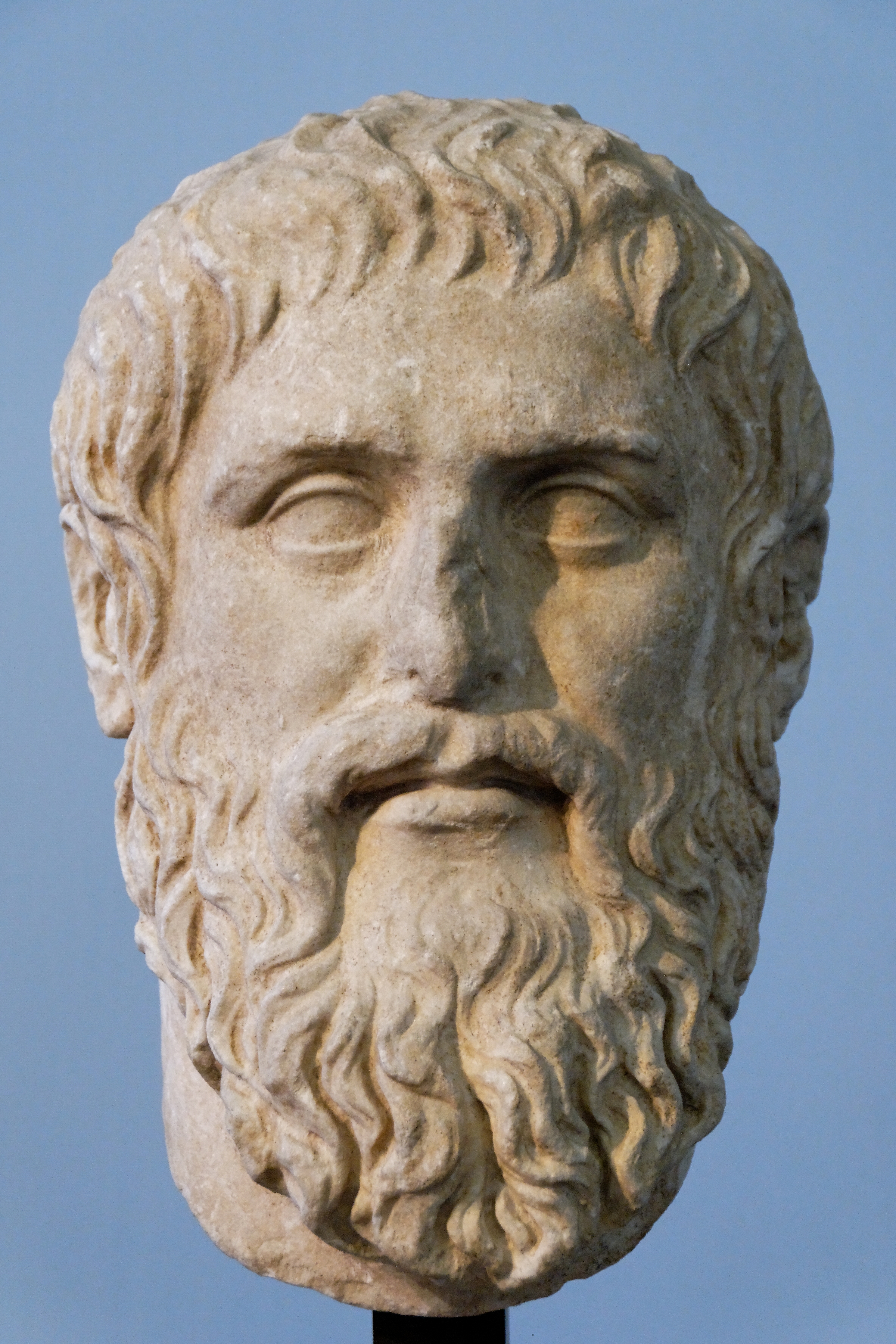
Plato

Begin at the beginning and go on till you come to the end: then stop.
- Alice In Wonderland

Daniel Clement Dennett III was born, like most human beings are, to parents. His father - whose name can be deduced from hints already given - was an OSS spy in Lebanon who knew Kim Philby and died under mysterious circumstances when Daniel the third was quite young. His mother raised him in Massachusetts & New Hampshire until he became of age. Dennett's philosophical curiosity and ability were noticed quite young. As an undergrad at Harvard, he was taken up by logician/mathematician/philosopher W V O Quine. For his graduate studies, he moved to England and studied with Gilbert Ryle, then in the midst of working on Plato's Progress.

This is the only logical - perhaps I should say reasonable or practical - place to start with comparisons, but it is not easy. Ryle and Quine were quite different philosophers. From Quine, Dennett took the idea that philosophy is continuous with science. Not over, to the side or under, but simply an attempt to use the same kind of reasoning as seen in science to a different variety of question. But Quine was interested in not just intelligently designed systems - but in incredibly intelligently designed systems of terrifying logicality. Dennett has never shared Quine's interest in axiomatic systems or in "reduction" in the sense of replacing a successful theory with another theory with one less kind of relation.

It is from Ryle that Dennett absorbed the phenomenological point of view that was the precursor to his own. What is "phenomenology"? To tell a just-so story, phenomenology begins, like all of Western Philosophy, in Ancient Greece. To Aristotle, it was clear that the point of life - the aim that one should set one's mind toward - was a life of mild pleasure, physical and intellectual. The Great-Souled-Man would have a wife, a boyfriend, wine, slaves, money, land, a lyre and scrolls. There could not be many Great Souled Men and this life of mild pleasure could not always be achieved, to be sure. But it was the goal of the state and of private life to make this possible. When developing his grand synthesis of the Greek and Christian point-of-view, Thomas Aquinas could not accept this in total. But he could accept part of it - that there was an aim to life. This "intentionality" was properly aimed at God by Aquinas's lights, not stable worldly pleasure. The Catholic priest, proto-psychologist and philosopher Franz Brentano took the concept of intentionality and made it central to the description of the conscious mind - the "stream of consciousness" in William James's famous phrase. From this environment, Husserl took the concept of intentionality and attempted to construct the entire scientific method from reflection over the object of intention. And that is what phenomenology is: the study of the stream of consciousness when it is directed at something.

But Dennett is not a phenomenologist. He has described his position as "heterophenomenology" - the study of another person's stream of consciousness when it is directed at something. As his paradigm case of heterophenomenology in his book Consciousness Explained, he takes experiments on measuring the speed of mental rotation. And Dennett is not a Rylean - Ryle's insistence that the Ancient Greeks had a realistic view of mind as a thing used for action is simply unimportant to Dennett.

Dennett shares much with J L Austin and the subsequent school of "ordinary language philosophy". Like them, he uses analysis of ordinary use of words to defuse artificial theorizing about their meaning, a deflationary attitude towards axiomatization and a belief that history of philosophy is not its most important aspect. But he implicitly rejects their conservative attitude that he meanings in ordinary language are the distinctions worth making - he proposes that experimental science from Newton to Darwin to Einstein to Gibson can and have enriched us with new distinctions and concepts, so there's no special reason to suppose philosophers cannot do the same.

Dennett shares with the pragmatist postmodern Richard Rorty a skepticism that mere "conceptual analysis" in the mode of Bertrand Russell (or WVO Quine) could settle anything meaningful and a love of deflating and differentiating. But Rorty took the fact that meaning was language relative to "explain away" the idea of truth and Dennett desires to always explain and never to "explain away" - especially not truth. For Dennett, there may be many stories, many mirrors which are true as Rorty says - but there are many more which are not true. For Dennett, biological evolution plays an important role in explaining the subjective differences experienced by humans. For Rorty differences are not things that need explaining. Further, Rorty believes passionate political engagement is terribly important, Dennett is faintly uninterested in politics except in so far as it intrudes on his work.

There is an obvious connection between Dennett and the French postmodern Gilles Deleuze - both would agree with the formula "monism = pluralism", that subjective différence is grounded in biology and perhaps more (I'm no Deleuze expert). But Deleuze accepts a primitive Freudian psychology (this is giving Deleuze credit), believed it was important to have extreme leftist politics, a faintly dismissive view of science (except as metaphor) and a deep interest in the history of philosophy. On all of these counts Dennett is opposed - in addition to the deep distinction between Dennett's clarity and Deleuze's unclear style.

Dennett's greatest philosophical influences (except for Ryle) are certainly Wittgenstein - like all post-war philosophers - and Wittgenstein's student GEM Anscombe, who was the first to subject intentionality to a withering Wittgensteinian criticism. But Wittgenstein and Anscombe do not really form a school - not one bigger than themselves anyway - and even then Dennett does not share their dismissive view of experimental science.

One can see from this brief survey that Dennett is not precisely in any school of philosophy - other than generally "the guys what study the mind". So what is Dennett's story? How does he go From Bacteria To Bach And Back?


All stories begin in the middle but some middles are very far away. I'm going to be very vague - for more information see Maynard Smith and Szathmary's The Major Transitions In Evolution. Before there were living things there were autocatalytic reactions, which I will call "circular processes", since they go from state A-> B-> ... -> A. One example is the RNA replication proces A->B->A. Any such circular process is provably impossible in or near thermal equilibrium, so these process must have been receiving energy. From the sun, from heat vents, from other chemical process, from the churning of tides, etc. To the extent that these differences in energy source etc. are perceptible, different theories become testable. One example of a thermal process would be a chunk of RNA - a ribozyme - that organizes another chunk of RNA to grab an atom of iron then stick it near an oxygen molecule. The iron would then oxidize and heat would be released, creating energy that the ribozyme could then use to reproduce itself. This ribozyme would be respiring - it would have a metabolism and heredity. Of course, if it was too good at making heat, it might want to be near another ribozyme that does nothing but take in heat and reproduce itself - that second ribozyme would help the first by dissipating heat. The balance between active respiring ribozymes and passive heat dissipating ribozymes would be spatially asymmetric - too many passive ribozymes and there won't be enough heat, too many active ribozymes and there won't be enough oxygen. A rybozyme can have some control over what rybozymes they are near by, for instance,  literally linking together. These RNA strands are the precursors to life as we know it.

These RNA strands are differentiated - they have different chemical properties. The differentiation between long RNA strands is potentially infinite - rybozymes are non-periodic crystals. As noted earlier, ribozyme -> ribozyme chains of creation can be circular. As they respire, they therefore have a metabolism. Finally there are (chemical) laws that govern the relative density of their activities - there are combinations of rybozymes that do well (replicate) in their environment and those that do poorly (run out of energy or build up so much energy as to disintegrate). Non-periodic difference, circular replication and blind selection are the building blocks of "natural selection", Darwin's most important contribution to the theory of biological evolution. If a rybozyme tends to be attached to another rybozyme, their fates become linked, so that they are the first "genes" and the RNA strands the first "organisms". After this, the second "major transition", to use Maynard Smith's terminology, was the discovery by a ribozyme that it doesn't have to create energy for catalysis via other rybozymes, but could use a more chemically active amino acid. Once the amino acid was discovered, the ribozyme became the ribosome - no longer a laborer but a capitalist. They would hold the knowledge capital of which amino acids to choose, the amino acids would create the proteins and the proteins would create, among other things, ribosomes. Again, a circular process is achieved and evolution by "natural selection" occurred.

Dennett now skips in the story with a mere "and so on in that fashion" all the way to the most recent major transition of evolution - the invention of language. I think Dennett feels he has covered this territory in other books, however I still find this disappointing. The distinction between the cell - with its milieu interieur - and the naked ribosomal process is not merely thermodynamic (though it is rooted in that) it also fundamentally altered the law of motion (it is the forth "major transition in evolution"). The primitive bacteria was just a bubble of protein protecting an RNA strand or two - letting in a bit of raw materials, keeping out harmful chemicals & foreign RNA. It would have been very useful to compare and contrast this first evolutionary discovery of an milieu interieur with another one - the discovery of the mind. But I digress.

Language starts - in Dennett's story - with a discretization of knowledge in order to make it transmittable. This is called "signalling". Discretization is a trick that evolution has been forced, by Pontryagin's Principle, into over and over again (unfortunately, Dennett does not use Pontryagin's Principle to explain the repeated discovery of discretization). The simplest way of remembering Pontryagin's Principle is that the shortest path between two points is teleportation, but if this confuses there are plenty of stories to be told with it. Let's look at a bacterium. It wants to stay a certain temperature, not too hot and not too cold. If it's in a temperature gradient, then it should head in the direction of the temperature it prefers. By Pontryagin's Principle, the best way to do this is to go as fast as it can in the right direction, then stop entirely once there. The control is digital - not because it is made of digital DNA/RNA/Protein parts but because that is the best possible control.

With signals discretization starts all over again. The first chemical signals between ribozymes looking to cooperate might have been single ribozymes. The same discovery might have been made by ribosomes looking to cooperate by sending out amino acids. In either case, an arms race would have instantly taken off, with signals becoming more complex so as to be more difficult to fake. Cells can also gain from cooperation - those signals went through the same arms race. Organisms may desire to cooperate - once again the arms race takes off. By the time hominins began evolving, it's probable that they had - if anything - overly complex signal making apparatus. We cannot assume, for instance, that voice box moved in the throat that this was for "language".

But what is a language? A language is a signalling system - a structure capable of making and translating incredibly complex signals. Some of these (such as words) have a certain structure, others (such rude hand gestures) do not. Those with a logical structure are considered language proper, those without are mere signals. Language and signals are both used to transmit information from the speaker to the listener. The words of language have meanings (somehow) and the sentences of language can be - among other things - true or false.

The study of the structure of language is called "linguistics".

The study of the structure of truth values is called "logic".

For Dennett, the study of meaning in language is (a special case of) "memetics".


Science must begin with myths and the criticism of myths.
- Karl Popper

If it is anything, the study of "memetics" must be the study of the "meme". The prototypical meme is the word "meme", intelligently - or not-so intelligently, as he has come to regret its use - designed by biologist Richard Dawkins in his book The Selfish Gene. This is confusing, so I'm going to look at another, less loopy case - the speakable term "macro".

You might think that "macro" is descended from the Ancient Greek word "makros" meaning long. This is a mistake. The speakable term "macro" is a collection of phonemes. It is not the phonemes ˈmæk.ɹoʊ because in England, Russia and South Korea it is pronounced differently but identifiable as the same. A US economist can say ˈmæk.ɹoʊ.iː.kə.nɑ.mɪks and a UK economist can say ˈmæk.ɹəʊ.iː.kə.nɑ.mɪks with no loss of meaning. They can talk about a procedural macro or a keyboard macro with perfect understanding. Further, the speakable term "macro" isn't an instantiation of a collection of phonemes. It could be, by a remarkable coincidence, that nobody on God's Grey Earth spoke the collection of phonemes "macro" on the 26th of February 2017 at 17:00:00.00 at all, but the speakable phrase "macro" didn't go away. The speakable phrase "macro" can be a word (as in the shortened version of macroinstruction) or a part of a word (as in macroinstruction).

Dennett argues that what "macro" is must be a kind of meme. A meme is a mentally representable distinction. Not all memes are speakable phrases (what Dennett, with some imprecision, calls "words"). Colors are memes or perceived through memes (depending on how you want to define things). To you and me, the sky and the sea are blue - to Homer the sky is sun bright and the sea is wine dark. The sky and the sea didn't change their electromagnetic frequency, what changed is the distinctions that are made.

But this isn't enough. That there are mental distinctions is unavoidably true, what Dennett would mean when he says "macro" is a meme is that it is a small collection of mentally representable phonological distinctions that is in competition with other small collections of mentally representable phonological distinctions. Now that we understand that "macro" is a mental distinction, we can talk about what it does to its users. When early programmers call something a "macroinstruction" they meant that it was an instruction that was large - large as in made of many instructions. This was not the only possible speakable term. The meme "macro" was in competition with, for instance, the meme "meta" (which is also a speakble term). It is equally descriptive - in the given intellectual niche - of macroinstructions to call them metainstructions - instructions made of instructions. One can easily imagine that "meta" may have actually fought against "macro". Its possible that at sometime in the 40's or 50's, two distinct engineers developed the same idea - one calling it a macroinstruction and the other a metainstruction. In another possible world, metainstruction won and we talk about syntactic metas and there is a constant struggle between users of vi and Emets. The vomit puns in this struggle alone wouldn't be worth it.

We can now return to the loopy "meme" meme case if we want. The phoneme "meme" was chosen more or less intelligently by Richard Dawkins with more or less the meaning I have given it above. But the speakable phrase doesn't care about Dawkins and quickly found a new niche. The speakble phrase now also means Internet memes. The meme "meme" is selfish and cares not one whit that this isn't its intended place - no more than a gene instantiated in Dawkins's body cares one whit about Dawkins's desires.

There are two objection to memes that are left undeveloped by Dennett in From Bacteria to Bach and Back. He points out that most of the objections don't hold water. Dawkins can intelligently design "meme" and Ragnar Frisch can intelligently design "macroeconomics". But so what, farmers have intelligently designed chickens - flightless birds - to have gargantuan flight muscles (called "breasts" in a quite memetically pleasing but inaccurate analogy to human mammaries). This is no proof against Darwinism or genetics. The real objection is that genes are potentially immortal and selfish - a genetic disease wants (Dennett extensively discusses and praises the practice of using phrases like "wants" here - even though these reasons and desires are not represented by any genetic diseases mind) to be in as many animals as possible, never mind detriment to the creatures it lives in. The metaphor to a businessman who wants to own shares in every business to hedge against his self-destructive capacities is a sort of pragmatic deduction from the well-established and uncontroversial models of genetics. Sex and dying of old age are examples of biological phenomena clarified by this metaphor. They are both attempts by genes to disassociate themselves from other genes that they work poorly with or are parasites. Sex and death are to a gene is like a contract with an exit clause.

But with the "meme" meme, Dawkins does the opposite. He starts with the immortal/selfish metaphor and then proposes scientific work be done. We have every reason to be stricter with the metaphors that precede new sciences than with metaphors to describe established work. What memes want is to be instantiated, so if picking up meanings will help they will. It does not follow that we are as mayflies to the meme, that when we are of no more use to the meme, we die out as the mayfly dies out so its genes may associate more freely. Dennett and Dawkins attempt to push this, but I find their examples to be not entirely convincing. Many of their examples are far too complex. Religions are not memes - neither are bacteria genes. The 124 year Wars Of Religion period was not caused by a memetic difference in the way that sickle cell anemia is a caused by a genetic difference. A person with sickle cell anemia cannot stop having sickle cell anemia, but a person can change religion.

The other objection is that the social sciences have every reason to be suspicious of biology and biological explanations. It is not that they have not yet been tried - rather they were extensively tried from 1851 to 1911. The almost entirely negative influence of Herbert Spencer (who was not at all a Darwinian, of course) was not a trickle, but the dominant flow of social science for decades. One can see it captured in amber in Marshall's Principles and other economic and sociological books of its time. Franz Boas and others did an enormous amount of intellectual labor to free sociology from the shackles of biological and pseudobiological metaphors. Dennett writes as if fear of biology was tied to a need for skyhooks and miracles, not a worry that an extensively mined field bottomed out a century ago. In order to convince people of the ripeness of their fruit, memeticists need to prove they have done this intellectual labor. The best and only way to counter this criticism is to show that working with memes is too fruitful. They must run when other theories may walk.

This book is one of many instances of Dennett working in this direction.

 Daniel Dennett

And so...
- Mayor Poopenmeyer, Futurama

The direction taken, the concepts discussed and the wonderful clarity of argumentation make this an excellent book, but I don't think it's good as a first Dennett book nor do I think it is his best. A neophyte Dennettier should start with Conciousness Explained and Darwin's Dangerous Idea, his best and most important books, after which reading him in any order is acceptable. In the absence of time for that, I still highly recommend this to anybody, no matter what their opinion on Dennett & his work is and even if they don't have a background in it.

Saturday, February 4, 2017

From Hot To Cold?

EDIT: D'oh! Added a bunch about energy hypersurfaces that makes it all clearer and more correct!

Imagine you have a room with a tank of water. The ambient temperature of its room is, say, 20 C. Right now the water in the tank is still and all the same temperature (thermal & mechanical equilibrium). Below the tank is a heating element (right now this element is off), above the tank a refrigeration unit (right now this unit is off). You watch me twist knobs so that the following is true: the temperature of the layer of water on the heating element will rise (perhaps slowly) to some value greater than 20 C but the temperature of the layer of water near the refrigeration unit will remain constant at 20 C. What will happen? Of course, the water will convect. This is called "Rayleigh-Bénard Convection". Essentially, I am moving energy out of into the plate and out of the refrigerator, losing some to the inward turning motion of the fluid.


None of this is controversial. There is a temperature difference and a flow. In the study of Rayleigh-Bénard Convection, this temperature difference gives the key qualitative facts about the flow. The temperature difference controls the flow (holding other things constant). But the temperature difference does not cause the flow, even holding other things constant. The continuous energy input to maintain the temperature difference causes the flow. How is this different?

There's an economic analogy - money supply changes may control trade in a monetary economy, but it does not cause it. Desire for income causes trade. But analogy isn't enough.

Look outside the room. There's a column of air that reaches all the way up into space. Let's say the air is also still and at constant temperature (because the Earth rotates this isn't quite true, but the conditions can be obtained in a lab). There is a very distinct pressure difference in this air column. The air on the ground has exactly 1 atmosphere of pressure. This pressure declines exponentially until air molecules get so scarce that it's best to just call it a vacuum. There is a pressure difference. Yet there is no flow - air is not constantly being sucked into space. Mechanical equilibrium is consistent with potential differences.


You might say that in this case it is because the pressure potential is balanced by the gravitational potential. This won't work. In Rayleigh-Bénard Convection, the temperature potential is balanced by the gravitational potential (this is the key to analysis, in fact). But in one there is mechanical equilibrium and in the other there is not.

What happened in the Rayleigh-Bénard case then? Simple: in Rayleigh-Bénard Convection there is net energy movement. The opening paragraph was comparative statics: we move from a static condition of thermal equilibrium to a static condition of linear temperature difference. In both the thermal equilibrium and Rayleigh-Bénard Convection cases, molecular chaos gives rise to large scale order. In the thermal equilibrium cases, the order is completely described by mechanical equilibrium. In Rayleigh-Bénard Convection, there is a much richer set of large scale equilibrium states - and it is impossible to tell which one you'll end up in when starting from the mechanical equilibrium state!

To do comparative statics, we need to go back to statics again. Let's go over Boltzmann's H-"Theorem"* which tells us what we need. To do this we need to bring in some statistical mechanics concepts. We start with a "microstate". A "microstate" is a big data structure that tells us everything about a physical system to the finest detail (for historical reasons, we will use a vector as our data structure). A "macrostate" is then a function of microstates. An interesting macrostate tells us something about the system. So-called "sufficient" macrostates tell us everything that we can know about a system. In the classical setting, the sufficient macrostates are exactly the classical thermodynamic potentials, as proven by Mandelbrot. I will ignore this and just give a clear example


Look at this square. Your location (a two dimensional vector of integers) gives your microstate. The macrostates are given by capital letter. In the above drawing, there are 625 microstates and 6 macro states. This is an "energy hypersurface", each square is a possible state with the same energy. In the Rayleigh-Bénard Convection example, there is a rise in energy of the system. This takes the system to a new energy hypersurface with more squares. To make things round, we'll make it 8 new macrostates with 10,000 microstates. This table gives the breakdown:

Macrostate Side Length Number Of Microstates H
A' 1 1 0
B' 1 3 .123...
C' 2 12 .278...
D' 3 33 .391...
E' 6 120 .536...
F' 12 456 .686...
G' 25 1875 .844...
H' 50 7500 1

Again, slowly. There are 8 macrostates and 10,000 microstates (add them up if you don't believe me). I normalize the entropy so that the largest macrostate has unit entropy**. Entropy is now, as Boltzmann promised, a measure of uncertainty. If I measure a system to be in macrostate A', I know exactly the microstate. If I measure a system to be in macrostate H', I know only that it is in one of 7,500 microstates. Notice that state [1,1] means different things in the original drawing and the higher energy hypersurface. I note these new states with a prime. This is a different data structure than a pure vector, but in the usual theory one does this just with vectors.

Now we need a transition rule. One possible rule is that the system can move in any cardinal direction that doesn't exit the system. What happens when I run this system starting in macrostate A'?


It climbs up to the maximum entropy macrostate, just as Clausius intended. This is Boltzmann's H Curve! This device was introduced in his letter to Nature in 1895. It's a great illustration of his goals and vision.

Wait, can I do this, just make up a transition rule? Well, I'm a mathematician, of course I can. Boltzmann did not have the necessary mathematical tools to see when this was physically realistic though. The first person to give a microphysically realistic situation that results in a dynamic like this (the technical term is 'Markovian') was Yakov Sinai in 1963 - 70 years later. From simulations and improvements in mathematical theory, we know that there ain't no rule sayin' a dog can't play soccer isn't quite a physical law saying a physical system has to behave like this. Some complex systems have weird conserved quantities and fail to behave like the H curve above ("thermalize"). But we will assume we have such a system for now.


Just looking at the above figure, we can see H does not always increase. What happens in the long run? To illustrate this, I let the simulation go a long time (in comparison with the number of microstates), then downsampled for legibility:


We spend most of our time at the maximum entropy state, sometimes dipping down into lower equilibrium states. But given we are in an non-maximal entropy macrostate, we expect to go straight back to the maximum entropy macrostate. This can be a source of flow! In the literature, these are called the "Onsager reciprocal relation". We can check to make sure that the amount of time is the number of states in each macrostate.

Perfectamundo!


Now we can come back to explaining the existence of flow in Rayleigh-Bénard Convection experiments. It starts off like the drawing above. In thermal equilbrium, the tank of water is in the maximum entropy macrostate - which in the drawing is macrostate F. When I changed the boundary conditions so that there is net energy flow, the fluid moved to a new energy hypersurface. Let's say that it moved it to macrostate A'. The number of potential states changed with the entropy. The fluid moved from the mechanical equilibrium macrostate F to macrostate A' (by fiat) to the convective macrostate H' (by H-"Theorem").*** In doing so, the entropy increased. This is the first H curve I drew. It's all as Gibbs could have told you: flow is a fundamentally statistical mechanical property.

* Why the scare-quotes? Well, for one, Boltzmann didn't prove this even by his own standards of rigor. For two, though my model can be tied up with the Perron–Frobenius theorem, the physical ideas are not always amenable to strict mathematical analysis. Boltzmann's statistical mechanics ideas were not at all easy to be really formalized. Finally, there are many H-Theorems with different proofs.

**Normalizing the entropy is equivalent to choosing Boltzmann's constant. There is something unphysical about my states. Each state is exponentially larger than the previous (about five times bigger) but in real mechanical systems we expect states to grow faster - Stirling's approximation is H ~ n log(n) rather than H ~ log(n). So in my example, H is roughly linear, but really we expect almost all the H on the maximum entropy state. I couldn't think of an easy geometric way of illustrating this (though I think Knuth gives one in "Why Pi?"). This doesn't effect the qualitative conclusions.

*** Caveat: the Rayleigh-Bénard Convection maximum entropy macrostates are no longer unique which makes the drawings more complicated without changing the essential point.

Friday, December 23, 2016

Why Was Keynes Different?

John Maynard Keynes

This is a post for all and none. Initiates to economics will see the fast one I'm trying to pull a mile a way, novices will have no idea what I'm blathering about. It's my attempt at writing a Nick Rowe post. I want to apologize in advance if I get the numbers wrong. The medium I'm using to write this is not conducive to editing and I am a poor enough craftsman to blame my tools. What I want to do is to make Keynes and monetarism strange to you again. Strange in the way it felt to Lionel Robbins and Jacob Viner in the 40's, when they were new. It won't be easy, since their language has pervaded thought so perfectly that it is hard to even talk without it...

Jacob Viner

A warning: Keynes was not different because he advocated spending out of depressions and saving out of inflations. Every sober person recommended this. Jacob Viner & Keynes on policy were indistinguishable - but there is no Vinerian economics. It is not because Keynes invented some black magic called "aggregation" - Giffen (yes, that Giffen) and his student Flux (who was the first to recognize Euler as the author of his famous theorem on homogeneous functions) had a spat on measuring national income a decade before the General Theory. Keynes was not different because he was a "statist" or because he was secretly had a labor theory of value or etc, etc, etc. The world was full of those types, but they didn't become Keynes. So what was it? Where to start...

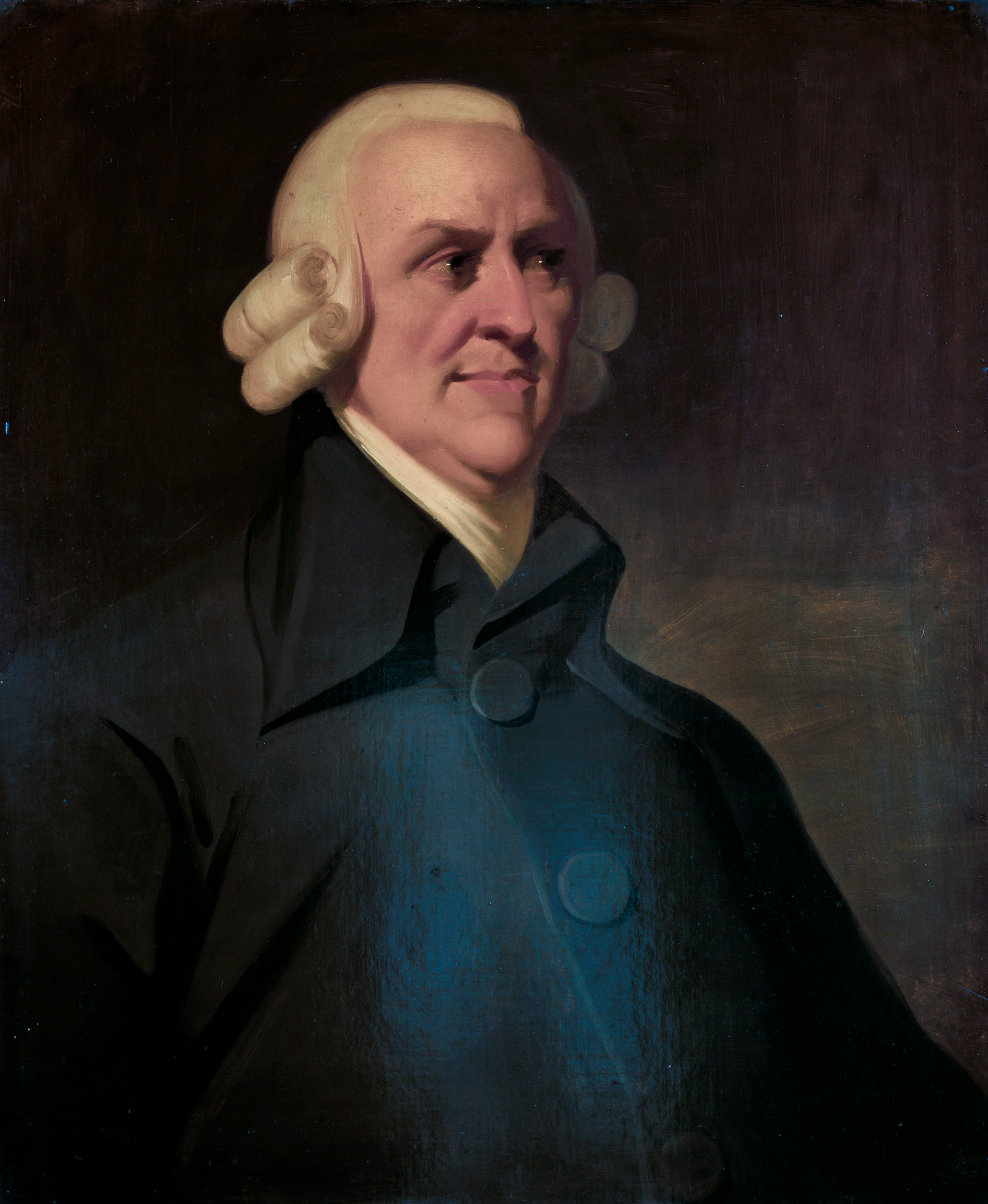
Adam Smith

Adam Smith was a wise man as well as a great economist, a man who knew where to start things. Smith gave us the following "State Of Nature" argument, or just-so story:

"If among a nation of hunters, for example, it usually costs twice the labour to kill an eager which it does to kill a deer, one beaver should naturally exchange for or be worth two deer."

Isn't that lovely?

David Hume

The state of nature argument was well established in 18th century thought, not least by Smith's mentor Hume. The point of a state of nature argument is not historical account (it his said that in the throes of the unguarded ecstasy of madness Rousseau actually believed in the historicity of such thoughts - I doubt this is so), but rather to show, in Voltaire's famous phrase, if something did not exist it would be necessary to invent it. Hume's famous rowers showed that social equilibrium would be invented even without language, demonstrating that conventions come first (logically speaking) and linguistic agreement after. Smith's hunters show that a market and a (relative) price system "come first" and formal markets after. It also demonstrates why ratios of prices are fundamental, rather than differences (try the argument with differences and see what happens). When labor is the only input the hunter can use (which is, for the economist, "production"), one has an easy and agreeable labour theory of value - though, of course, once there are multiple inputs this story loses its agreeability. But this is unnecessary, Keynes is a marginalist like any other. Subjective value is part of his analysis, just like it was your high school Econ teacher.

Keynes - who was also a great and wise man whatever anyone tells you - did not start with a just-so story about the existence of trade and the balance of demands, though he probably should have. Unlike the other world changing theses of its era (such as Frank Knight's Risk, Uncertainty And Profit), his General Theory assumes that you walk in capable of doing marginal economics on the level of a Pigou off the bat rather than spending a chapter on his personal conception of the supply and demand lines. As a matter of historical fact, Keynes never wrote a introductory book on basic conceptions (he and Pigou would just say "It's all in Marshall."!). Most of his serious writing is on money on the international stage, but the General Theory is about an "Isolated State", as it were. This might explain why students and the unserious had such difficulty but it wasn't just them...

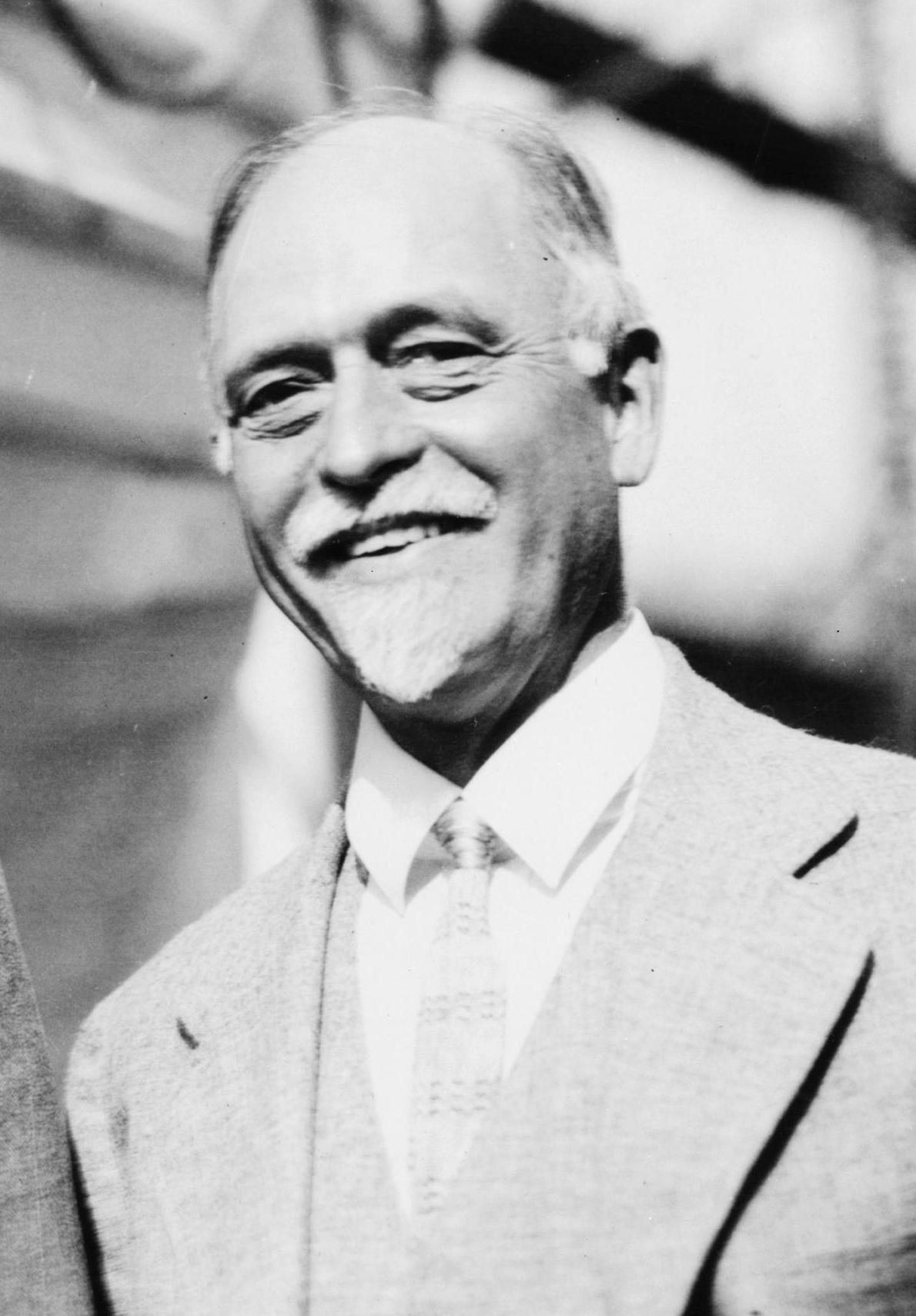
Irving Fisher 

We have to keep going past Adam Smith now. Here comes Irving Fisher, perhaps the greatest economist of all time ... though not gifted with deep personal wisdom. His American accent will be more familiar than Smith's 18th century Scottish brogue. He asks us to consider not hunting today, but hunting tomorrow as well. Let's say that a deer in the hand is worth two in the bush. How many deer today is a beaver tomorrow worth? The answer must be four - a beaver is worth two deer and a tomorrow is worth half a today.

But what if the difficulty of hunting changes with the seasons? Let's say that hunting is easier next season, so that the same amount of labor that gets one beaver today will also get two deer tomorow, three beaver tomorrow or four deer tomorrow. Then a promise of a deer tomorrow is worth half a deer today, the promise of a beaver tomorrow is worth a third of a deer today and the promise of a beaver tomorrow is worth 3/2 of a deer today. In terms of marginal analysis, this is the product rule for derivatives applied to a simple spot & future market. If the market left this so-called "intertemporal equilibrium", then anyone could gain just by cyclically trading beaver & deer.  This arbitrage argument is in Keynes's General Theory (Chapter 17, part II).

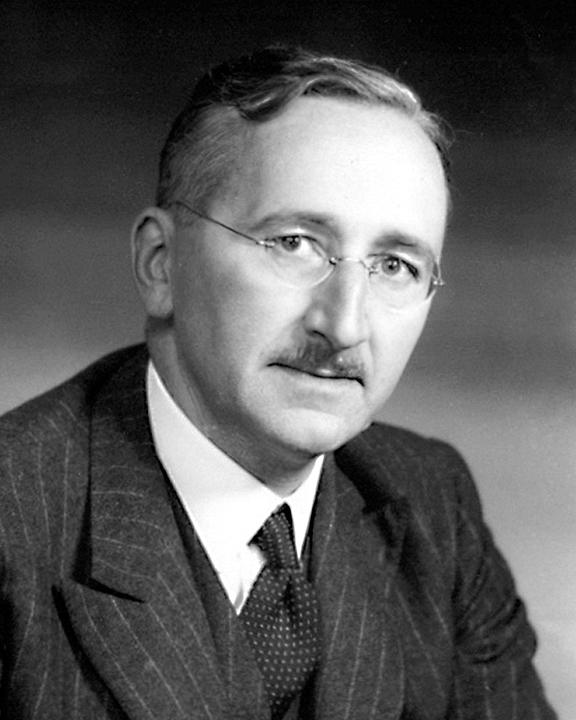
Frederich Hayek

So far, so good. Right now we're telling the story that Brad DeLong calls The Story Of The 20th Century - that of production increases & galloping scientific innovation. Economics is a serious subject about the things of our lives - the clean water, the iPhones and the clothes all together. Knight, Hayek and Schumpeter see that the entrepreneur is the central actor, able to take on uninsurable risks because they have local knowledge that others can't get - and the romantic temperament that drives the will to power. And this is - as far as it goes - undeniably true.

But it doesn't go all the way. The ancients called wise he who can control his enemies - and Keynes was a wise guy as well as a great man. The name The General Theory Of Employment, Interest And Money was a trick but not an underhanded one. It is that, but this isn't mainly that. The book is really an exposition of a Money Theory Of Production. Keynes announced such a book before writing it and admits it in the aforementioned Chapter 17.

Knight and Viner - the Old Men of Chicago - obsessed over the poorly named concept of the "long run". What this really means is that the path of production is picked out more or less like the beavers and the deer above, except lucky years are replaced by lucky (or, rarely, talented) entrepreneurs. In modern terms, this is called "golden path growth" and the obsession is justified by "turnpike theorems".  But Keynes, the greatest of the international monetary theorists and practitioners, saw that in many countries unbalanced flow & pricing of gold destroyed industries even though they were stocked to the gills with gutsy entrepreneurs and genius scientists.


Why, back with our hunters, do you think that just because they can get the deer and beaver at the rates quoted they necessarily will? Must every hunter go out for the hunt? This is a very crude way of thinking about "output in general". Surely a hunter could become irrationally exuberant (filled with romance, let's say) about his ability to kill beaver and hunt it in defiance of logic - and surely this would alter the price ratio whether he gets lucky or not. Surely each level of output, in terms of labor spent, is associated with a particular price system - in economic terms, each quantity of labour to spend gives a different production possibility frontier which, as it's dragged out doesn't necessarily touch the indifference curve at a locus of points drawing a straight line.

That's 2deep4me. Let's hear one last folk tale instead. Next year doesn't make it easier to hunt in general. Instead, next year the amount of labor to catch a beaver will be four times what it takes to hunt a deer tomorrow - and that amount will stay static. Now nobody would buy a promise for a deer tomorrow at a market clearing price. The asset whose rate of production has climbed most rapidly with output in general has knocked out the other assets - exactly as Keynes taught in Chapter 17!

You might be thinking "Where's the unemployment, the interest rates & the money?". They're all there.  The fast one I pulled is to talk about the path of production instead of the "interest rate". Interest rates are an abstraction, what exists are things and prices. Only after acclimatization in the polite fiction of interest rates does the intertemporal & Keynesian world make obvious sense. If I had said "The money-rate of interest rules the roost." one would be off talking about unrelated things. But when I say the identical, but differently worded "The production path of money knocks out less profitable production paths." it suddenly feels alien, requiring proof and argument. Which is what Keynes did.

Joseph Schumpeter 

Keynes ruined economists lives in order to save civilians. Before Keynes, all economists agreed that just because the story of the 20th century was about innovation and not money it should be the story that economists tell. Schumpeter the romantic was so furious that he said that if Keynes would not tell this story he wasn't an economist at all! It seemed so obvious that economists must focus on The Story, right? Keynes made economists not the epic poets of innovation but mere dentists checking Ulysses teeth before he goes to war.

Monday, December 19, 2016

What Do Their Deaths Mean?

Thomas Schelling

The late Thomas Schelling is often described as a "game theorist", but what that means is rarely clearly discussed. Game Theory is usually conceived as a branch of mathematics, an abstruse brand of pseudo-psychology inspired contests between hyper-rational contestants. And it is true, game theory is an abstruse brand of mathematics. It can and has been used by philosophers such as Jaako Hinitikka to ground our idea of quantifiers. It can and has been used by mathematicians such as Abraham Wald to ground our idea of statistics.

I don't think Thomas Schelling ever used mathematics beyond a high school level. In that sense, he was not a game theorist in the sense of Von Neumann and Bob Aumann. Schelling's contributions were not mathematical, they were philosophical. Thomas Schelling is one of the most consequential social philosophers of the 20th century. What was important to Schelling was not Game Theory's difficult technical content, but rather the important constraint that everyone's decision depends on everyone else - at least on that. This concept of equilibrium - the balance of the personal actions of each actor - lead Schelling to the concept of commitment. Equilibria allowed Schelling to escape escalation.

"As little as possible..."
- Chinatown

War, and especially nuclear war, was Schelling's great fear. Why did the great powers go to war in World War 1? There are many, many historical roots, but certainly the basic answer is for various reasons the high command of each European country badly missestimated the willingness of every other European country to go to war. Norman Angell was wrong - France & Germany would go to war over Alasce-Lorraine even if it meant breaking linkages and reducing output. Why couldn't the Great Powers after a year of war (which certainly revealed the true willingness to fight) get together to multi-laterally deescalate? The War cut off their ability to communicate, there was no focal point at which they could come together. Even though everyone knew that their opponent was more ferocious than they had allowed, they couldn't act on it.

Or take the famous Camp David Accords. Israel and Egypt both wanted to avoid further war. But Egypt didn't know for sure that Israel wouldn't become belligerent. And so Israel couldn't know if Egypt knew that Israel didn't want further war. And so on and so on. If you're Jimmy Carter, how do you make the true intentions of Egypt & Israel "common knowledge" (an expression coined by Schelling - who also coined "focal point", "collateral damage", ...).

The concept of international politics that is developed by Schelling in his book Arms And Influence is that of a broken, abusive family. Schelling's goal was to stop them from murdering each other, despite the gaslighting, the stealing and the drunken brawls. Who can forget his infamous analysis of rational irrationality? If you can convince them you're crazy enough to burn the whole thing down, they have to give into your demands. So when North Korea acts up again, the last thing you want to do is over commit and escalate...

Thomas Schelling's work went beyond war, of course. There are two pieces I'd like to pick out as particularly interesting.

The first is the famous Schelling Discrimination model. This model is exposited in his book Micromotives And Macrobehavior. One sunny day, Schelling was listening to an interview of Fidel Castro. Castro called America a "racist nation". Schelling, of course, didn't think the descriptor fair but then how can you explain all the obvious discrimination? Schelling decided to define down discrimination and examine the consequences when everyone had weak preferences but they all had to be satisfied together. Using pennies & nickels on a chessboard, he found that he could construct scenarios where initially mixed neighborhoods spontaneously segregated even though nobody particularly wanted to be in the majority (as long as they had a couple friends).

Now, as a model of racial discrimination in neighborhoods this model is a nullity. Racial discrimination in neighborhoods was not spontaneous. As to spatial economics it isn't up to snuff, since there aren't any prices. One can't do comparative statics of an anti-discrimination law with a Schelling model. As a mathematical model it already existed under the name "Ising model" and had been solved in the 40's. The contribution of the model was philosophical. The contribution of the model was to introduce complex system behavior. These complex systems can't necessarily be captured by aggregate models. In the Schelling model there lurks a representative agent. The agent isn't "racist" - he doesn't necessarily dislike being in the minority. But he lives in a segregated society and does nothing about it.

The second contribution of Schelling's I want to pick out is his discussion of addiction. His thoughts on addiction are developed in his book Choice And Consequence. The first economist to seriously discuss addiction was Gary Becker, who posited that addiction was a "rational" behavior - that is, increases in the price of cigarettes (and reduction of prices of cigarette substitutes, etc. etc.) will tend to reduce the use of cigarette demand. Schelling offered a much more radical interpretation that addiction is the result of internal bargaining. In order to become an ex-addict, the addict must engage in the kind of commitment strategies analyzed by Schelling in the field of international relations. Anyone who has known addicts has even seen them act out Schelling's famous rational irrationality in order to convince themselves and others that they will remain addicts.

This is also a philosophical contribution. Students will recall from their micro classes that a group may be licitly aggregated in a supply & demand model if the aggregate obeys "WARP", otherwise they must be distinguished. Schelling recognized that there was no secret sauce on a man's skin that made this axiom true within him.

One could go on and describe Schelling's influence - such as inspiring the David Lewis/Brian Skyrms approach to reviving the Humean project of reducing meaning to preference theory or inspiring a million internet types to call every possible behavior as "signaling". But that would be an injustice to his own creativity. Instead, the best thing to do is to remind ourselves of the moral weight. In Schelling's analysis, when other channels breakdown governments murder in order to communicate. Even if we are saddened, we must go on. What does all that death mean?

Saturday, December 10, 2016

All My Possessions For A Moment Of Time

Another commentary on a Twitter spat, you say? Well, my throat glands are returning to normal, so I can go back to normal soon. Until then...

Clio, Muse Of History

The brilliant blogger & economist Brad DeLong opens his economics class by giving a defense of economics as history, perhaps the unique history of the 20th century. The history of the 20th century in this viewing is a Whig's history, perhaps an authentic one.

DeLong's world is one of amazing, galloping productivity increase - a world were man's ability to create and control comes to dominate all things, where even the will of heaven is a plaything of this global engine. A world of "growth", economically defined.

The great economist of inequality Branko Milanović politely fired back with a defense of Eric Hobshawm's "short twentieth century". Neville Morely, another economic historian, also came to Hobshawm's aid.

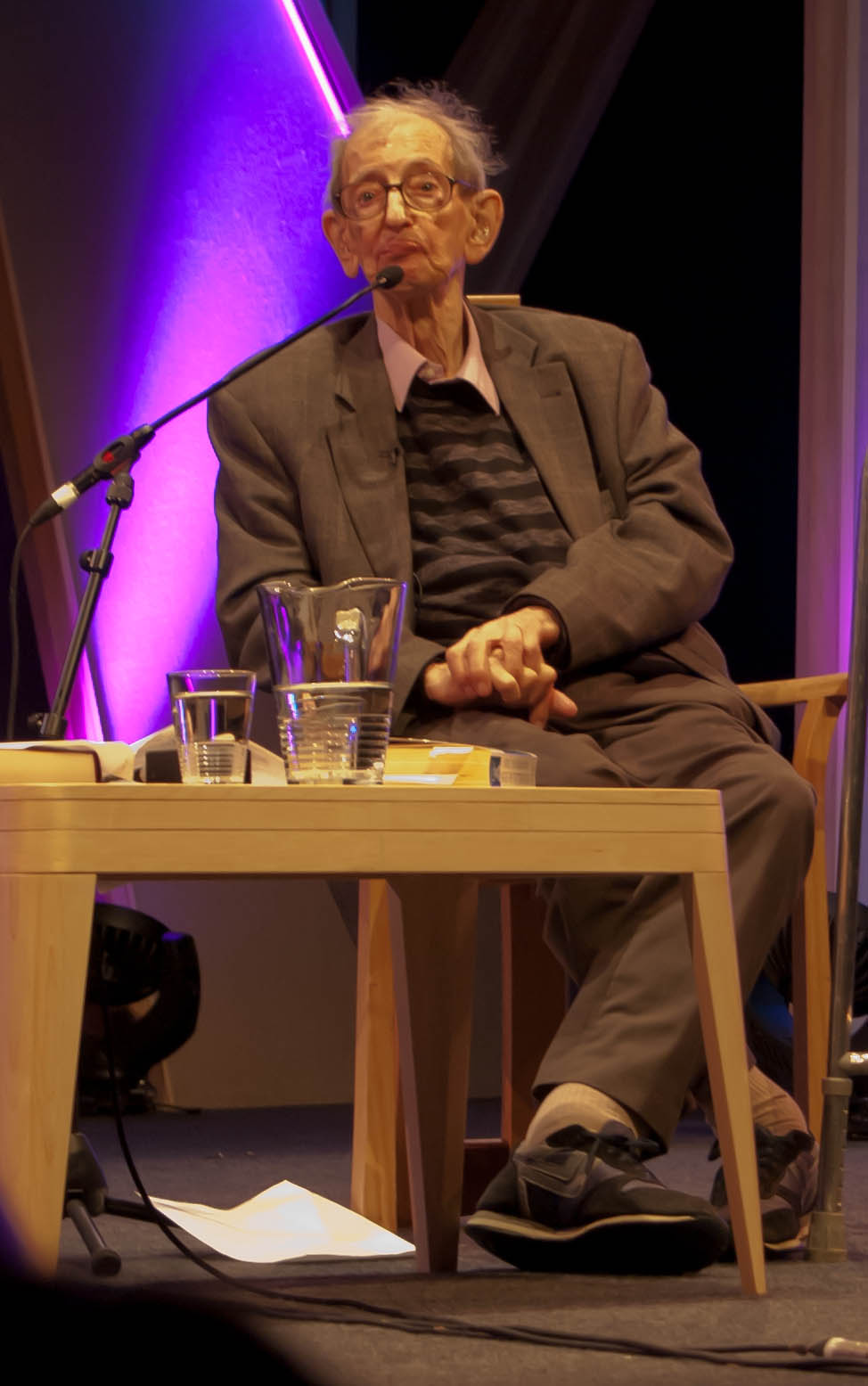
Uh, great photo of Hobshawm, Wikipedia

I'm not much of a Hobshawm scholar, in the sense that I've never read his books. In the same way, I'm the third best French speaker among my siblings. But it seems a reasonable gloss that in essence, Hobshawm saw the 19th century as the rise of Capitalism (as Marx saw it) and the 20th century as the rise of Communism (as actually existed in Russia and elsewhere). When you write this story, the 19th century is very long. Surely it was already starting in 1776, as Adam Smith's analysis of Capitalism needed a Capitalism to analyze. Also, there was some kind of political revolution in that year of slight importance. Surely this phase of history was still present in the actual Leopoldville of the 1950's. Not only was the 19th century very long - it was unevenly distributed.

The distribution of actually existing Communism in that "short 20th century" was also mercifully uneven.

General Mobutu

The facts are not open to doubt. The 20th century opened with a demon haunted world embroiled in imperial depredations and closed with ... if not "freedom" per se, at least significant bourgeois freedom ("Freedom's just another word for 'Nothin' Left To Lose' ... and nothin' ain't worth nothin', but it's free..."). When a Belgian hit squad (with US money) killed Lumbumba and burned away his bones with acid, they still could not install a Belgian government. Instead, the Congo got the fearsome General Mobutu. Mobutu was many things: a violent hypocrite who took Western money and condemned foreigners with equal ease, an embezzler and inflationist - but one thing he was not was Belgian. No amount of cruelty would return the old empires. There was no want of trying. De Gaulle can cry out for "Algerian France" all he wants, it made no difference. Times were somehow ... somehow different. This is a story worth telling, an understanding worth coming to.

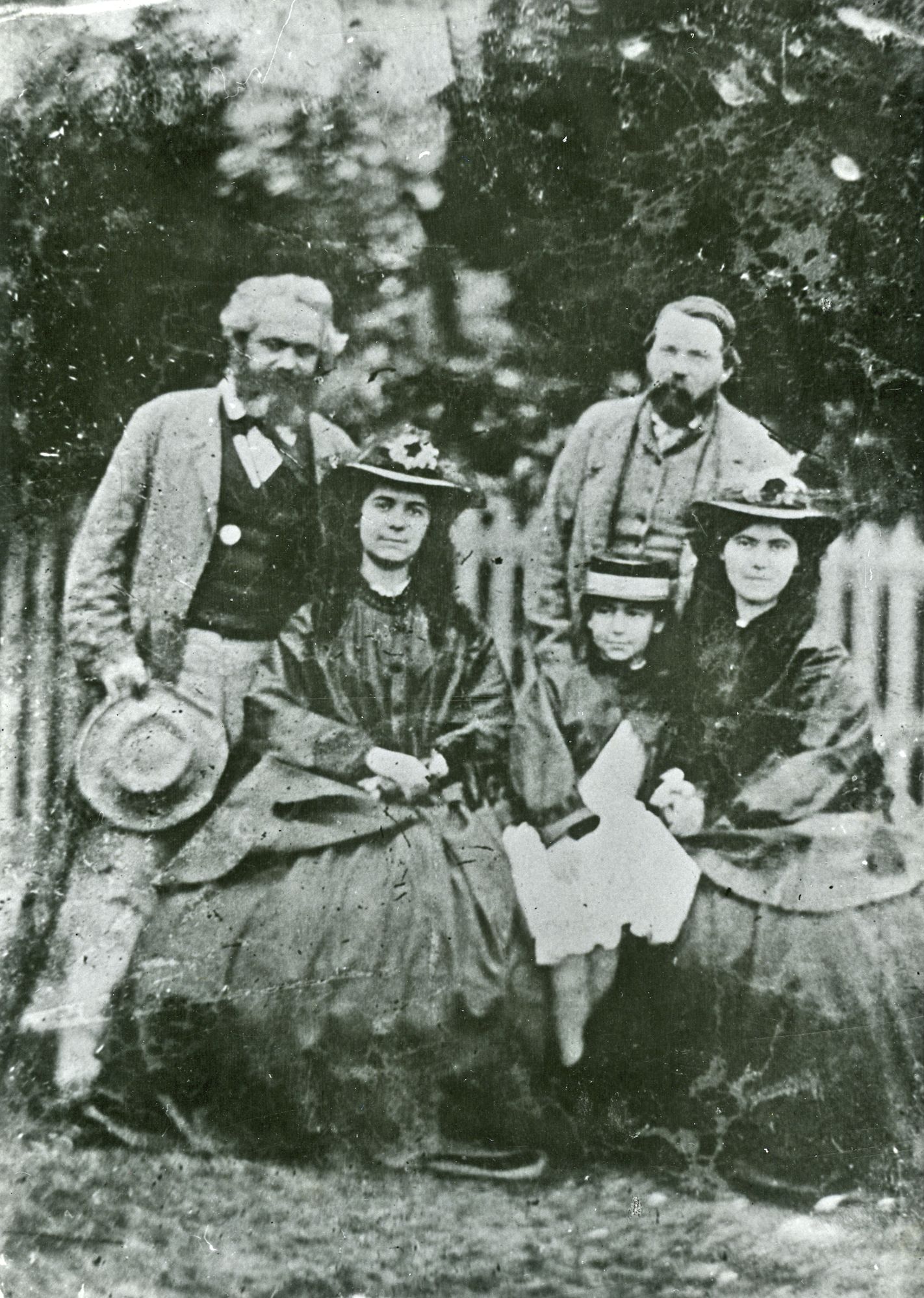
Engles, Marx and three of the Jenny Marxes

A specter floats behind this debate. The specter of Karl Marx. Not communism, Communism, Actually Existing Communism, c0mnU1sm or anything like that. But Karl Marx, the German born philosopher, socialist, economist, journalist, etc. with his carbuncles and his Party and his beloved wife and daughters. How does Hobshawm's view fit with Marx's exactly? It seems that there is an underlying idea in Hobshawm that Stalin or Mao or ... was the realization (or a direct precursor to the realization) of Marx's epic tale of historical progress from primitive communism to ... well, Communism. But Russia, China, the Congo, Vietnam, North Korea, etc. etc. etc. were not late capitalist societies that underwent a fall in the rate of profit making collapse of the Capitalist systems and the rise of Communist ones inevitable. They were agrarian empires. Frankly, they were all sorely lacking in capital. The organic composition of capital in those countries was ... to be honest, still pretty damn organic. The outlines of Hobshawm's story as I understand them are not compatible with the outlines of the Marxist story as I understand them.

The Marxist story as I understand it is a (precursor to? perhaps a bitter uncle ...) DeLong's story! DeLong's is a story of changes in the organic composition of capital - no, we can be more clear. In the language of this post, DeLong's is a story of the distribution matrix changing through time in ways that cause \( \lambda \) to fall to near 0, which is just a way of saying that the maximum rate of profit is rising by leaps and bounds.

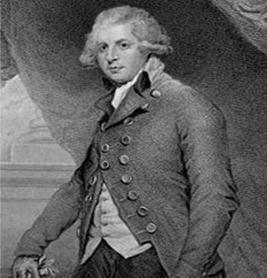
John Maynard Keynes

It's interesting, since I feel that if DeLong were to nominate a man for economist of the 20th Century, he would nominate John Maynard Keynes, the great slayer of Say's Law. The 20th Century is surely the century of the Great Depression and WWII. Were these times of galloping productivity? Everyone believes in Say's Law when the discussion is not about Say's Law - even you and me (and, yes, even Keynes made mistakes like this). DeLong implies but does not state that the long run history is a full employment history. He implicitly assumes that a balanced growth path is an acceptable behind the scenes driver of history.

I'm not so sure the 20th century will be remembered in this way.

E P Thompson

But let's go back to Hobshawm. I can't make sense of what I've read of him in terms of what I've read of Marx. What I've read of Hobshawm reminds me much, much more of E.P. Thompson. Thompson wrote of artisans and William Blake resisting capital deepening through moral action. Thompson had a beautiful, Blakean vision of a socialist state: "I am going to create a world of beauty. My eyes will see as through a new mind."*

Okay, Thompson's vision was incredibly vague and its relationship with Marx more elective affinity than anything comprehensible. Leszek Kołakowski rightly ridiculed Thompson on these grounds. It's difficult for me to understand these Thompson and Hobshawm characters, being a vastly different age and temperament. But I think that I can.

Let me tell you a story. It's a story about a pencil. I am holding it in my hand right now. To make this pencil, trees had to be cut down, pulped and reglued to be soft enough to easily sharpen. Somebody when cutting down these trees cut themselves and bled on the wood. Their blood is in my hands. Aluminum ore had to be dug out of the ground, processed at great difficulty, pressed and painted. These miners are worked to the bone in non-union mines. Their sweat is in my hands. Paint had to be synthesized. Precursors to the chemicals making this unnaturally red paint had to be synthesized. Everything that happens in every one of those chemical factories is part of this pencil. Open pit graphite mines are giving miners lung cancer. Those deaths are on my hands, are they not? Forget the labor theory of value, it's a will-o'-the-wisp. Isn't the fact that those deaths and all that pain happened because I wanted a damn pencil just the plain meaning of imputation?

Economists have a word for the fact that everything in this world is connected - well, actually they have dozens of words for hundreds of the closely related concepts that capture this idea with precision. Their special word is "equilibrium". Equilibrium means me, you, Sumatran loggers and Chinese graphite miners are all trapped in a single point in price space (which may be infinitely dimensional, or even have continuously many dimensions!) trapped unable to move. The tar that sticks us to this point has many names, the names of the great theorists: Nash, Pareto, Walras, Bayes ...

I don't fault Hobshawm or Thompson for cowering before this beautiful and horrifying vision.. It is a terrifying vision - whether set out by Marx or Walras. It is the real world in which we live, with all that implies. It is important to understand that. But I can and will fault them for not seeing that other visions can be equally or more terrifying. That they could let themselves only see the good of Stalin, Mao and Ho Chi Minh while fearing and hating bank managers and their ilk is something I can and will fault them for.

Hobshawm had to admit that Stalin did not create a world of beauty. Communist Poland was not a world of beauty. The idea of a short 20th century is a tacit, backhanded way of making this admission.

I prefer to be more direct.

The Long 20th Century?

So, the question becomes: Is the 20th Century the century of Marx's ideas (as DeLong thinks - after a fashion) or of Marxist parties (as Hobshawm seems to think)? Or perhaps it was the story of John Maynard Keynes and Milton Friedman, a story of uneven progress with the promise of balance. Perhaps it is the story of Lumumba & Mobutu, or the Park family versus the Korean people or Nixon or... Maybe it is billions of stories babbling from their intertemporal equilibrium trap.

In the end, I am on the side of Hume, such metaphysical talk should be burned for warmth...

*I cheated here. This is actually a quote from the 2002 cartoon Ghost In The Shell: Stand Alone Complex. It just captures beautifully what they wanted to say.

Friday, December 9, 2016

Economy And History Livin' In Perfect Harmony


"The paths up and down are the same."
- Heraclitus

I actually have quite a few blog posts percolating right now, but this is the one being written instead. It's about history, economics and accounting a little bit. You'll see where Heraclitus comes in later.

Economic history blogger Pseudoerasmus recently wrote a brief tweetstorm about the excellent Eric Foner's boneheaded comment on methodology. Foner seems to have implied that counterfactuals have no place in history at all, which is shocking to the point of incomprehensibility. Even a simple statement of fact like "Cotton was core to the southern economy." can hide a counterfactual (perhaps "If cotton didn't exist, nothing would take it's place."?). An absolutely core question to the analysis of the Civil War is certainly whether southern cotton plantations were seeing output growth in the way that northern factories were. In order to talk about this, we simply must talk about the "growth" paths cut off by the Civil War.

David Hume

To see why, let's have a cartoon sketch of the use of  "causality" in historical argument. I, a Humean, think most causality talk is confused. Causality is only a way of talking about underlying functional relationships. If the path of history is A B C, we might not want to say C is just the damn stupid thing after B.

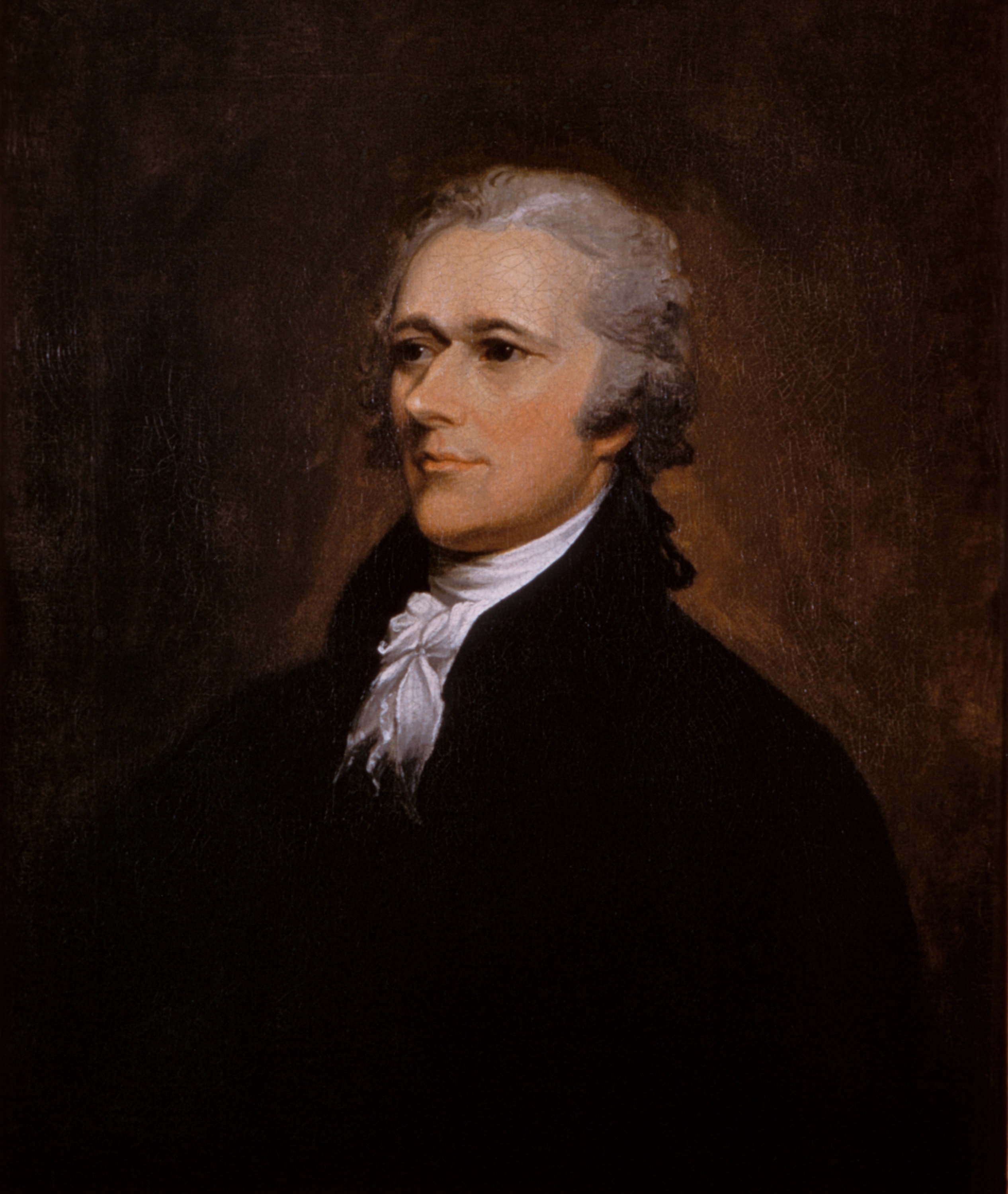
Alexander Hamilton

When Alexander Hamilton left the British West Indies for America, he was leaving a place where whites were not just relatively but absolutely rich to a place where they were poor - relative to whites in the British West Indies. But it is the USA that became rich and not the British West Indies. These are historical facts of no interest. What is of interest is why this outcome occurred and not vice versa. What might be interesting is the claim that the reason is that the British West Indies made slavery too central to their institutions, making them "extractive" (i.e. they want to get rich by chiseling) rather than "progressive" (i.e. they want to get rich by raising productivity). Someone, maybe John Stuart Mill, can draw some deep political conclusions from that.

Robert Fogel

We can talk about politics and metaphysics now because there's causality, slavery -> low productivity -> bad institutions (even long after slavery is abolished). A is slavery and C is poverty. But here comes our friend Robert Fogel. He tells us that slavery in the Old South didn't necessarily reduce productivity (recall that productivity is just a relationship between inputs and outputs), that large slave plantations might have had even higher productivity (more output per unit input) than free farms. The simple Millian story of progressive institutions is not simple.

But what does buddy Bobby's story have to do with the British West Indies? What we are really saying is that if British West Indies could adapt high productivity technologies of the Old South, then the slavery -> low productivity link would break down. Historians and economists evaluate counterfactuals by looking at close analogies. Now we can bring this up to date - if Baptist was right and productivity change was all about whipping machines, those technologies could have been (those magic words!) adapted by British West Indies slave drivers. Counterfactuals within counterfactuals!

(Aside: you know, some economic historians have taken Baptist to task for exaggerating the iniquities of slave masters by tending to take the darkest testimonials. But constructing a representative slave by taking the \( \min_i(U_i)\) over all slaves \( i\ ) is not an obviously methodologically unsound procedure. The representative firm, consumer, slave, etc. is not the average!)

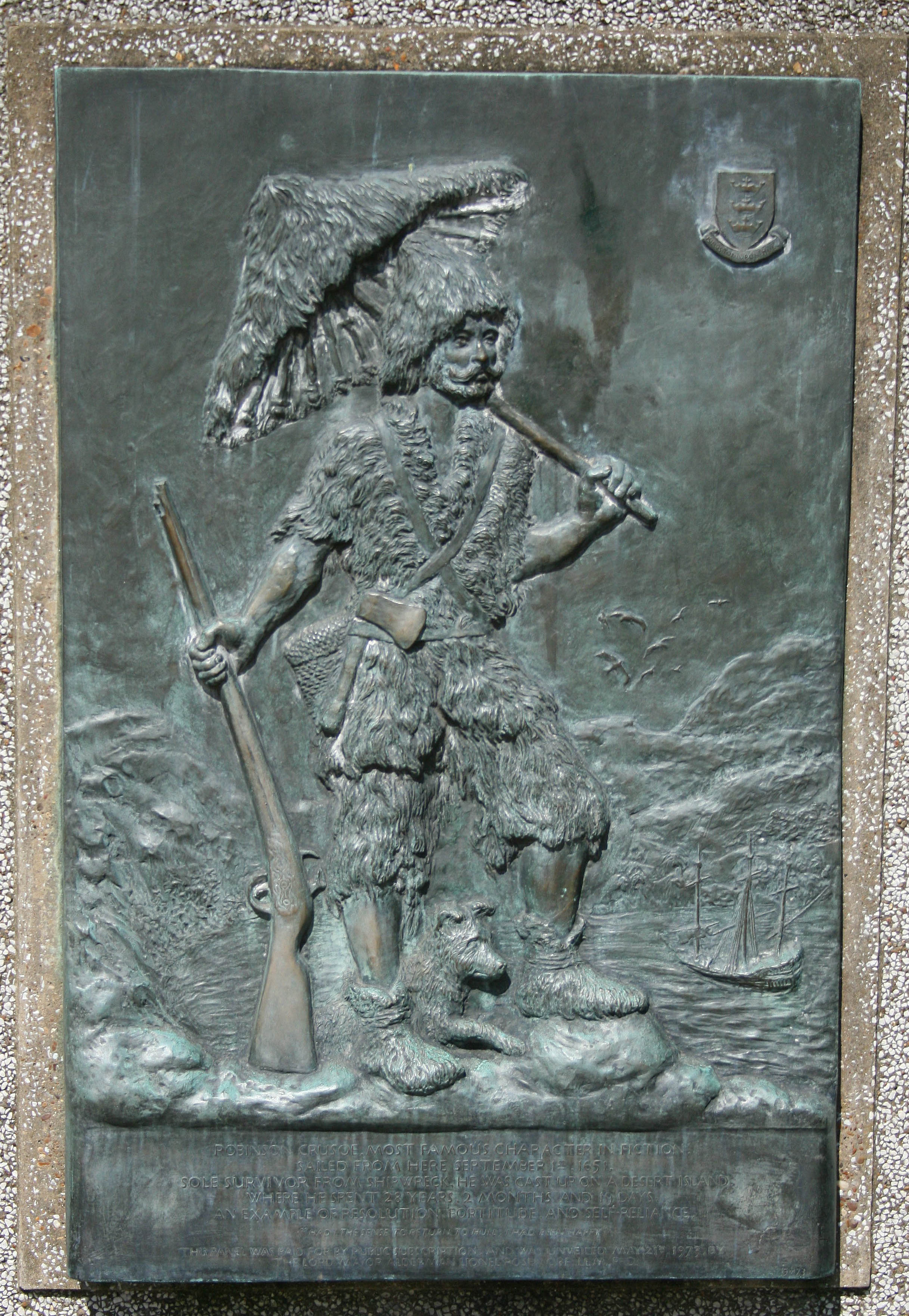
Robinson Crusoe

Now that we know what we mean, I will play good cop to Pseudoerasmus's bad cop (this implies we are both after the same thing and I think we are). A warning: there's gonna be an equation coming up. It is necessary to use an equation as a metaphor for the difference between how economic historians and narrative historians. I won't be doing any real economics or history because that will just cloud up the methodological point.

I will start with the narrative history. Once upon a time, there was an island inhabited by people. Later settlers will call it "Crusonia", but the natives called it "Atlantis". By far the dominate food of the Atlantians was rose hips. Sometimes they'd catch a rabbit, sometimes they'd eat worms. But it was almost all rose hips. The Atlantians died 800 years before settlers came to Crusonia, after a blight killed off all Atlantian Roses.

How would an idealized economist approach this story? The big variable is the number of rose hips \( Y \). Obviously, the count of rose hips on the island at any particular time is exactly the number of rose hips per rose \( g \) times the number of roses \( K \). This is just counting ... but hey, there's another way of counting. We can count the rose hips not just by number born but by number used. Each rose hip is either eaten or used to grow another rose. Let \( r \) be the number of rose hips per rose that grow into new roses and \( C \) be the number of rose hips eaten.

The number of rose hips doesn't care about how we count them. By metaphysical necessity,  "The paths up and down are the same.". This gives us the governing equation

$$ K = \frac{C}{g-r} $$

I've written this to be as simple as possible, but I do have a point. The above equation is just accounting, it is automatically true. It's a thin description, even thinner than any real cliometric analysis. But now we can talk about causality (functional relationships). If \( g \) and \( r \) were constants, then increasing consumption should increase the number of roses. Well, why do you think roses grow rose hips in the first place? Or maybe the causal arrow moves in the opposite direction - it makes perfect sense to think higher consumption is associated with more roses. But why should \( g \) and \( r \) be constants? Doesn't it make sense that the number of rose hips per rose that grow into roses should vary inversely with the number eaten? Then you have \( r(C) \). Or perhaps if there are too many roses, then they start competing with each other for land - then you'd get \(g(K)\).

We can now approach the narrative above. During the end times of the rose blight, \( K \) tended towards 0. This will force C to be zero (which kills everyone), but its impact on \(g\) and \(r) is ambiguous. Did the Atlantians foolishly continue eating at the same rates? Did they desperately change their habits but were doomed by the rose blight? These questions are statements about functional relationships - a thick historical description will answer them (at least qualitatively).

If we want to go on to do real economics, we have to start worrying about equilbria - the points at which the annual stock of roses balances the flow of rose hips (into bellies and the ground). This is also useful, but takes us far afield.

Le Penseur

So this is my good cop routine in a nutshell: A thick historical narrative description is very, very important - it should give us good qualitative reasons to believe in casual relationships. A thin cliometric numerical description is equally important - not only can it clarify those descriptions but it can also serve as a sanity check on thicker descriptions.

Monday, November 21, 2016

Eat Yourself Fitter!: A Review of Production Of Commodities By Means Of Commodities


Niels Abel said about Carl Gauss "He is like a fox who effaces his tracks in the sand with his tail.". The same can be said of Italian economist Piero Sraffa, whose big book on the theory of production is 112 pages long. Though published in 1960, there is plenty of evidence that Sraffa had the basic ideas written out in 1928. This 32 year gestation period was mostly a time of intense "taking out", resulting in book that is like a glittering diamond with aperiodic facets.

Piero Sraffa, John Maynard Keynes and Dennis Robertson

The most important and most annoying thing about Production Of Commodities By Means Of Commodities: A Prelude To A Critique Of Economic Theory is that it is a ... well, prelude to a critique of economic theory. There are huge, yawning gaps that presumably would have been covered in the actual critique had Sraffa's perfectionism not prevented him from publishing it. This results in a book that often works by innuendo and carefully laid traps rather than by overt calculation.

Obviously, I can't approach Sraffa's level of brilliance in a blog post, but here we go critiquing anyway.

Philip Wicksteed

By "Economic Theory", Sraffa means the marginal method of Wicksteed, Irving Fisher and so forth. Unfortunately, it isn't easy to actually say exactly what this theory means, especially in equilibrium where all the forces balance. Perhaps the essential thing is captured in the famous quote from Richard Whately: "It is not that pearls fetch a high price because men have dived for them; but on the contrary, men dive for them because they fetch a high price.".

What could this possibly mean? The price of a commodity is just the balance of supply and demand for that commodity - whether it is a "final good" (like cake - a good whose demand is strictly for its own consumption) or mere "factor" (like flour - a good whose demand is strictly for making other goods, like cake, to consume) or something in between (like water - which is both consumed for its own sake and used to make cake). The vaunted and so-called "supply" is just the flour manufacturer's demand (for, say, money). "Equilibrium" is the balance of the demands of everyone's goods against everyone else's demand for everyone's goods.

Production theory, while not simple (due to involving demands across time), isn't special - just because the price of flour is determined by the demand for cake tomorrow doesn't mean it isn't set by the balance manufacturer's demand and consumer's demand.

Piero Sraffa

Sraffa's system is different. Sraffa is directly inspired by the system of David Ricardo, with the philosophy and economy of Marx floating ominous and powerful in the background. Instead of concentrating on the balance of subjective demands, he concentrates on a balance of objective supplies. Sraffa's system concentrates on the actual shifts of goods used in the creation of new goods. The actuality of this is both very important - especially if you want to be an historical materialist - and deeply problematic - especially if you want to do economics.

Take the simplest example - a single period of single product industries that produce with no surplus. The total amount of each good at the end of the period will be denoted \( G_j \). The amount of good \( j \) actually used in the production of good \( i \) is denoted \( G_{ji} \). Therefore, we define the distribution matrix  \( A \) by \(a_{ij} = \frac{G{ij}}{G_i} \). This matrix is the disaggregated distribution of goods - \(a_{ij}\) is how much of good i is used by industry j. Since there is no surplus, \( A \) is a stochastic matrix, therefore it is easy to see there exists a vector \( p \) such that \( A p = p \). This vector is the system of prices which would allow the system to hold together - at these prices there would be no social force away from the distribution of goods entailed by the distribution matrix.

It is here where Sraffa meets Scylla and Charybdis. What is so special about a self-reproducing economy? Yes, such a price vector can exist, but who cares? What if an industry becomes irrationally depressed and pointlessly produces less one year? Sraffa's system is not based on production functions in the traditional sense - \( A \) is the actual distribution of goods in the system, not the solution to some maximization problem. Sraffa is very proud of this because it lets him sidestep market structure. Sraffa cryptically boasts about this in the introduction of the book. He never explains that this is how he is able to handle increasing returns - because in his system he can't even write them down. Without market structure, Sraffa can't talk about stability or even why \( p \) will be chosen in actuality. His results are written subjunctively, "If the economy is self-reproducing, then...".

In the Wicksteed-Fisher system above, \(a_{ij}\) is the demand for good i by industry j and the price vector \( p \) zeros out excess demand. If one year an industry accidentally underproduces, then it's good's price next year will go up (there will be excess demand). This causes it to be overproduced next year - demand feeds back onto demand. If the system is stable (which may require some amount of intelligent management), eventually the original price vector will be retrieved. It makes sense to work it out temporally.

Now, you might object that Sraffa's system actually is stable, since for any all positive starting price vector \( p^s \), one clearly has \( \lim_{k \to \infty} \frac{A^k p^s}{\| A^k p^s \|} = p \). So if the distribution matrix holds still from time period to time period, the price level will adjust to it. But remember that Sraffa's system is based on the actual distribution of goods. There's no reason to associate \(A^2 p^s\) with two years of production - unless the distribution of goods is fixed by the Gods and the Kings. But why would that be? I'll come back to this point in a bit.

Joseph Schumpeter

This continues to be an issue when Sraffa makes his move at recovering classical political economy. Let's see why. Weaken the assumption that \( A \) is stochastic to merely being non-negative and irreducible. The Perron-Frobenius theorem now gives us the existence of an all positive price vector  \( p \) such that \( A p = \lambda p \). Again, this price vector is calculated solely from the actual distribution of goods \( A \). The eigenvalue \( \lambda = \frac{1}{1+R} \),  where \( R \) is the maximum level of profit (that is - one where the wage is zero). Another way to think of \( R \) is the amount of surplus in the system. This is an eigenvalue, so it's uniform across industries (not dependent on \( i \) ).

The wage of labor is then related to the actually realized profits \( r \) by the simple equation \(w = 1 - \frac{r}{R}\). In other words, \( \frac{r}{R} \) is the proportion of the surplus going to industry and \( w \) is the proportion going to labor (paid in that standardized unit that Sraffa laboriously constructs). If this is right, then Marx understood the political economic struggle basically correctly. Workers of the world unite - you have nothing to lose but your chains!

... because production doesn't depend on actually realized profits, so you can increase your wages until \( w = \frac{1}{R} \).

But wait - why must the level of profit be uniform? In Sraffa's system, there isn't any industry structure - \( R \) comes out of the matrix of actually distributed goods. But what if right after the distribution of goods \( A \) is measured (though, of course, Sraffa doesn't discuss measurement), an entrepreneur invents a better mousetrap factory. Let's say there are increasing returns and so all the market concentrates under her company. What economic force is equalizing her (long run) rate of profit with everyone else's? In other words, why can we rule out Knight-Schumpeter theories that actually realized profits and industry structure matter for production a priori?

 Richard Cantillon

Now, like I said before, Sraffa's book is a Prelude. Not answering these questions is a flaw, but it is a flaw that I think Sraffa would be happy to cop. Classical economics had an answer for these - one that Sraffa leaves carefully in the background. I'll briefly sketch Cantillon's answer as an example. You can read more here, but their notation is sometimes illegible. I'll just use words:

Cantillon was Irish, so let's draw an imaginary Ireland. There are two goods, potatoes and cake. There are two classes of people, royals and laborers. Laborers eat potatoes, royals eat cake. Assume that labor is homogeneous and land is uniform. Wages and rents are therefore uniform - otherwise, just switch to the more profitable sector (in other words: constant returns). Since there are only two goods, one can now solve for equilibrium based on the balance of income flows. The fund for labor for growing cake (that is, the uniform wage times the quantity so employed) must exactly be the total rent received for growing potatoes. Since rent is the same everywhere, this gives us the total rent  - which must also be the amount spent on cake. The number of laborers in the economy is a function of the amount of potatoes grown. Hopefully, there is some amount of potatoes that results in a stable population. That ratio decides the amount spent on potatoes the labor supply. Since we know the wages and the labour supply, we know the wages fund. We can then keep working through until we've solved for prices and quantities separately. With Cantillon's assumptions, everything is proportional to the quantity of land with proportionality constant coming from technology.

There are many differences between this argument and Sraffa's argument. In Cantillon's system, there is a clear - albeit slow - equilibrating social force. If "too much" land is given to growing potatoes, population will grow and wages will fall. As a result, landowners will be able to grow lots of cake cheaply until population falls again. If "too much" land is given to growing cake, then the population will be forced down and wages will rise until landowners are forced to change their pattern of land use. God chose the final distribution when he made man an animal.

Sraffa was intensely concerned to not assume uniform land and constant returns - in his system, rent is not uniform across land. He didn't want to spurn his first paper. If land is uniform, all patterns of land use are equally valid. But if land is starkly non-uniform as Sraffa believes (or at least, believes it is important not to rule out a priori), then a pattern of land use consistent with population stability may not even exist (though I have no proof of this). Nowhere in Production Of Commodities By Means Of Commodities does Sraffa even mention determinants of population!

Henry George

Earlier I said that Sraffa's analysis is full of innuendo and carefully laid traps. His discussion of Land Value Tax (LVT) is an example. Because land cannot be produced and therefore isn't in that set of self-reproducing commodities called "basic" by Sraffa, a LVT cannot affect production and therefore is not economic. It falls entirely on the landlord. This result is identical to the usual, "supply and demand" result, though less general (since the supply and demand result holds even if land is mispriced). But it carefully hints at the basic definition of what is and is not an economic result. Sraffa implicitly argues that there is no economic argument against a Land Value Tax because it doesn't affect production - implicitly defining economics in a way that emphasizes production.

Vilfredo Pareto

From the perspective of Pareto, this definition is by its very nature political - it values some people (producers) over others (landowners). You might agree - as I do, on basically utilitarian grounds - with a stiff LVT, but to simply dismiss landowners outright and a priori is a little shocking!

I'm sure that Sraffa could entirely defeat me philosophically, that he had very good arguments that this and not, say, "the optimal use of scarce resources for given ends" is the best way to do political economy. I'm sure he could give a good reason why this and not, say, Rawlsian reasons are the best reasoning behind an LVT. I'm sure he could give a good reason that the resulting distribution would be "just" to any Nozickian objectors (such as James Mill). But he doesn't deploy these reasons openly in Production Of Commodities By Means Of Commodities.

Piero Sraffa

Considered as a foundation of economics, there are many other things lacking in Sraffa's slim book - money, uncertainty, technical progress, etc. - but I can forgive all of these in return for it's flash and fire. I find it very hard to forgive the lack of an equilibrating mechanism.