Monday, November 21, 2016

Eat Yourself Fitter!: A Review of Production Of Commodities By Means Of Commodities


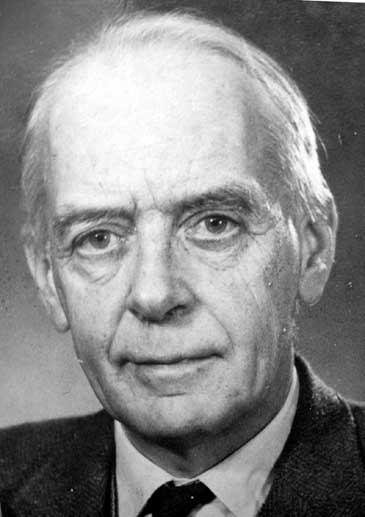
Niels Abel said about Carl Gauss "He is like a fox who effaces his tracks in the sand with his tail.". The same can be said of Italian economist Piero Sraffa, whose big book on the theory of production is 112 pages long. Though published in 1960, there is plenty of evidence that Sraffa had the basic ideas written out in 1928. This 32 year gestation period was mostly a time of intense "taking out", resulting in book that is like a glittering diamond with aperiodic facets.

Piero Sraffa, John Maynard Keynes and Dennis Robertson

The most important and most annoying thing about Production Of Commodities By Means Of Commodities: A Prelude To A Critique Of Economic Theory is that it is a ... well, prelude to a critique of economic theory. There are huge, yawning gaps that presumably would have been covered in the actual critique had Sraffa's perfectionism not prevented him from publishing it. This results in a book that often works by innuendo and carefully laid traps rather than by overt calculation.

Obviously, I can't approach Sraffa's level of brilliance in a blog post, but here we go critiquing anyway.

Philip Wicksteed

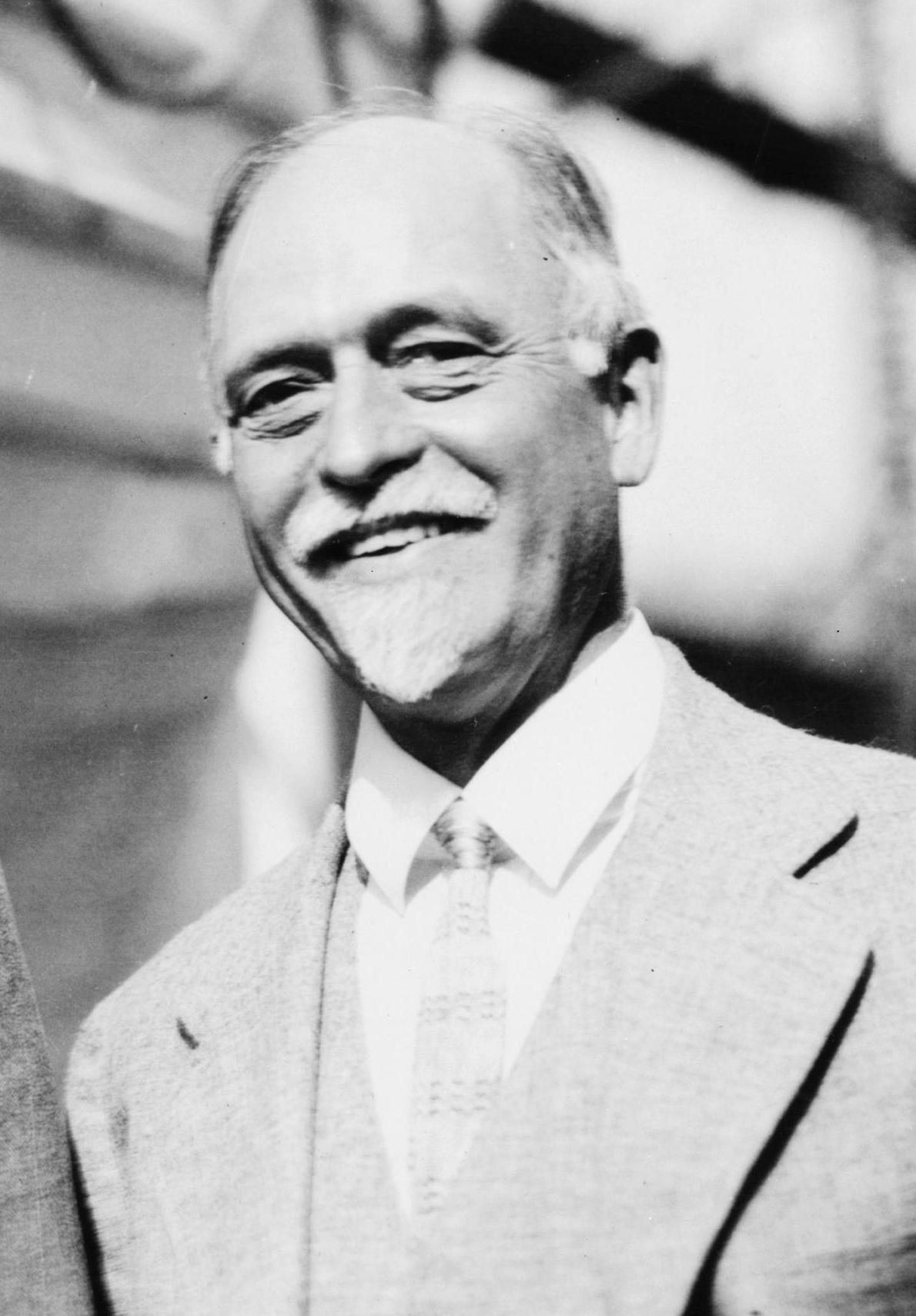
By "Economic Theory", Sraffa means the marginal method of Wicksteed, Irving Fisher and so forth. Unfortunately, it isn't easy to actually say exactly what this theory means, especially in equilibrium where all the forces balance. Perhaps the essential thing is captured in the famous quote from Richard Whately: "It is not that pearls fetch a high price because men have dived for them; but on the contrary, men dive for them because they fetch a high price.".

What could this possibly mean? The price of a commodity is just the balance of supply and demand for that commodity - whether it is a "final good" (like cake - a good whose demand is strictly for its own consumption) or mere "factor" (like flour - a good whose demand is strictly for making other goods, like cake, to consume) or something in between (like water - which is both consumed for its own sake and used to make cake). The vaunted and so-called "supply" is just the flour manufacturer's demand (for, say, money). "Equilibrium" is the balance of the demands of everyone's goods against everyone else's demand for everyone's goods.

Production theory, while not simple (due to involving demands across time), isn't special - just because the price of flour is determined by the demand for cake tomorrow doesn't mean it isn't set by the balance manufacturer's demand and consumer's demand.

Piero Sraffa

Sraffa's system is different. Sraffa is directly inspired by the system of David Ricardo, with the philosophy and economy of Marx floating ominous and powerful in the background. Instead of concentrating on the balance of subjective demands, he concentrates on a balance of objective supplies. Sraffa's system concentrates on the actual shifts of goods used in the creation of new goods. The actuality of this is both very important - especially if you want to be an historical materialist - and deeply problematic - especially if you want to do economics.

Take the simplest example - a single period of single product industries that produce with no surplus. The total amount of each good at the end of the period will be denoted \( G_j \). The amount of good \( j \) actually used in the production of good \( i \) is denoted \( G_{ji} \). Therefore, we define the distribution matrix  \( A \) by \(a_{ij} = \frac{G{ij}}{G_i} \). This matrix is the disaggregated distribution of goods - \(a_{ij}\) is how much of good i is used by industry j. Since there is no surplus, \( A \) is a stochastic matrix, therefore it is easy to see there exists a vector \( p \) such that \( A p = p \). This vector is the system of prices which would allow the system to hold together - at these prices there would be no social force away from the distribution of goods entailed by the distribution matrix.

It is here where Sraffa meets Scylla and Charybdis. What is so special about a self-reproducing economy? Yes, such a price vector can exist, but who cares? What if an industry becomes irrationally depressed and pointlessly produces less one year? Sraffa's system is not based on production functions in the traditional sense - \( A \) is the actual distribution of goods in the system, not the solution to some maximization problem. Sraffa is very proud of this because it lets him sidestep market structure. Sraffa cryptically boasts about this in the introduction of the book. He never explains that this is how he is able to handle increasing returns - because in his system he can't even write them down. Without market structure, Sraffa can't talk about stability or even why \( p \) will be chosen in actuality. His results are written subjunctively, "If the economy is self-reproducing, then...".

In the Wicksteed-Fisher system above, \(a_{ij}\) is the demand for good i by industry j and the price vector \( p \) zeros out excess demand. If one year an industry accidentally underproduces, then it's good's price next year will go up (there will be excess demand). This causes it to be overproduced next year - demand feeds back onto demand. If the system is stable (which may require some amount of intelligent management), eventually the original price vector will be retrieved. It makes sense to work it out temporally.

Now, you might object that Sraffa's system actually is stable, since for any all positive starting price vector \( p^s \), one clearly has \( \lim_{k \to \infty} \frac{A^k p^s}{\| A^k p^s \|} = p \). So if the distribution matrix holds still from time period to time period, the price level will adjust to it. But remember that Sraffa's system is based on the actual distribution of goods. There's no reason to associate \(A^2 p^s\) with two years of production - unless the distribution of goods is fixed by the Gods and the Kings. But why would that be? I'll come back to this point in a bit.

Joseph Schumpeter

This continues to be an issue when Sraffa makes his move at recovering classical political economy. Let's see why. Weaken the assumption that \( A \) is stochastic to merely being non-negative and irreducible. The Perron-Frobenius theorem now gives us the existence of an all positive price vector  \( p \) such that \( A p = \lambda p \). Again, this price vector is calculated solely from the actual distribution of goods \( A \). The eigenvalue \( \lambda = \frac{1}{1+R} \),  where \( R \) is the maximum level of profit (that is - one where the wage is zero). Another way to think of \( R \) is the amount of surplus in the system. This is an eigenvalue, so it's uniform across industries (not dependent on \( i \) ).

The wage of labor is then related to the actually realized profits \( r \) by the simple equation \(w = 1 - \frac{r}{R}\). In other words, \( \frac{r}{R} \) is the proportion of the surplus going to industry and \( w \) is the proportion going to labor (paid in that standardized unit that Sraffa laboriously constructs). If this is right, then Marx understood the political economic struggle basically correctly. Workers of the world unite - you have nothing to lose but your chains!

... because production doesn't depend on actually realized profits, so you can increase your wages until \( w = \frac{1}{R} \).

But wait - why must the level of profit be uniform? In Sraffa's system, there isn't any industry structure - \( R \) comes out of the matrix of actually distributed goods. But what if right after the distribution of goods \( A \) is measured (though, of course, Sraffa doesn't discuss measurement), an entrepreneur invents a better mousetrap factory. Let's say there are increasing returns and so all the market concentrates under her company. What economic force is equalizing her (long run) rate of profit with everyone else's? In other words, why can we rule out Knight-Schumpeter theories that actually realized profits and industry structure matter for production a priori?
 Richard Cantillon

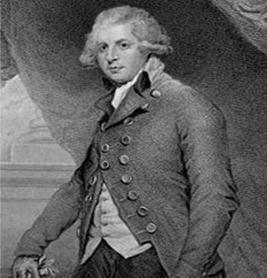
Now, like I said before, Sraffa's book is a Prelude. Not answering these questions is a flaw, but it is a flaw that I think Sraffa would be happy to cop. Classical economics had an answer for these - one that Sraffa leaves carefully in the background. I'll briefly sketch Cantillon's answer as an example. You can read more here, but their notation is sometimes illegible. I'll just use words:

Cantillon was Irish, so let's draw an imaginary Ireland. There are two goods, potatoes and cake. There are two classes of people, royals and laborers. Laborers eat potatoes, royals eat cake. Assume that labor is homogeneous and land is uniform. Wages and rents are therefore uniform - otherwise, just switch to the more profitable sector (in other words: constant returns). Since there are only two goods, one can now solve for equilibrium based on the balance of income flows. The fund for labor for growing cake (that is, the uniform wage times the quantity so employed) must exactly be the total rent received for growing potatoes. Since rent is the same everywhere, this gives us the total rent  - which must also be the amount spent on cake. The number of laborers in the economy is a function of the amount of potatoes grown. Hopefully, there is some amount of potatoes that results in a stable population. That ratio decides the amount spent on potatoes the labor supply. Since we know the wages and the labour supply, we know the wages fund. We can then keep working through until we've solved for prices and quantities separately. With Cantillon's assumptions, everything is proportional to the quantity of land with proportionality constant coming from technology.

There are many differences between this argument and Sraffa's argument. In Cantillon's system, there is a clear - albeit slow - equilibrating social force. If "too much" land is given to growing potatoes, population will grow and wages will fall. As a result, landowners will be able to grow lots of cake cheaply until population falls again. If "too much" land is given to growing cake, then the population will be forced down and wages will rise until landowners are forced to change their pattern of land use. God chose the final distribution when he made man an animal.

Sraffa was intensely concerned to not assume uniform land and constant returns - in his system, rent is not uniform across land. He didn't want to spurn his first paper. If land is uniform, all patterns of land use are equally valid. But if land is starkly non-uniform as Sraffa believes (or at least, believes it is important not to rule out a priori), then a pattern of land use consistent with population stability may not even exist (though I have no proof of this). Nowhere in Production Of Commodities By Means Of Commodities does Sraffa even mention determinants of population!
Henry George

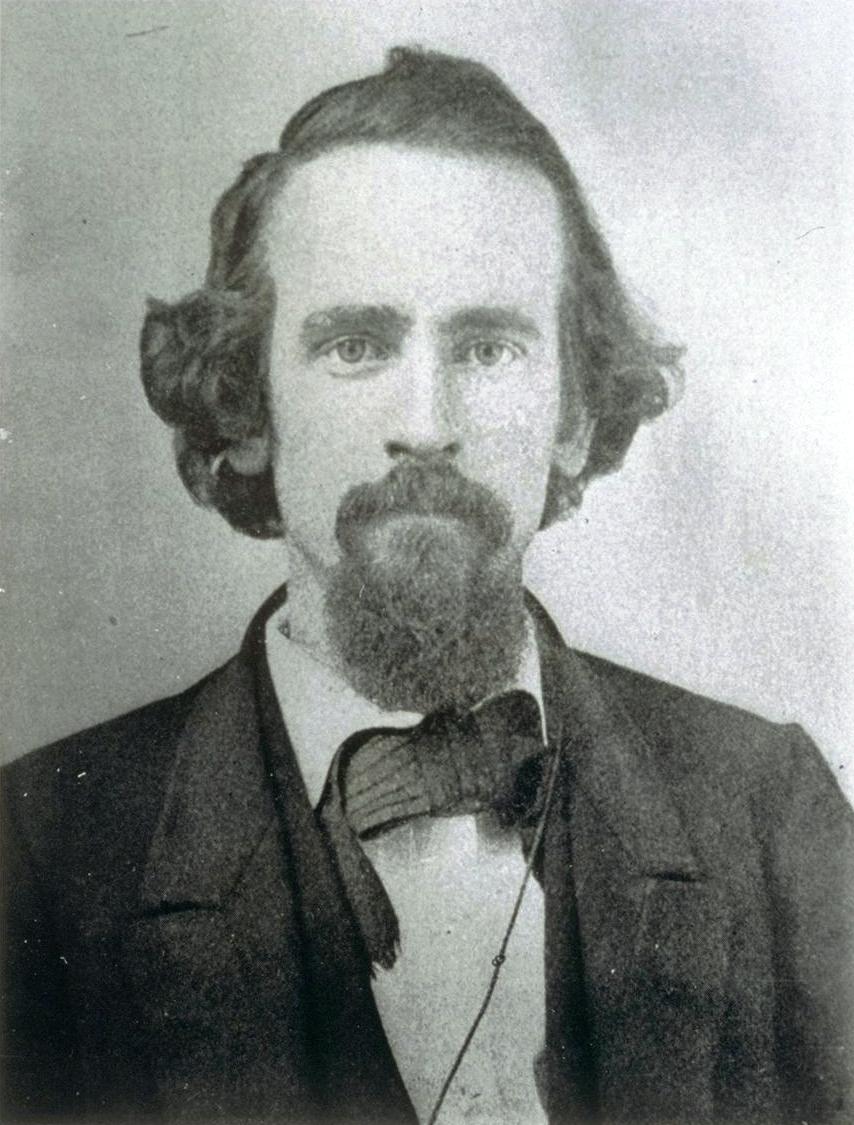
Earlier I said that Sraffa's analysis is full of innuendo and carefully laid traps. His discussion of Land Value Tax (LVT) is an example. Because land cannot be produced and therefore isn't in that set of self-reproducing commodities called "basic" by Sraffa, a LVT cannot affect production and therefore is not economic. It falls entirely on the landlord. This result is identical to the usual, "supply and demand" result, though less general (since the supply and demand result holds even if land is mispriced). But it carefully hints at the basic definition of what is and is not an economic result. Sraffa implicitly argues that there is no economic argument against a Land Value Tax because it doesn't affect production - implicitly defining economics in a way that emphasizes production.

Vilfredo Pareto

From the perspective of Pareto, this definition is by its very nature political - it values some people (producers) over others (landowners). You might agree - as I do, on basically utilitarian grounds - with a stiff LVT, but to simply dismiss landowners outright and a priori is a little shocking!

I'm sure that Sraffa could entirely defeat me philosophically, that he had very good arguments that this and not, say, "the optimal use of scarce resources for given ends" is the best way to do political economy. I'm sure he could give a good reason why this and not, say, Rawlsian reasons are the best reasoning behind an LVT. I'm sure he could give a good reason that the resulting distribution would be "just" to any Nozickian objectors (such as James Mill). But he doesn't deploy these reasons openly in Production Of Commodities By Means Of Commodities.

Piero Sraffa

Considered as a foundation of economics, there are many other things lacking in Sraffa's slim book - money, uncertainty, technical progress, etc. - but I can forgive all of these in return for it's flash and fire. I find it very hard to forgive the lack of an equilibrating mechanism.

Friday, October 21, 2016

Get Some Sleep!: A Contextual Review Of Dont Look Back

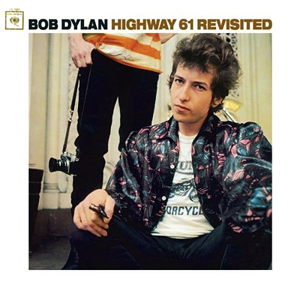
Bob Dylan

Starting on Friday, April 30th 1965, Bob Dylan made a 11 day concert tour of England - the first organized "concert tour" he ever went on. D A Pennebaker convinced Dylan or someone to let him follow Dylan around with a camera the whole time. This ended up being a movie:

Specifically, This Movie


In May of 1965, Dylan was about to turn 24 years old and three years deep into a record contract. He had an intense cult following and critical acclaim to spare, but was having difficulties turning this into album sales. His latest single "Subterranean Homesick Blues" - a deeply weird folk-rap with a shambolic garage rock backing - had managed to scrape the bottom of the US charts (number 39!) even as it ripped his folk purist cult following to shreds. His albums weren't doing much better - his first album had bombed so hard that it nearly destroyed not only his own career, but that of the executive that hired him. Two of his next three albums managed to make it into the top 30, but it was clear to anyone who looked at a checkbook that the songs (which included "Blowin' In The Wind" and "Times They Are A-Changin'") were being quoted, covered and ripped off more than bought.

This was the first image that came up when I typed "UK 1965" into Google.


But Bob Dylan records were selling much better in England, where they had some distinct advantages. The Beatles seal of approval, for one. They practically worshiped Bob Dylan, and their word was worth a lot. Another was distance from Dylan's strident pro-Civil Rights activism. Dylan had refused to go on tastemaker Ed Sullivan's show when CBS asked Dylan to drop a satirical song (Sullivan defended Dylan, but it added up to nothing). Finally, England is itself a smaller audience where word of mouth can consume an entire country. Dylan's pitbull manager Al Grossman (who surreptitiously helped himself to 50% of Dylan's songwriter fees - just in case you thought the most acclaimed songwriter in America could get rich) made a deal for an English concert tour with English super-agent Tito Burns. The money was clear - Bob's second album was the "fastest selling folk album in the history of England" according to a reporter somewhere in the movie.


Seated: Grossman, Dylan and Baez


According to a newspaper article read aloud in the movie, Dylan arrived in England by plane mere hours before his first scheduled concert in Sheffield. With Dylan were his aforementioned manager Al Grossman; Bob's famous, successful and beautiful girlfriend Joan Baez; unpleasant hanger-on Bob Neuwirth and super-producer Tom Wilson (who, if you need bonafides, produced Sun Ra's first professional album). Each of these people is leeching out something different from him: Wilson and Dylan are still developing their folk-rock sound; Neuwirth is a hanger-on; Baez came thinking she'd get to perform a few nights with Dylan; and Grossman is Dylan and Baez's manager.

Tito Burns is to the right


There's a lot of mean spirit in this movie. At one point, Tito Burns and Al Grossman conspire to put the BBC and another promotion into a bidding war over a Dylan appearance. Burns is convinced they can get the fee raised to £1,500, but not if they demand it right off the bat. One gets the feeling that The Beatles didn't have to fight over £300 (which, admittedly, is $6,712 in 2016 money). I'm still not sure if Bob Neuwirth had any job at all beyond being mean to everyone except alpha dogs Dylan, Grossman and Wilson.

Bob Dylan and D A Pennebaker

But in terms of personal cruelty, the central figure is Ol' Robert Dylan himself. The only thing that stops Dylan from being completely unsympathetic is his tendency to retreat into himself when annoyed. There's a scene early in the movie when Dylan is signing autographs from some fangirls and one of them off handedly mentions she likes his acoustic stuff better than his electric stuff. She has no idea that she stepped right on an issue Dylan is extremely sensitive about, and one can see Dylan physically choke back venom even though he knows that there is no point and no victory in spitting it at this school girl. Dylan frequently rags on the perfectly nice Donovan, for no particular reason except that Donovan's name keeps randomly popping up during his tour. Dylan obsesses over chart performance and filling halls - as he has to at this point in his career. Indifference is a luxury. It seems to be obvious to everyone except Joan Baez that Dylan and Baez's relationship is over - he barely acknowledges her until she starts singing Hank Williams songs and he never gets around to putting her on stage (aka the entire fucking reason she flew to England). Once she gets the message, she disappears and Dylan's behavior no longer benefits from having her positivity as a chaser.


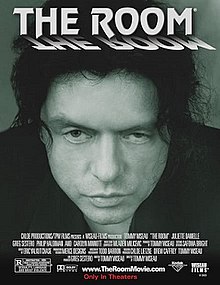
Tommy Wiseau imitating Dylan

Dylan is trying to make a contradiction real. In order to function he has to be a celebrity - he's a singer-songwriter, not a corner-store druggist after all. But Dylan is incapable of giving straight answers to anyone. Over the course of the movie, he gives increasingly petty attacks to the press. Recall the episode of the high school girls - they love and own every Bob Dylan record, but they don't like them his way (the little monsters). Like Tommy Wiseau, Dylan combines a lust for fame and a demand for anonymity.

If it seems like I keep returning to the fangirls, I suppose I should be honest about why. Because he can't just spew hatred at them, it's the only time in the whole movie Bob Dylan says anything interesting. One of the girls says Subterranean Homesick Blues "... doesn't sound like you", to which Dylan responds "But I made it with my friends. I got a right to make things with my friends, don't I?". If Dylan could have been that disarming and unusual with the reporters, they'd take their pound of copy and leave.

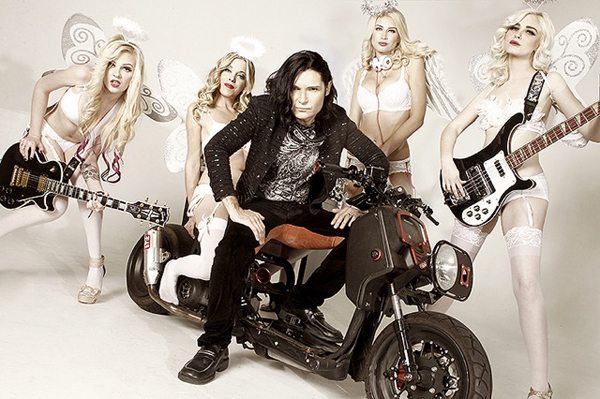
Corey Feldman is an illustration of "not making it". Sorry, Mr Feldman.


Watching this movie again, the truly fascinating thing about this movie isn't necessarily what happens as what failed to happen. Legendary Nobel Prize Winner Bob Dylan is, in this movie and at this point in his life, nothing but a low-to-mid-level celebrity so wrapped up in himself that he can barely function. There have been plenty of musicians with more success than Dylan has had at the point of this movie that went on to be nothing. People go from six figure advances to their parent's basements easier than you might think. It wouldn't be hard to imagine a world in which grocery store owner & college drop-out Bobby Zimmerman is bemused to see his songs on bargain 60's CD collections. He shows up on Where Are They Now? shows to explain how the early recall of Freewheelin' and Grossman's management made it impossible for him to make money. Even more darkly, in that world, Subterranean Homesick Blues is remembered on awful What Were They Thinking? TV as an incomprehensible attempt to sell out to rising of electrified rock while still appealing to the oh-so-massive Beat poet audience.


Yes, I'm glad to say some good came out of all this. You see, Dylan was able to channel all the negativity and anger he exuded in this movie into a song - you might have heard of it. This song went to number 2 (kept off by The Beatles, of course) and retroactively made Dylan into an Always Is instead of the Has Been he might have been. Tom Wilson produced that song, which is remembered as the crowning achievement of his long and varied career. Joan Baez recovered from the break-up to make some of her most artistically interesting records, including perhaps the greatest Christmas Album ever. Al Grossman, Tito Burns and 8 concert hall owners made good money. Even Donovan embraced folk rock with "Sunshine Superman" and never looked back. That's a precedent that I'll now follow.

I made it through an entire review of a folk music movie without mentioning A Mighty Wind. This ending is just to fix that.

Sunday, September 25, 2016

Isn't This Such A Utopia? Mother 3 Review


I recently finished playing the Japanese Role Playing Game (JRPG) Mother 3 in its fan translation. This was an excellent game which continues the series tradition of great writing, fun game play and wonderful music. Let's start with a bit of background.

The Mother series of JRPGs is the brain child of the famous author and copywriter Shigesato Itoi and many of his traditional themes are developed in the series. Mother began as something of a joke. It's conception commenced after one day (I think he was stuck sick, but I can't remember where I read this), Itoi decided to play DragonQuest III (a new hit game at the time). He became intrigued by its simplistic, shonen manga-like writing and found himself narrating along to the battles. Itoi, at the time a well known advertiser, decided to approach Shigeru Miyamoto - the creator of Mario and others - with a pitch for a video game set in modern day with preteen characters. They developed a friendship and professional relationship that would end up being very important - Itoi, for instance, was the one who convinced Miyamoto to drop Ultra from the name "Nintendo Ultra 64". This was one of the first "celebrity" video games, and recall that the last time a celebrity made a joke video game it didn't go so well. We're lucky we got what we did.


Mother (in English, EarthBound Beginnings) is a very important series for the history of JRPGs. It's design (in particular, the way it approached the world map) clearly influenced Pokemon and Itoi's gentle but epic tone helped pave the way for the approach later Nintendo games, such as some of the Legend Of Zelda games or Super Mario Galaxy, would aim for. That being said, it isn't hard to tell that its the work of someone who doesn't have much experience making games. It's unbalanced and obviously not very play-tested. And moving to the third hand, the soundtrack was a huge, unexpected success, to the point that it was decided to release the soundtrack in a traditional form. (Yes, that is the most 80's thing in history, but in a fun way)


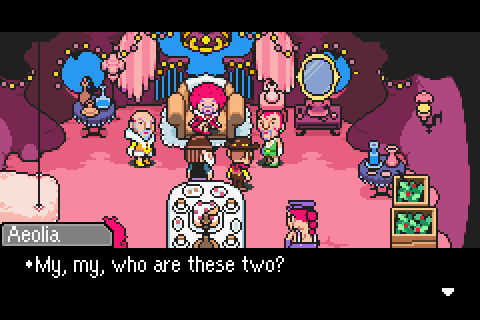
The second game in the series, called Mother 2 in Japan and EarthBound in English, is the big epic of the series. I'm going to do a lot of comparison between Mother 2 and 3 later, but let's talk about the place of EarthBound in the biz first. First of all, its tagline was "Adults, children, and even older sisters.". Normally one wouldn't talk about a tagline as being important - but remember that Itoi is a copywriter/advertiser first and a video game designer 12th or 15th. From a business perspective Itoi, Miyamoto and Iwata (another very important Nintendo higher-up) had the goal of making a game that would reach beyond the so-called "otaku" young male nerd market and appeal to "older sisters". In order to do this, Itoi aimed to make a game with a plot, themes and style that would speak to ordinary people. Therefore, the general goal was to avoid, say, dragons salivating over nubile elf princesses. I think the right comparison would be to Steven Speilberg's film E.T. vs ... maybe, Frank Herbert's Dune. The mainstream audience isn't interested in the machinations of the mentat Thufir Hawat against the House Harkonnen (even though technically, they're all human). They find it much easier to see little Eliot find his place in the world through friendship and hardship. A sci-fi adventure in a world with chrysanthemums and Reese's Pieces is just plain more interesting to normal people (sorry fellow SF fans). The advantage of a long development time, much larger space and much more powerful machinery allowed Itoi to explore and decorate the world of Ness's adventure much more intricately. One of his goals, for example, was to fill the world with whimsical and useless things - much more like our own than the typical RPG where every little thing matters. And, like EarthBound Beginnings to some extent, this game used a deliberately cartoony, Peanuts-like art style to emphasize its difference with the shonen manga style prevalent among JRPGs then and now.

Claus, clay sculpture

Well, now that we know where Mother 3 came from, we can talk about what it is. I'm going to leave spoilers to a special spoiler section. Let's start with the characters, setting, plot and what have you.

 Lucas, clay sculpture

Like its predecessor EarthBound, Mother 3 has a rich cast of characters. There's main character Lucas (pictured above), ninja/bassist Duster, enslaved dancing monkey Salsa, punk rock girl Princess Kumatora, serious rancher & father Flint, mysterious giant Leder (an obvious Twin Peaks reference, which I am always on the look out for), cruel and banana loving merchant Fassad, the sexless Magypsies, the lovably egotistical Rope Snake (I was not expecting this to even be a character, much less the hilarious one he was) and many more besides. Itoi really went out of his way to try to make the characters encompass many personalities. For instance, the aforementioned Duster has partial paralysis in his left leg. In a "normal" game, he would have ended up without this quirk. But in Mother 3 it's just allowed to be part of who he is. It's not often in video games that a character is just allowed to be disabled like that. That being said, there sure aren't many black people....


Partially as a result of this diversity, there are a surprising number of gay jokes in Mother 3, which I really wasn't expecting. The sexless Magypsies, for instance, hew pretty closely to crossdressing okama stereotypes. I found them funny, you might not.


The Nowhere Islands provide our quirky setting and its hidden secrets. More than the islands themselves, the game centers on Tazmily Village, a utopian place where people do what they want for each other because they want to. If you bring nuts to one woman, she bakes them into bread. The local "store" has items sitting on the ground. The jail has never been used, because there isn't any crime. The plot of Mother 3 requires the various leads to continuously return to Tazmily Village and watch how it evolves. Money is invented, alienated labor is introduced and commodified entertainment is brought in as a pain killer. Dangerous politics are played with as the borderline-fascistic Pigmasks control access to good employment (and, by extension, the entertainment). Itoi does a good job of avoiding being preachy or boring with these ideas, which is pretty amazing. The Pigmasks are people who the characters develop relationships with, the foreman is even appreciative of all the work your doing. The aforementioned commodified entertainment is a band that really does love music and its audience. It would have been easy to go the lazy route and make the Pigmasks inhuman jerks and the band pro-slavery sloganeers, but it would also be cheap. And avoiding the cheap turned out to be pretty important a the secrets of the Nowhere Islands are slowly revealed...

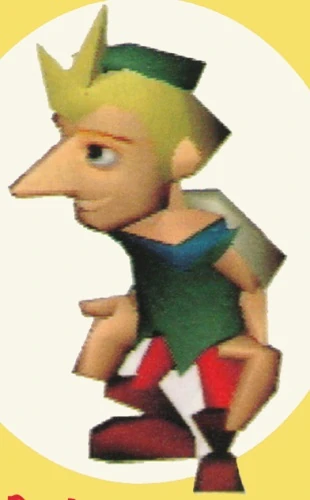
Character design from an early, 3D version of Mother 3

Mother 3 has basically the same art style as EarthBound, which is great because - as you can see above - early 3D art looked terrible and is now extremely dated. The march of time allows Mother 3 to do a lot more with what it has than EarthBound. There's some funny animation in there, not just having the sprites move up and down. Needless to say, the music is uniformly excellent, which even plays a role in game play. If the player presses the attack button in sync with the music, they'll perform an extra attack (up to 16). However, these extra attacks do little extra damage and clash with the way the damage is tabulated. Like in EarthBound, when a player character is hit their health rolls downward over time. If one is quick, a character can be fatally injured several times over and still be in battle. Healing a sufficiently large amount instantly reverses the counter, saving the character from dropping out of the battle. These tactics, however, cannot be combined with the amount of time it takes to do 16 hits.

While I'm complaining, it really annoyed me that my PP wasn't refilled after boss battles. I don't know why, but sometimes it seemed not even my health was replenished. Unlike EarthBound, enemies don't run after you've beaten the local boss, so this made for some painful limps home (I never died because of this, but it was annoying). These are my only complaints about the game play, which otherwise is loads of fun.


Before we move on to spoilers, I want to do more comparison with EarthBound. In some ways, Mother 3 is a superior game. I mentioned already the animation and variety of characters. I'm also happy to add that the most annoying game play flaw of EarthBound - dealing with an inventory system full of useless quest items - has been completely addressed. Quest items are now helpfully tucked away in their own space. Though the plots are very different, both games are basically a Hero's Journey (some argue that all stories are a hero's journey and this may be so, but they aren't all helpfully described as one). But, in my opinion, Mother 3 simply feels less epic than EarthBound. It may be the case that on a technical level, the Nowhere Islands are larger than Eagleland. But Ness's quest feels like more of a quest. I think that a lot of it has to do with the fact that Lucas is constantly returning to Tazmily Village (until the very end), while Ness is going from city to city. The overall thrust is the same: Ness goes from the comfort (and free room & board) of his family through a succession of larger and more expensive cities - meanwhile, Lucas sees Tazmily village from the primitive, utopian togetherness of the beginning to seeing it become a post-industrial semi-ghost town as everyone moves to the big city. But with more literal distance, Ness's journey feels like ... more of a journey. Only in the last chapter is Lucas really all that far from home. By the time you control him, he's already over his fearfulness from the first two chapters. It would be nice to have been part of that experience. Ness's process of growing up was represented in game play in a very clever way - at lower levels he was prone to suddenly become homesick and would randomly fight sub-optimally. Since Ness is by far the most powerful character, this could be very dangerous! After you've leveled up enough this stops happening. Lucas's growth process doesn't directly affect game play. It may or may not help that a major reveal in Mother 3 is the way it is tied into EarthBound, which made me feel as though the game I was playing was sort of a side game and the "real EarthBound 2" was about Ness's reaction to Porky's message at the end of that game...

SPOILERS

There are two stages to the major reveals of Mother 3.

The first happens once you reach Chapter 7, the centerpiece of the game. It is revealed that the Nowhere Islands are on top of a sleeping, godlike power known as The Dragon. This is hinted at very early in the game. The ageless Magypsies are tied to magical objects known as The Needles, which keep The Dragon slumbering. Only a chosen hero can remove The Needles, and I don't think I'm breaking any hearts when I reveal that the lead character happens to be chosen. Whoever should draw The Needles will have control over the nature of The Dragon when it awakes. Oh, and by the way - your creepy fascist enemies have someone who can draw needles too...

The second round of reveals take place in New Pork City. The most obvious reveal is the true nature of your creepy fascist enemies. They are controlled by Porky Minch, who you might recall from EarthBound. As you recall, traveling through time and across universes left him insane, immortal and very powerful. Leder, the mysterious giant from the first few chapters, goes on to reveal more secrets around this time. The world that the Nowhere Islands exist in is on the border of being completely destroyed. The power of The Dragon keeps the Nowhere Islands from themselves collapsing into the chaos of the surrounding world. The original inhabitants of the Nowhere Islands (which they called the Kingdom Of Oshoe) are gone, only the Magypsies remain. The current inhabitants are refugees from the destroyed outside world who wiped out their memories to try to make their new civilization peaceful. Only Leder was left with the memories to reveal in case it was necessary, otherwise the magical Egg Of Light kept the memories suppressed.

Now comes the speculation. How does this world exist in reference to the original EarthBound? Where are the Nowhere Islands in comparison to Eagleland? It's usually assumed that the Nowhere Islands are just somewhere in Eagleland's future, only thousands or even millions of years later.  We know Porky can travel across worlds as well as time, so his presence proves nothing. However, there is another hint that this is the same world - Lucas's family has Ness's Franklin Badge (which plays an important role in the plot, so it's clear we were supposed to notice this connection). Again, to play the third blackbird in Wallace Stevens's tree, this is not quite conclusive evidence since the badge is obviously supposed to be connected to Benjamin Franklin, so it might not be necessarily Ness's Franklin Badge (I have a hard time swallowing this though).

Let's posit the Nowhere Islands exist parallel to Eagleland for a moment. What consequences could that possibly have? I think this theory's chief virtue is the sense it makes of Porky's loneliness. Porky can travel across infinite spaces and flit through time at random, but he can't do the one thing he wants - gain the love and respect of the people he cares about. He nearly completely destroyed the world in which the Nowhere Islands exist, because his only remaining goal in "life" (if you can call a being in his state "alive") is to destroy "everyone who doesn't like [him]". Even Porky can see the pointlessness of destroying the world - in many ways his plans in Mother 2 and 3 are brilliant. His plan in Mother 2 was the more sensible conquest after all. But if it is just one world among many, it becomes easier to see his behavior from his end as a game. The Dragon is just another omnipotent psychic monstrosity to unleash on another doomed little world, just as Giygas was in the original worldline. Because of this, I think that it is best to think of Mother 3's setting as being parallel to EarthBound's (or at least, so far in the future that they might as well be).

It has the side advantage of not canceling out Mother 2's ending as well.

NO SPOILERS

So, that's about all I have to say about this game for now. It's a great game that I recommend to anyone with the 20 or so hours to spare it take to play it. Have fun!

Wednesday, September 14, 2016

Karl Marx And The Birth Of "Nations"

K Marx
 
In celebration of the 149th publishing day of Capital Vol I, I want to talk about something Marx never did. But let's approach it through him anyway. Let's start with a highly simplified version of Marx's historical period idea. Do you remember what Capitalism is, kids? That's right boys and girls, Marx defined capitalism as when the means of production (capital goods) are owned privately. The owners are called, conveniently enough, "capitalists". Capitalists are that large and politically powerful class of people who make their money off just owning said capital - called "profit". This gives rise to a Prisoner's Dilemma: if you - the capitalist - have more capital than your brother, then you win and make more and the same for him. But if you both try to buy more capital, that just lowers the price and therefore the profit. Do you remember Marx's word for such a fatal Prisoner's Dilemma? That's right, kids, it was "contradiction"!

Now remember Marx's outline of current history (current to him): Today we have the Capitalist mode of production, which was born from the contradictions of the Feudal mode of production and whose own contradictions will give rise to the Socialist mode of production (which totally will have no Prisoner Dilemma contradiction, promise).

Charlemagne (Left) and his son Pippin (right, with the hunchback)

What was the Feudal mode of production? It was dominated by powerful landowners called "Lords" who made their living off just owning land - called "rent" instead of profit. The contradiction of Feudal mode of production was that the core of it was zero-sum, nobody could have more land without taking it from someone else. Meanwhile, capital can be accumulated (this is called "primitive accumulation of capital") until its returns are more powerful than the rent of the local prince. Once this is achieved, its only a matter of time - Marx claimed - until the Capitalists take over. Because primitive accumulation of capital is insanely slow, this takes a long time. The Feudal mode of production completely dominated the world (off an on, sometimes empires fail for reasons unrelated to growth) from the time Sargon Of Akkad overtook the city of Uruk in 2340 BC until about 1776 AD, when the first explicitly non-feudal country was founded, and partially dominated it until WWI or II wiped the last bits of Feudalism off the Earth.

Otto Leopold, Prince of Bismarck

Marx isn't usually given credit for some predictions related to this, which he should. As he developed and perfected his system, the crafty Otto von Bismarck and his allies were carefully crafting a German superstate dominated by the Prussian Junkers class of landed noblemen. Lords, not Capitalists. Marx's prediction that this state could not be stable due to misjudging the economic base was interesting and basically correct (though perhaps not accurate in detail). Instead, Marx is blamed for his prediction that class would become the basis for politics (instead of nation or dedication to transclass and transnational liberal concerns). It is fair to blame him for this, but incomplete.

Gilgamesh I, King of Uruk
 
What gave rise to the Feudal mode of production? Well, the Feudal mode of production was based on high level elites (Emperors/Popes) exploiting low level elites (Princes) who themselves exploited peasants. This evolved out the Asiatic mode of production (Uncle Karl was not terribly politically correct), in which there were only equally sized local lords vying over the rents of their neighbor's land. The contradiction here is obvious - there's a Prisoner's Dilemma over whether two neighboring countries should go to war. The end of this mode of production coincided approximately with the beginning of history.

Nobody, Just A Drawing. Chill.

The "Asiatic" mode of production itself evolves out of the truly ancient mode of production, in which there are basically only individuals that give to their families ("primitive socialism"). Hmm...

If this outline seems bad, there are four reasons. One is that I don't remember every detail of Marx's theory and it is nothing if not detailed. Two is that I deliberately left some things out that I do know, because they aren't important for what I want to talk about. The third is that Marx was human and his theory was not perfect. The fourth is that I'm a bad writer with unclear ideas.

George C Williams

Okay, now I will deliver on my promise to talk about something Marx never did. In 1966, George C Williams launched an attack on the idea of group selection in his book Adaptation And Natural Selection. I see this as essentially taking our models of natural selection seriously. Our models include things like stable gene frequency ratios and fitness returns to individual genes, but nothing like staying in a group for the good of one and all. Williams could use the example of the life-cycle: why do we, human beings, die? It must be an biological trait, but how can that have a positive return under natural selection. There are organisms that do not age. The reason is because natural selection does not work on "us", but on genes. It might be worth it to a gene to be in an ever changing bundle of individuals. One reason could be that this shields it from happenstance of being placed with bad genes that make the individuals sick. Another reason is that genes can have multiple functions and dysfunctions over the life-cycle.

 W D Hamilton

If we abandon the unsound idea that evolution happens to individuals or groups, then how can groups exist at all? The first - but by no means sole - sound explanation came from W D Hamilton, who came up with "kin selection". The basic idea is that if a gene is in - or probably in - three individuals then it is in - or probably in - that gene's advantage to act the same in all three. The more related two individuals are, the less evolution can act on their differences. For instance, many of the cells in my body are almost perfectly related, so they all work together. That group of cells is "me", in a sense.

This isn't the only way groups can form. There are myriad helpful bacteria inside of me, maintaining my current state. I am not closely related to them, they are bacteria and I am a mammal. However, if they do good for me and I do good for them (by continuing eating). The genes within us maintain an equilibrium of reciprocal altruism - my immune system will exact harsh punishment to those bacteria that defect. This isn't "group selection" per se, all of this happens for the good of the genes and not those bacteria and I (we've never met). And it has to happen directly - there's no reciprocal altruism among individuals who can never meet (that's group selection). But it shows how careful one has to be.

Okay, but what does this have to do with Marx? The issue today is to go from the ancient mode of production up to the Feudal mode, past that into the Capitalist mode (and hey, can't forget the mysterious Socialist mode!), all while grounded in a psychology where brains are mostly made of fatty tissue. Where does the ultra-sociality of humans come from, if anywhere?

Mancur Olson

The above history, which I attributed to Marx, is actually much older. Thucydides, if he didn't expound it, could have. And there is certainly no shortage of explanations how one travels from one period to another. One very nice modern version of the trip from the primitive to the Asiatic mode of production is found in a paper by Mancur Olson. Start in a primitive mode of production. In this stage of history, people live in primitive communism based mostly on kin selection. They can also try to steal from each other, or band together to steal from a third party (reciprocal ... "altruism"). If everyone is in a roaming kinship band of hunter-gardener-thieves in a flat, undifferentiated world, they have no incentive to break out of this system. But lets say some gardens are better than others (maybe they're closer to water, maybe their land is more fertile). A stationary band of hunter-gardener-thieves has very different incentives than a roaming one. If the thieves are too nasty, people will abandon the garden for a worse one far from them. The thieves also have incentives to provide for a better garden (more to steal). These incentives are perverse from the point of view of a thief but positive from the point of view of a gardener (or, now that they are stationary, a farmer). They are the contradictions of the ancient mode of production. The leader of this group of thieves has become the first Asiatic king.

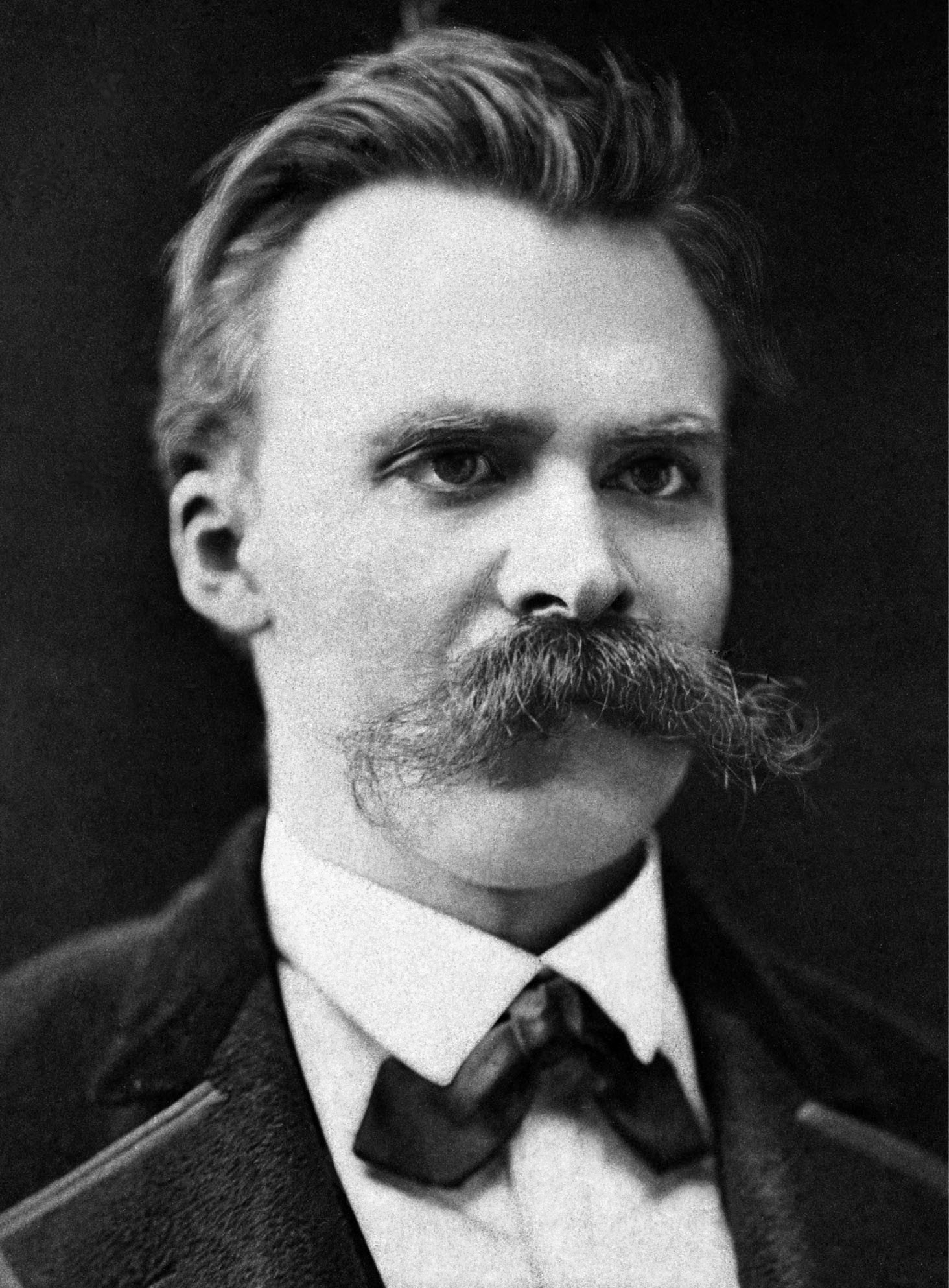
Frederich Nietzsche

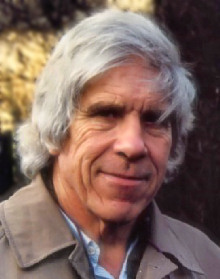
This point of view, common to Marx, Hume and down to today, has been widely propagated. There seems to be little to criticize, except in a few details of exposition. But is there an alternative? The psychology in the above exposition is very English, in sense of the classical Humean Utilitarian school. People act according to their interests as best they can, and genes do the same more perfectly. But we know that this isn't a very good psychology. Can't you hear Nietzsche laughing at us for "looking for the efficient, governing, and decisive principle in that precise quarter [that is, Morals] where the intellectual self-respect of the race would be the most reluctant to find it (for example, in the vis inertia of habit, or in forgetfulness, or in a blind and fortuitous mechanism and association of ideas, or in some factor that is purely passive, reflex, molecular, or fundamentally stupid)"?

Yes, that's what we need. Not just a list of perverse incentives and Prisoners Dilemmas (in the old Marxian language again: "contradictions of society"), but a real living Genealogy of Development - Morals, if one holds with Marx that they too are derived from the means of production. But how could "the inertia of habit" form empires?

Sarah Brosnan

A new view could be evolving out of ... evolutionary psychology! Not the stuff you see mouthbreathers on the internet, the "examining how monkeys play games" stuff. Sarah Brosnan at the CEBUS Lab of Georgia State University has been doing fascinating work examining how - well, how monkeys play games in order to try to understand their reactions to unfairness. She finds that they don't like it! Brosnan proposes that monkeys don't like unfairness and have various social methods of dealing with it. If true, this shows that far from developing out of a bandit state, high levels of social development (on beyond kin selection and reciprocal altruism) may have been the norm even in very early human societies. Keith Chen is perhaps the first economist to take this area of research seriously and literally. He interprets the behavior seen by Brosanan as being the result of simple social heuristics. In other words, "the inertia of habit" gives rise to inequity aversion. Eventually, rules to deal with inequity are made. These are the first social institutions. This is a new and possibly groundbreaking way to look at the development of early societies. Replacing the long standing Humean psychology with a more realistic and fallible Nietzchean one is to be greatly desired.

Well, that's our Das Kapital birthday tour simplified history tour. Hope you enjoyed a couple factoids. For extra credit, solve for implications of the Brosnan-Chen-Nietzchean theory for modern society and any possible future society!

Thursday, September 1, 2016

What Was, Is And Could Be Austrian Economics?

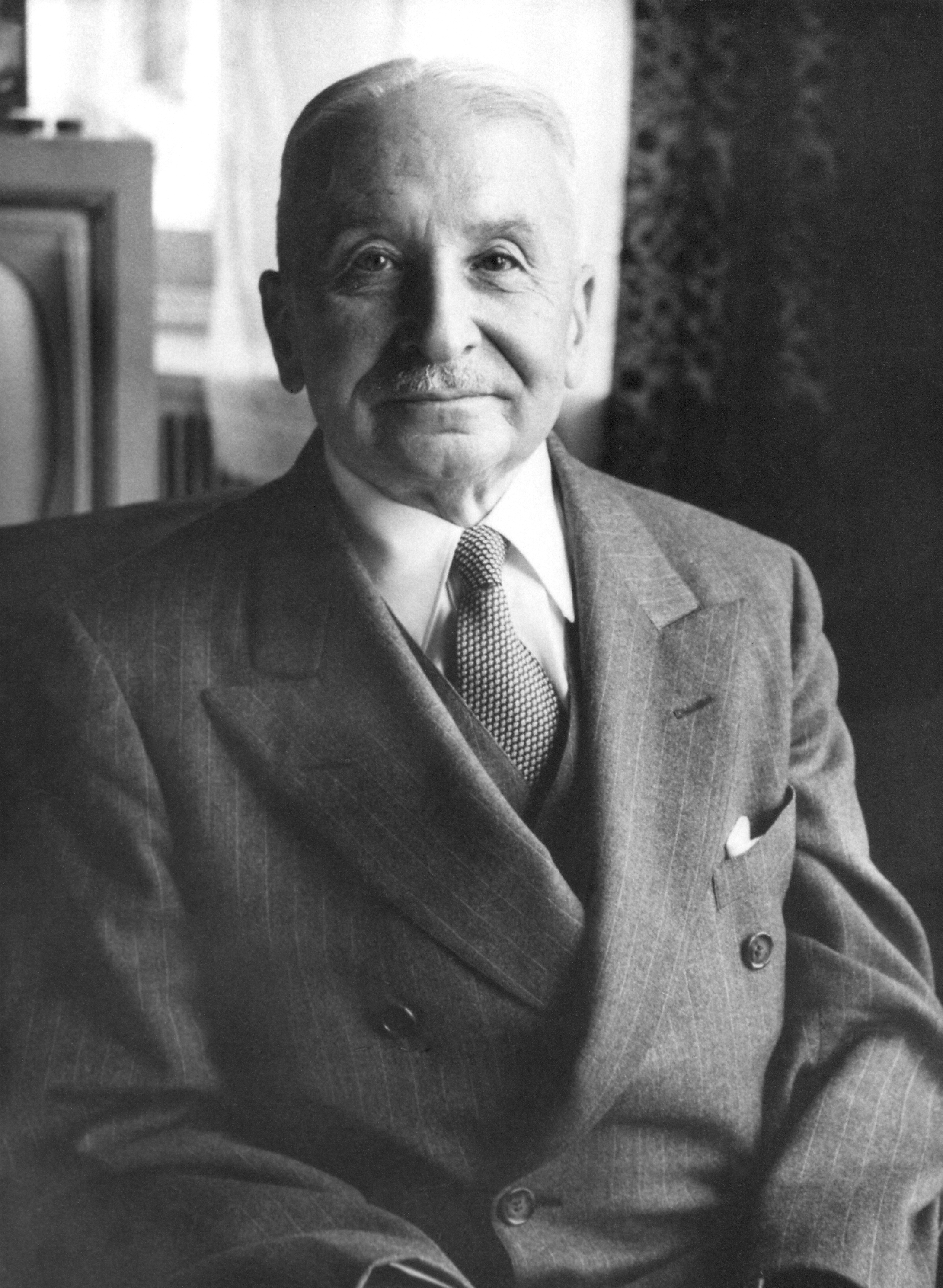
Ludwig von Mises

So-called "Austrian Economics" didn't start as a by-word for "libertarianism" (whatever that is). That's not to say it wasn't political. The elder Carl Menger was part of the generation that discovered the method of marginal analysis but he also was a close associate of Crown Prince Rudolf. But when the Austrian School was still young and vital, Austrianism was capable of having wide differences of opinion. Wieser, Menger's first student, was sympathetic to some varieties of socialism. Bohm-Bawerk (according to Wikipedia) invented income tax as an alternative to a production tax laden with perverse incentives. Bohm-Bawerk's student Schumpeter believed that breakdown of the capitalist system was necessary, but bad and to be prevented as much as possible. What happened?
Morgenstern & von Neumann

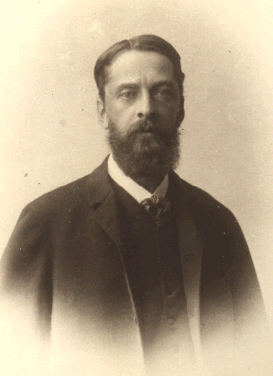
Part of the later seeming uniformity is due to the re-writing of the books to separate The Austrians from ... the Austrians. Nobody wants to remember that von Mises was chief economist for the Austrian Chamber of Commerce when the city was called "Red Vienna". Morgenstern - despite having written one of the first, best and clearest books on the dangers of using measured aggregates to guide policy (and, through this analysis, a precursor to rational expectations and random walk stock hypotheses) has been written out of the official Austrian history book. Anyone who went on to have a good career in economics has been all but abandoned by the Austrians: Abraham Wald (probably the most important non-famous economist) and the younger Karl Menger both attended and loved von Mises's seminars.

Otto Neurath

This was made possible by the intellectual environment that the Austrian economists lived in. Higher education and research in Red Vienna was unusually loose and - as a result - creative. When the economist von Mises got his doctorate, Freud was beginning his own discussion group. Freud's group included Herbert Graf, who produced Schoenberg's operas. When von Mises was dealing with reactions to his book Liberalism, Neurath and the rest of the Vienna Circle was doing the same for The Scientific Conception of the World. The time was ripe for loose collections of followers. And Ludwig von Mises was part of that.

Piero Sraffa

With that out of the way, I want to talk about what I understand to be Austrian economics. I make no attempt to reconcile it with the precise words of von Mises et. al.. I offer the following pseudo-reason tounge-in-cheek: One can argue that as a brute historical matter, the great Austrians did not completely understand their own system. So my obvious misunderstandings are going to be only following in that tradition. Once upon a time, after publishing what seemed to most like it would be the new big book on the macroeconomy (a useful phrase not yet then coined), Frederich Hayek was unable to answer his critic Piero Sraffa's simple question of why there is only one interest rate if capital is dis-aggregated. This question is easily answered (in fact, Irving Fisher had solved the problem before Hayek was born), which I take as evidence that Hayek did not understand the intertemporal equilbrium framework he proposed. Ludwig von Mises's approach to anything resembling disagreement or criticism was not to respond, but to spew bile and anger (hey, this approach seems to work for physicists), which leaves open the possibility that even if his formulation of Austrianism had a flaw, he wouldn't discover it.
Roger Garrison

As a result, I will be relying largely - but not completely - on Roger Garrison's easily understood and probably-not-entirely-stupid formulation from Time And Money. I thought this book was just the bee's knees, and anyone who likes pre-Lucas economics should check it out (preferably after you've read some less biased introductory stuff).

I will start where Garrison suggests but does not go, with a highly dis-aggregated production function. There are \( N \) goods in the economy (let's not worry about innovation and entrepreneurship yet, we're gonna start with an "evenly rotating economy"). The production function is therefore is a vector function \( \vec{f} : \mathbb{R}^{+N} \to \mathbb{R}^{+N} \). The quantity of outputs of each good is summarized in the vector \( \vec{Q_1} \in \mathbb{R}^{+N} \) , the quantity of inputs of each good is summarized in the vector \( \vec{Q_0} \in \mathbb{R}^{+N} \), the quantity of labor allocated to the production of each good is \( \vec{L} \in \mathbb{R}^{+N} \), and the quantity of land allocated to each good is \( \vec{T} \in \mathbb{R}^{+N} \). For each \( \vec{L} \) and \( \vec{T} \) fixed, I assume there is a unique stable growth path. I will assume these are fixed for the rest of this post and therefore ignore writing them over and over again. Around this stable growth path, the "means of production reproduce themselves" in Marxist language. I will call this the "golden path". That is,

\[ \vec{Q_1} = \vec{f}(\vec{Q_0}) \approx A \vec{Q_0} \]

around the growth path for an all positive matrix \( A \) (there are weaker conditions than positivity, I won't use them). By the Perron-Frobenius theorem, there is therefore a unique, positive, simple largest eigenvalue \( \lambda \) with an all-positive eigenvector \( \vec{\lambda} \). Obviously, the real interest rate is then \( r  = \lambda - 1 \).

Every other eigenvector of \( A \) has at least one negative component. One might think (with some allowance for vagueness and intuition) that any small deviation from the golden growth path will involve some eating of resources, which will eventually return the system to the golden path.

This is a loose, "Austrian" version of a Turnpike "Theorem". I put "Austrian" in quotes because a Marxist could accept it and "Theorem" in quotes because it isn't anything near a theorem. Let me pause to explain why I think it could be seen as Austrian. Let's say the initial quantity of goods \( \vec{Q_0} = a \vec{\lambda} + b \vec{v} \), for \( a,b > 0 \) but \( b \ll 1\). The initial quantity is "mal-distributed", the \( b \vec{v} \) portion of the distribution is actually going to destroy some goods. But if the production function is iterated (i.e. the market is allowed to operate without interference), because \( \lambda \) is the largest eigenvalue the system will eventually go back to the equilibrium growth path. This won't be caught by all aggregates (that is, non-negative scalar functions \(g(\vec{Q}) \) ), so using them to guide the economy might not be the best.

Trotsky

Let's pause for a moment. Now I think this is a good mathematical approach to von Mises's position, but I haven't yet captured the idea in its entirety. So far, there is nothing in the above that would ruffle the leather jacket of a loyal Communist leader. In order to complete this theory, one would need to describe the method by which final demand impute backwards to determine \(\vec{f} \) and \( A \). This imputation process is where the system becomes neoclassical and eventually perhaps distinctively Austrian.

Frederich von Wieser
 
The Austrian economist who completely developed this theory was Wieser. Through Frank Knight into Paul Samuelson, Wieser's method has been absorbed into mainstream theory as Linear Programming. There are many technical steps along the way, for instance, as Uzawa points out the opportunity costs of factors of production are not well defined in the general case (but downward opportunity cost - the shadow price of lacking a quantum of a factor - is, which allows him to save the theory). One of the victims of the explicit thinking through is probably "roundaboutness", "capital intensity" and other scalar measures of capital except as first order approximations. Dimension is conserved by continuous functions and Brouwer will not be mocked. Even when we aggregate, we must not do so willy-nilly.

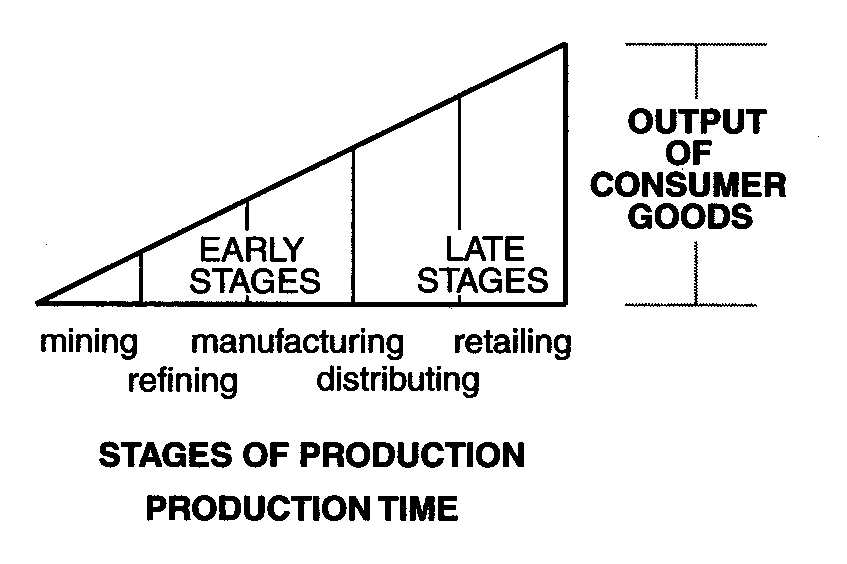
Hayek Triangle

Well, then let's move to a more aggregated view. We measure aggregate output with some scalar function \( Y = g( \vec{Q} ) \). One good such function is \( g( \vec{Q} ) = min_i (Q) \), \( g( \vec{Q} ) = \Sigma_i (Q_i) \) another. According to our earlier view, if \( Q_0 \) is near the golden path, then after \( T \) time units, \( Y = \lambda^T g(Q_0)\), or just about. Since this is an aggregate, we can even look at real data. Let's look at a nice period of time with no recessions - the Clinton years (height of the New Neo-Classical Consensus)


Obviously, this isn't evidence of anything in particular, partly because the theory so far can fit everybody from Karl Marx and Joan Robinson through Paul Samuelson and Robert Solow all the way to von Mises and Hayek.

Hey yeah, what about that? So I sort of posited a capital theory that can be verbally described as maybe having some Austrian characteristics. What about the distinctive Mises Austrian macroeconomics - where is von Mises's idea that the dance of the dollar distorts capital structure and and is the sole cause of recessions/depressions/etc.? I've left out all discussion of money so far. It's been an "evenly rotating economy", if not a barter economy.

 John Hicks

To continue further we need a money market and that for Garrison that means IS-LM. Garrison underrates the influence of his Keynesian schooling which he disliked as much as he overrates his Austrian enthusiasm which he liked. I think Garrison this gives the Austrian school more credit than they deserved by giving them the benefit of a post-war theory. The IS-LM analysis was not possible until after Keynes, General Equilibrium theory and probably much besides. Interestingly, IS-LM was invented by one of Hayek's students, the eclectic Sir John Hicks. I won't go into detail about IS-LM now, because I think that the Krugman description is basically right. One hitch for the uninitiated: most economists would say IS-LM is connected to the Keynesian Cross, but Krugman develops a model that works on nothing but neo-classical fundamentals and aggregation, so you might get confused if you use Krugman's advanced model and suddenly see someone object to a feature of the other model.

Irving Fisher

Hicks' IS-LM model is the second simplest possible money theory, but there is one simpler - the equation of exchange of Irving Fisher, Alfred Marshall etc.. This was the money model of the early neoclassicals, Mises very much included. When an Austrian tells you that printing money always leads to inflation and only inflation, they have this model in mind. I honestly doubt one could be "distinctively" Austrian with an IS-LM money model, and his use of this model explains to me why Garrison is able to approach Monetarist models when Mises and Hayek could not.

When I say "equation of exchange", I don't just mean \(M V = P Y \) - where \( M \) is the quantity of money, \( V \) is the velocity of money, \( P \) is the price level and \( Y \) is real output - though that is part of it. I mean the pre-Keynesian, pre-Friedmanian classical and neo-classical understanding of those variables as functions of the deeper economy. This isn't quite what the Austrians thought, but one must begin at the beginning. That understanding is as follows:

The meaning of \( M \) has remained unchanged and vague. The velocity of money \( V \) is best understood as \( V  = \frac{1}{k} \), where \( k\) is the portion of real output that people want to save (Garrison - and, well, everyone - represents this with a PPF curve). This is a deep and unchanging fact about human nature, society, etc. As before, aggregate output \( Y = g( \vec{Q} ) \). The price level \( P \) adjusts more or less rapidly to changes in \( M \). (Without a definition of the price level, one may not even talk about inflation.)

So the ultra-classical theory of money contains two variables and two constants. It could be better written \(\frac{M}{P} = k Y = const\) - verbally, "The real amount of money is equal to the amount of savings, which is a constant.". The problem with this ultraclassical theory is in the second equation \( k Y = const\). The problem is called the Lucas Critique, first pointed out by Keynes. There is no actual theory of which k is chosen, other than that it is related to something deep and immovable. Keynes pointed out that it should be affected by the interest rate, which is agreed upon by Garrison's PPF diagram. The point on the PPF diagram is decided by the IS-LM equilibrium. So one can see Garrison giving a Keynesian innovation to the Austrians for free isn't without consequence. Garrison's system fixes \( k \) - and therefore \( V \) - by using a general equilibrium framework in a way that was missing from pre-macro "macro".

Ludwig von Mises

Okay, okay. What does all of this have to do with Edler von Mises? Well, von Mises was not one of those who left the sentence "The price level \( P \) adjusts more or less rapidly to changes in \( M \)." alone. In fact, von Mises believed that "price level \( P \) ... less rapidly to changes in \( M \).". Remember that the real interest rate is determined by the structure of the highly dis-aggregated production function - the capital structure. This is the same in all markets, including money. But von Mises believed that it was difficult for practicing capitalists to tell the difference between a temporary mistaken change in the money or bank interest rate and the underlying true interest rate. Some entrepreneurs mistakenly switch to a technique only viable at the bank rate of interest (which drives \( Y \) up), but then get stuck when the interest rate inevitably returns to the unique real interest rate (which drives \( Y \) down). Overshooting causes a boom-bust business cycle. The only thing that can be done during the bad times is to let the mistaken entrepreneurs liquidate and purge the unstable techniques. This, I think, completes the basic overview of what is distinctive about Austrian economics as I understand it.

So what is wrong with this, if anything? I can think of four objections:

First of all, it's hard to develop realistic examples of this kind of reswitching, since reswitching takes place in logical space and not temporal. That is, von Mises and the others (Joan Robinson etc.) treat the loans behind the choice of technique as if they were constant interest rate loans, then make the interest rate vary - it's no surprise that the outcomes are paradoxical! Why haven't modern banks innovated loans that are aware of the dance of the dollar (you can really tell I love saying that)? As far as I am aware, Austrians simply haven't thought this out very well, but I could be wrong - they write an awful lot of words.

Secondly, von Mises's system assumes that the government can fool people in predictable ways, but you can't fool all the people all the time. If the government tries to take advantage of the "drives \( Y \) up" part of the Austrian business cycle during election years (and Austrians claim that they always will! They don't though), why can't people figure that out? A vague place for expectations is a huge flaw in any intertemporal system, and Austrians are all about how cool an intertemporal their system is. While on this subject, von Mises assumes that \( M \) is determined willy-nilly, not by a policy rule. Both of these are considered severe limitations in modern economics, which has gone a long way to treat them (not long enough!).

Thirdly, von Mises seems to assume that it is obvious that the direction of causation is from the means of production onto the monetary superstructure (again, using Marxist language). But, if the Daishogun declares that on pain of death the inflation rate shall be 2% and the nominal interest rate will be 5%, then eventually the capital structure will move to make the real interest rate 3% and not the Daishogun. This, arguably, is what we are seeing in the Euro Area right now. In other words, von Mises was positing a particular institutional structure (perhaps strong neo-liberalism with skittish bankers) without being explicit about it. I don't know if this is a criticism, since Austrians feel that Austrian-style institutions would be a boon...

Fourthly, we can return to the theory of positive matrices in the dis-aggregated production function. Recall that all the vectors leading away from the golden path have negative entries. I interpreted this loosely as meaning mal-distribution eats away resources (or, at least, does not produce as fast). The golden path is unique in not doing so. Therefore, we might expect mal-distribution not to create a von Mises style boom-bust cycle, but rather a Friedman style plucking model. I'm not sure that this objection holds water on a mathematical level, but examining linear algebra and the theory of positive matrices would be worth doing.

Well, I'm sure much of this has been covered before and better, so I'd be happy to take any useful comments you might have. I'd be particularly interested in demolitions (or demonstrations) of the first and fourth objections, or even just a numerical working through of the fourth objection. I hope it is clear that I am not unsympathetic to Austrian Economics, even if I don't yet think that it is as all-fired great as Garrison does. The question in the title is one that I am asking you, not one that I want to explain!