I'm working on those quantum posts, which need to be pretty detailed. This is in addition to my real life. So today I'll just share one of America's great unknown artists:
Within his looping, repetitive, raga-like song style hides sophisticated musicianship:
Hopefully you find something you love:
Friday, September 12, 2014

Thursday, September 11, 2014
Is It The Same Temperture In Every Possible World? Part 1
It's strange, but people didn't argue about the interpretation of classical mechanics. The usual explanation is that classical mechanics is intuitive, which is obviously untrue - if it was why are so many students so bad at it? Even if it wasn't obvious, psychologists have convincingly argued that our intuitive reactions to how objects move do not follow Newton's Laws. There are at least two facts about quantum mechanics that lead people to feel it needs interpretation:
- Not everything can be sharply defined at the same time. (what used to be called 'complementarity')
- Things are not, in general, continuous (what used to be called 'quanta')
However, the first reason clearly raises two questions. One is "Where does apparent sharpness come from?" and the other is "How does nature know what to make sharp?". The second question is very tough. There are a variety of answers. The original answer, enshrined in ancient texts, is that how you set up your experiment somehow decides what nature will make sharp. Explaining this led von Neumann to support the idea that the universe is guided by each human consciousness. Many leap all to quickly to reject this idea, but I will argue in a bit that it could conceivably be a theorem of quantum mechanics!

Harald and Niels Bohr
The most powerful man in early quantum mechanics was the great physicist Niels Bohr. Bohr's complete work runs 13 volumes, his scientific work covering 9 fat books. Throughout his graduate studies, Bohr worked on the problem of modeling solids (specifically, metals) with dynamical models. Einstein and Jean Perrin had convincingly shown that the atomic hypothesis was not just a convenient thought experiment, but a genuine description of the world. A couple years later, Einstein had published the first modern (that is, quantum) solid state physics model, which was a bit of a proof of concept showing that quantum mechanics could be used to new physics. Bohr's thesis included a proof that classical physics could not explain ferromagnetism. The intuition is that in classical physics, jiggling atoms are as likely to go one way or another, and since their little magnetic poles can point at any angle, there will always be enough room for them all to point different directions. This demonstrated that only quantum mechanics could explain solid state physics, which remains a very interesting and deeply quantum mechanical field!
But I digress. Bohr, when confronted by the question "How does nature know what to make sharp?" would say that there is nothing behind the experiment. All we do is observe, beyond that we can neither see nor speak. "Whereof one cannot speak, thereof one should remain silent." - Wittgenstein. Bohr was influenced in his description by positivism, but many have argued that he may have been more influenced by other philosophies, such as existentialism. Regardless of whether this vision was positivistic, pragmatic or mystical, it was accepted as gospel for some time. In this series of posts, I will explain what the possible replacements of silence could be. I'll have more on this subject in the fullness of time, including: 1) Why did people get bored with Bohr?, 2) What are the most prominent alternatives?, 3) What do the alternatives mean mathematically and philosophically? and 4) What can we believe?.
Monday, September 1, 2014
Why Can't We Be Friends: The Difference Between Bayesian And Frequentist Statistics In Two Paragraphs

Universes as plenty as blackberries

A primitive binary classifier
Frequentists (aka error statisticians) think data is random and parameters are deterministic. We know what world we are in, but have to eliminate noise, error, etc. The world itself is random! We don't need priors, we need to get an idea of how our world would change if we started in the same place. Bootstrapping and other sampling distribution techniques are good for doing exactly this. Who cares if a hypothesis matches our data really closely, our data might be filled with noise and imperfection (no likelihood principle).

An unusually calm disagreement in the social science
Bayesian and Frequentist philosophies cannot be totally reconciled, because there exists tests maximally efficient in one and incoherent in another. They are like elliptic and hyperbolic geometry in this way. Use of one theory or another for a given situation is a philosophically deep choice. One doesn't have to dismiss one or the other just because they disagree if you look at different situations. Instead one has to be honest about the flaws (and, perhaps, to a lesser extent the strengths) that one's method of choice has for the problem at hand.
Sunday, August 31, 2014
Search Theory And Idle Capacity
Through Mainly Macro, a blog about macroeconomics from a New Keynesian perspective, I discovered this paper by Pascal Michaillat and Emmanuel Saez. The associated slides are a good summary. The paper is very hardcore economics theory paper, aimed a a very hardcore economics question - why does unemployment lurch around the way it does? It's a difficult question. Why did people gainfully employed in 1928 suddenly find themselves without jobs for 11 years? No matter what your opinions are on this matter, this paper will be of a benefit to you for clarifying how that cause got into the economy as a whole.

This paper takes a search theory perspective on the subject. This improves on the repeatedly cited Barro model because it allows Saez and Michaillat to use supply and demand to analyze the situation. In addition, they are able to use this model in a compartmentalized way. For instance, in this paper, they just use aggregate demand, but the model can be relaxed with different models of demand. Different ways of finding prices are examined in this paper, from crude price fixing to Nash bargaining. As far as I can tell, one could take any pricing mechanism and get a new version of this model as a result. Risk and uncertainty are abstracted out, meaning this is not a model of - say - the 2007-8 financial crisis (which in this model is just "some demand shock"), but rather of how the crisis got into the economy. Since prices are affected by risk and the pricing mechanism in this model is arbitrary, this would be a good place to put that. For instance, there is a great deal of difference (in productivity) in hiring different people for a given position, even a "low skill" position. How is the model affected by increasing uncertainty of hiring?
I don't know much about the relevant precursor model. I will say that as a mathematician, I think that the name "disequilibrium" is a bad choice of words. The word "equilibrium" means that there is no change over time, the use comes from mechanics and has been extended by physicists and mathematicians (and economists!) in appropriate ways. When Barro, Fisher, etc. call a model "disequilibrium", they mean that the economy is not assumed to rapidly respond to changes in the way that the old fashioned Alfred Marshall model. That means that this paper is equilibrium analyses of a disequilibrium model, which is comprehensible only if you already know what this is all about. I am against this word, antidisequilibrium. But unfortunately antidisequilibriumism has little chance against established use.

Also, economists draw charts sideways. The variable x (market tightness, illustrated on slide 9 and 10) is the independent variable and quantity of a good is the dependent variable (with a maximum capacity k). They can't help it, Alfred Marshall did it and people had to do it to match him, then their students had to do it to match them, etc. But surely even economists can see that this is worse than Hitler and that the only use for such charts is discovery of landmines? Can't economists and publishers band together to rid of us this evil?

Because there is already a good explanation of the bones of the model (from a New Keynesian perspective) on the blog I found this paper on, I'll end by talking about myself. Though you can't tell from this post (in which I talked about famous crises), I have a really hard time thinking about economic models in relationship with the world I am in directly. When I read the excellent textbook The Spatial Economy I found myself thinking a lot more about Sun Tzu than the highway system. When I read this paper, up until section 5 (the empirical part) I found myself thinking a lot more about feudal societies (such as the Tokugawa Shogunate) than modern fluctuations. It's strange, because the modern ones have actual time series and other empirical data - which is what I do! Perhaps it is just more fun.

This paper takes a search theory perspective on the subject. This improves on the repeatedly cited Barro model because it allows Saez and Michaillat to use supply and demand to analyze the situation. In addition, they are able to use this model in a compartmentalized way. For instance, in this paper, they just use aggregate demand, but the model can be relaxed with different models of demand. Different ways of finding prices are examined in this paper, from crude price fixing to Nash bargaining. As far as I can tell, one could take any pricing mechanism and get a new version of this model as a result. Risk and uncertainty are abstracted out, meaning this is not a model of - say - the 2007-8 financial crisis (which in this model is just "some demand shock"), but rather of how the crisis got into the economy. Since prices are affected by risk and the pricing mechanism in this model is arbitrary, this would be a good place to put that. For instance, there is a great deal of difference (in productivity) in hiring different people for a given position, even a "low skill" position. How is the model affected by increasing uncertainty of hiring?
I don't know much about the relevant precursor model. I will say that as a mathematician, I think that the name "disequilibrium" is a bad choice of words. The word "equilibrium" means that there is no change over time, the use comes from mechanics and has been extended by physicists and mathematicians (and economists!) in appropriate ways. When Barro, Fisher, etc. call a model "disequilibrium", they mean that the economy is not assumed to rapidly respond to changes in the way that the old fashioned Alfred Marshall model. That means that this paper is equilibrium analyses of a disequilibrium model, which is comprehensible only if you already know what this is all about. I am against this word, antidisequilibrium. But unfortunately antidisequilibriumism has little chance against established use.

Why are they doing that? I've seen this show and I have no idea...
Because there is already a good explanation of the bones of the model (from a New Keynesian perspective) on the blog I found this paper on, I'll end by talking about myself. Though you can't tell from this post (in which I talked about famous crises), I have a really hard time thinking about economic models in relationship with the world I am in directly. When I read the excellent textbook The Spatial Economy I found myself thinking a lot more about Sun Tzu than the highway system. When I read this paper, up until section 5 (the empirical part) I found myself thinking a lot more about feudal societies (such as the Tokugawa Shogunate) than modern fluctuations. It's strange, because the modern ones have actual time series and other empirical data - which is what I do! Perhaps it is just more fun.
Thursday, August 28, 2014
Feynman On What "Science" Is

In celebration of the decision of CalTech to put The Feynman Lectures On Physics online, I thought I'd reproduce something he wrote in his wonderful little lecture QED: The Strange Theory of Light and Matter. The full lecture can be found here. As far as I know, this is the only lecture on quantum field theory aimed at a popular audience. I first read this book years ago, and I often find myself using Feynman's visualization tricks often. For instance, Feynman's visualization of complex numbers as being little clocks on points helped me make sense of complex analysis. I've found that even the obvious fact that \( e^z \) can pass from positive to negative without hitting zero can be a stumbling block for people raised on real numbers
Naturally, this lecture series starts out with a sort of mission statement and declaration of purpose. Reviewers prefer to skip these, instead reviewing the book/lecture/etc that they want instead of what they are really getting. And I'm sure that some will be disappointed that this book doesn't go into detail about, for instance, the mathematics of path integrals. But this throat clearing is an important part of engaging with an audience, even an audience that wants to see you. In so doing, Feynman actually produces an interesting thesis on the philosophy of science:
"The Maya Indians were interested in the rising and setting of Venus as a morning 'star' and as an evening 'star' - they were very interested in when it would appear. After some years of observation, they noted that five cycles of Venus were very nearly equal to eight of their 'nominal years' of 365 days (they were aware that the true year of seasons was different and they made calculations of that also). To make calculations, the Maya invented a system of bars and dots to represent numbers (including zero), and had rules by which to calculate and predict not only the risings and settings of Venus, but other celestial phenomena, such as lunar eclipses.
In those days, only a few Maya priests could do such elaborate calculations. Now, suppose we were to ask one of them how to do just one step in the process of predicting when Venus will rise as a morning star - subtracting two numbers. And let's assume that, unlike today, we had not gone to school and did not know how to subtract. How would the priest explain to us what subtraction is?
He could either teach us the numbers represented by the bars and dots and the rules for 'subtracting' them, or he could tell us what he is really doing: 'Suppose we want to subtract 236 from 584. First, count out 584 beans and put them in a pot. Then take out 236 beans and put them on one side. Finally, count the beans left in the pot. That number is the result of subtracting 236 from 584.'
You might say, 'My Quetzalcoatl! What tedium - counting beans, putting them in, taking them out - what a job!'
To which the priest would reply, 'That's why we have the rules for the bars and dots. The rules are tricky, but a much more efficient way of getting the answer than by counting beans. The important thing is, it makes no difference as far as the answer is concerned: we can predict the appearance of Venus by counting beans (which is slow, but easy to understand) or by using tricky rules (which is much faster, but you must spend years in school to learn them).'"
I think this is a wonderful metaphor for mathematical modeling, and it is a very good approach to teaching students. In my teaching, I very frequently encounter students completely uninterested in my subject - it would be more correct to say that I occasionally find students interested in math. What I do to engage the students is to encourage them to think that what I am teaching is not abstracta to be vomited onto a test, but tools they can use as scientists and engineers. I notice that I get much more engagement when I do this (it seems to also get higher grades, but I haven't done a regression or anything...).
Incidentally, Feynman earlier admits that his history of QED is a Whig history, and mentions a couple of other issues in then contemporary philosophy of science. Feyerabend's claim that he was philosophically ignorant was always complete horseshit, based on Feyerabend's unwillingness to confront new scientific and philosophical difficulties. For instance, Feynman's anti-foundationalism shows up in a later part of this section - to him, it's modeling all the way down. I don't know whether this is trivially true or exaggerated. Just wanted to beat that dead horse a little more.
Tuesday, August 26, 2014
Foundations and Other Unneccessary Things

The economist John Maynard Keynes once said "Madmen in authority, who hear voices in the air, are distilling their frenzy from some academic scribbler of a few years back.". Practical men, to paraphrase, are usually under the spell of popular philosophy. A few weeks back I did a post on Wittgenstein's criticism of the logicist program. I concentrated on a technical aspect, he pointed out that the interpretation of quantification over infinite sets is left open (that is, there are multiple models for given sets of axioms), therefore the alleged foundations of mathematics don't specify a specific mathematical language. Modern mathematicians admit this, but don't care. I didn't go into as much detail about a stronger, but more philosophical, criticism. Principa Mathematica , Die Grundlagen der Arithmetik, etc claimed to be the foundations of mathematics, but if we found an error in them (and an error was found in Grundlagen), then we would dispose of the book and not mathematics. In other words, in practice, there is nothing special about axioms that make them "below" theorems. Mathematics, and Wittgenstein argues science and even more life in general, is more like a hyperbolic tower where everything leans on everything else than an inverted pyramid where everything leans on the bottom stone. I bring up Keynes because I realize now that there is no way to read this and not be affected. I may or may not be a Wittgensteinian, but he has affected how I see things in a fundamental way. I must keep this in mind when I enter into "foundational" controversies.

After my Jaynes post, I did a bit of re-reading of his big book. What is the value of Cox's Theorem? What makes it superior to the usual Kolmogorov Axioms? To the extent that Cox and Kolmogorov disagree, so much the worse for Cox (as far as I can tell). Kolmogorov's axioms are deliberately vague as to interpretation. They are models for statements about normalized mass or subjective valuations of probability. Cox's theorem is no shorter or more intuitive. I don't think that the interpretation that the functional equations are about subjective degrees of belief is any more suggested than in the Kolmogorov axioms (that is, it isn't at all). Why? We can interpret f to be "the sand in this unit bucket outside this set", then recognize that being outside the outside is being inside, etc. Therefore, Cox isn't any better a foundations for subjective probability than Kolmogorov.

Azazoth
Cox's theorem isn't strong enough to constrain countable unions, which means that if it was The Real foundation of probability then it would run into strange problems. As I said in the Wittgenstein post, mathematicians like to deal with the infinite by making it as much like the finite as we can without risking contradiction. Countable additivity is a way of doing this. If you have half a bucket of sand and half a bucket of sand, then you have (half plus half equals) one bucket of sand. That's additivity in a nutshell. But if you add up infinitesimal (that is, limits of smaller and smaller scoops of) grains of sand (in a limiting procedure), what happens? In countable additivity, you get a bucket of sand - lucky you. In finite additivity, the answer isn't defined. There's no reason to think that you wont add up bits of sand and get Azazoth. In other words, you give up the ability to compute probabilities.
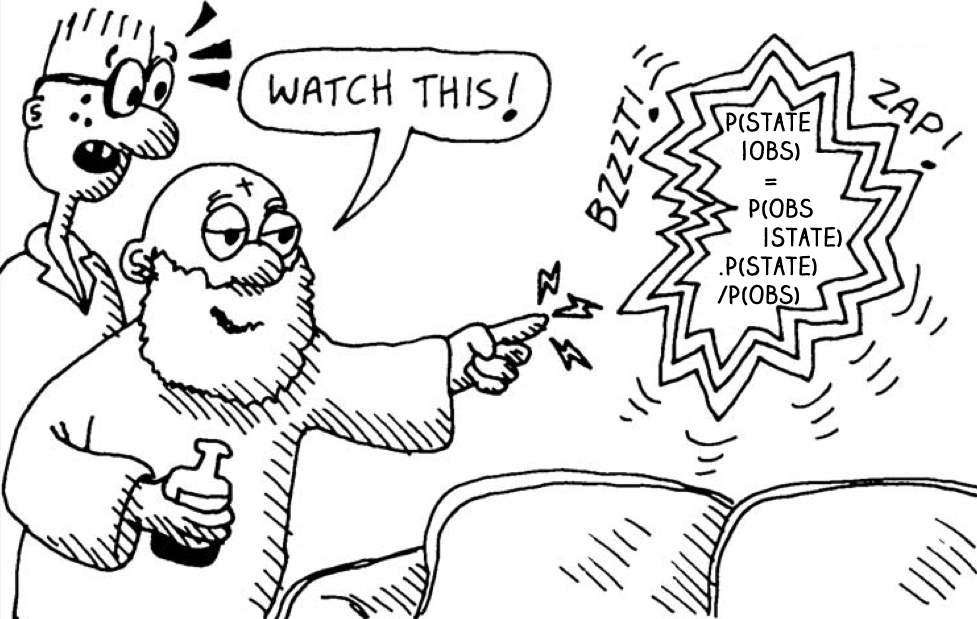
The problems are even worse for the Bayesian, because finite additivity isn't consistent with conditionalization (hat tip: A Fine Theorem). Since finite additivity is all Cox's Theorem gives you, clearly it needs to be made more robust! (Unlike, say Kolmogorov's Axioms) Obviously, I strongly disagree with that paper's thesis that de Finetti gave "compelling reasons" to abandon countable additivity, and regard de Finetti's examples of "intuitive priors" as bizarre. (Also, I find A Fine Theorem's Kevin Bryan's arguments even weaker. It isn't obvious to me that his hostile description of frequentist consistency is induction in any sense, much less a bad one...). The famous Bayesian Jaynes must have at least sensed this, because he was always combatitively pro-countable unions. But is his foundation for himself a castle built on sand? The answer is obvious to me, Jaynes just never cared about such things, thought it was a merely technical problem without deep import to general theory (he says in the appendix that the only difference between his approach and Kolmogorov's was that Kolmogorov took an infinity first method and him an infinity last).

Dr Fine, Dr Howard and Dr Howard in deep philosophical debate
This issue might be worth maintaining low level controversy about it, and Kolmogorov put it in the right place - as a questionable but reasonable assumption. An "axiom" as we mathematicians say. Sure, countable additivity is so useful and clearly correct in so many contexts that giving it up seems like giving up your legs. But science is multithreaded being, and intellectual controversy often ends in clarification. But in the Cox framework, finite additivity isn't a theorem, it's just a quirk of not constraining our function enough. It just doesn't feel like enough to me, it seems to me that if Kolmogorov, Doob et al were wrong they must be wrong in a much deeper way. Anyway, that's enough about countable probability.
As I said from the outset, it seems obvious to me that axioms are philosophical matters and arguing about them gets you into nothing but a Wittgensteinian language game. But there are differences between Kolmogorov and Cox about finite additivity (and whether functional equations are more intuitive than measure theory). So maybe there is some, small content there. Therefore, I will now e-beg for answers. Tell me about the wonders of Cox's Theorem, internet! I'm all ears!
Saturday, August 23, 2014
Quick Review: Phoenix Wright - Ace Attorney
Well, you can't spend all your time working hard. Even the sick, dying and people in dire poverty have to entertain themselves. Even though I have a plethora of projects, a few ideas that need exploration to become projects and of course there's all the time I ought to be improving myself in some way. Let me share with you some of what I spend that time doing:

The Ace Attorney series is a set of video games, members of a genre called visual novels. A visual novel is sort of like the old choose-your-own-adventure books or, more directly, adventure games where the main form of puzzle is choosing dialog. I don't have much experience with this genre of games, in fact this series is basically the only ones I've played. Even then, I've only played the core part of the series the Phoenix Wright trilogy. From the little bit of research I did, it seems that Ace Attorney is a bit more like an adventure game in that there are many puzzles other than choosing dialog. The idea is that a visual novel will make up for its reduced emphasis on traditional video game design to tell a more compelling story. Again, I haven't played much, but I expect that the quality of the stories varies wildly.

P Mason
In essence, these are murder mystery stories where you are cast in the role of the great detective yourself. If you've seen or read Perry Mason, you'll find the basic goals familiar. You have the clues, you have to solve the case and you have to force the killer into a dramatic courtroom confession. This participation, a fact unique to its video game format, is what sets the series apart. Well, that and its off the wall humor.
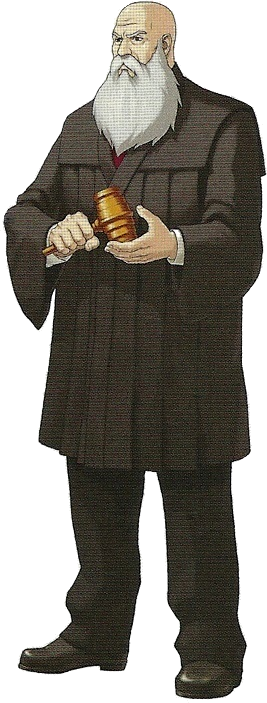
The legal system in the game is vaguely based on the Japanese legal system (very judge oriented, confessions by the defendant aren't compelling, prosecutors take even the concept of losing a case to be a personal insult, etc.) and beyond that fairly absurd. I'd like to read a lawyer's comments, but what I'd really like to read is a philosopher of law talk about the series. The reason is that a good lawyer has a lot of knowledge of one kind of law, just like a good surgeon has a knowledge of one species, but a philosopher of law would be better to comment on an arbitrary legal system - and the legal system of the Ace Attorney series is often very arbitrary!

Being a series of stories about murder, betrayal, decade long schemes, endless lies, corruption at high levels of government and innumerable small ills that accompany the big ones, the series is mostly a comedy. The characters are as over-the-top and broadly drawn as anything Dickens wrote. David Simon once said "Murderers lie because they have to; witnesses and other participants lie because they think they have to; everyone else lies for the sheer joy of it...". And so it is, everybody is filled with secrets, sometimes things embarrassing only to them and sometimes issues that are more comprehensible. One murder involved a low rent tokusatsu studio. One young fan refused to tell what he saw because he was traumatized. Not by seeing a murder, but because he thinks he saw his favorite hero be defeated! Truly we live in trying times.

Another recurring element in the series is mysticism. Not dark, esoteric lore like Eric Voeglin or more intellectual fare like the Shin Megami Tensei series. Possession and spirit channeling are major elements of the series. This seems to be a trademark of producer and man in charge Shu Takumi, since he also made the excellent puzzle game Ghost Trick which is about ... well, ghosts. If this bugs you, then so it goes.

Complaints, I have a few. The series is sometimes too linear. Many of the times I've failed to present evidence it was because there are two problems with testimony and I was going to present them in the wrong order. The series doesn't have a lot of replay value, especially since you'll spend time asking everybody everything the first run through. Well, anyway, back to work - this time for real!
Personal Note: Posts full of dull pictures of scientists streak broken! Now I will be less self-conscious.
Subscribe to:
Posts (Atom)