Showing posts with label Is It The Same Temperature In All Possible Worlds. Show all posts

Tuesday, September 30, 2014

Is It The Same Temperature In All Possible Worlds? Part 4: Bra-Ket Notation


So, in the last installment of IITSTIAPW, I attempted to explain how the fact that quantum particles fluctuate along many paths to a target brings a picture that looks like the physical lines of force for an electric field. This might be called the "position field" of a particle. This field gives all the information there is about the position of a single particle. In this post, I will introduce some notation to help tame these thought experiments. I was hoping to get all the way to entanglement today, but not quite.

Actually, a gravitational potential is unrealistic, partly because most quantum particles are too light to really notice gravity. You could do this experiment with electric potentials though.

In our first thought experiment, we have a particle on a special angle iron. This angle iron is bent and placed on a support. Three sensors are placed on the angle iron, two in the crook of the metal and one on the edge of the right side. The left sensor is green, the right crook sensor is red and the edge sensor is orange. The red sensor turns on only if the orange sensor is activated first. If a classical particle should be placed onto either side, then it would fall down the bend of the angle iron until it hit the red or green sensor (there is an extremely tiny stable region, but that can be safely ignored), though only the green would ever be activated. A quantum particle however has more choices, as illustrated below.

 Possible paths if we measure green (top) or red (bottom)

The particle is said to be \( \left| G \right\rangle \) if the green sensor is activated and to be \( \left| R \right\rangle \) if the red sensor is activated. The name of this notation is "ket", but it is read, essentially, "state G". So the above sentence should be read out loud "The particle is said to be in state G if the green sensor is activated and and to be in state R if the red sensor is activated.". These are all the possible states of the system. As it turns out, the seemingly unique right method to represent quantum states is as complex vectors, linear algebra type vectors. While there is a result that explains why they are complex vectors given they are vectors (long story short, it is because complex numbers can have the same length and rotate), there is no result explaining why linear algebra should be used in the first place. The square of the length of these complex vectors . The structure was guessed by a group of physicists and nobody's ever managed to make it go away. Amusingly, most of the physicists didn't actually know linear algebra beforehand and painstakingly reproved many old theorems in new, less expressive notation.

 More paths are like more lines of force, they represent a stronger field, a higher probability

By themselves, after we look at the results we might say that each situation either happened or didn't. So we can without loss of generality claim that \( \alpha \left| G \right\rangle \) and \( \alpha \left| R \right\rangle \) have a length of one. But before the sensors are turned on, things are more complicated. The above picture implies that we must be in some state \( \left| S \right\rangle = \alpha \left| G \right\rangle + \beta \left| R \right\rangle \) where \( | \beta |^2 \ll | \alpha |^2 \) and \( | \beta |^2 + | \alpha |^2 = 1\). \( \left| S \right\rangle \) is said to be a superposition of states. Notice above that even though \( \left| S \right\rangle \) is written as the some of two states, if you look above you'll see a single perfectly good field. Superpositions of states are still pure states, there is still only one particle fluctuating around. In a later post I'll cover multiple particles, in which case entanglement starts becoming an interesting issue.

We measured R!

Let's say that we place a quantum particle on the crook of the angle iron and waited a while. Later, once things have settled down, we turn on the sensors and the red sensor clicks! Happening at all is sufficient evidence that the universe is not classical. But quantum physics fixes more than that. We denote the situation that we measured the system in a particular state, say \( \left| R \right\rangle \), by \( \left\langle R \right| \). This new object is called a "ket" and is basically read "measuring state R". When you have a bra and a ket together, you have a bra-ket. A bra-ket is the probability of measuring state bra from state ket. For example, if you are definitely on the left side then you aren't on the right side and vice versa, so that \( \left\langle R | G \right\rangle = 0 \) and \( \left\langle G | R \right\rangle = 0 \). Let me write how that sentence should be read aloud. "If you are definitely on the left side then you aren't on the right side and vice versa, so that measuring state R from state G has probability zero and measuring state G from state R has probability zero.". Obviously, if you're at a sensor, then it clicks right away so that \( \left\langle R | R \right\rangle = 1 \) and \( \left\langle G | G \right\rangle = 1 \). These states are "orthonormal" vectors by design. But what if I put the particle in the middle and waited a long time before turning on the sensors, like I did in the above experiment? Then the particle is in \(\left| S \right\rangle \), so that $$\left\langle R | S \right\rangle = \left\langle R \right| ( \alpha \left| G \right\rangle + \beta \left| R \right\rangle )$$ $$\left\langle R | S \right\rangle = \alpha \left\langle R | G \right\rangle + \beta \left\langle R | G \right\rangle$$ $$\left\langle R | S \right\rangle = \alpha 0 + \beta 1 = \beta $$ This is the most basic linear algebra structure of quantum mechanics.

Very Formal

If I were being formal, I would go over the precise axioms of the so-called bra-ket notation. In addition, so far I have only worked with a single measurable, position. Instead, I'll just make promises. In the next few posts of this series, I will first go over quantum mechanics for multiple particles, then give the formal bra-ket axioms (which is, in essence, an axiom scheme for quantum mechanics) and finally extend the ideas in these posts to fields.

Wednesday, September 24, 2014

Is It The Same Temperature In Every Possible World? Part 3: The Pure Wave Function

EDIT: I uploaded a version that didn't include a major point I wanted to make.

A View of Mount Fuji
 
In the last post, we talked about how in quantum physics there are new ways for a particle to move. The new ways I called "fluctuating", a particle can fluctuate to you in addition to moving in a more traditional way. I'll call the old method "rolling". This opens up new opportunities for a particle, since a particle that can fluctuate and roll can get into places that a particle that could only roll around couldn't. Take moving around carbon. I can roll you a lump of coal if you aren't too far uphill, but I can burn it and let it waft (fluctuate through the air) over to you no matter how high you are. Getting the coal to you on a large mountain is analogous to getting two protons to fuse. Since the proton can fluctuate, it can get close to another proton even if it doesn't have enough energy to overcome the electric repulsion by direct movement.


Imagine a ball sitting on the bottom of an angle iron. At either end of the iron we have detectors, so that we know that the ball is at one end of the angle iron at \( t_1 \) and at the other end at \( t_2 \). Classically, the ball can only really do one thing, roll down the piece of metal on the base of the joint. This means that the classical view of the particle's position is something like this:

Rolling

But quantumly, the ball can go on paths other than the base. The ball can fluctuate up the side of the angle iron.


Fluctuating

All of these paths are consistent with the experiment/our knowledge of the world/the boundary conditions. Just like the cloud of coal particles that waft toward you, it isn't the case that this quantum particle goes on a particular one of the paths. From the perspective of the starting time, the future path is undetermined, from the perspective of the ending time, the past path is undetermined. But indeterminism isn't a theory, and we're now ready to see what it is that quantum theory does determine. Let's look at the above situation from the top.

The Top

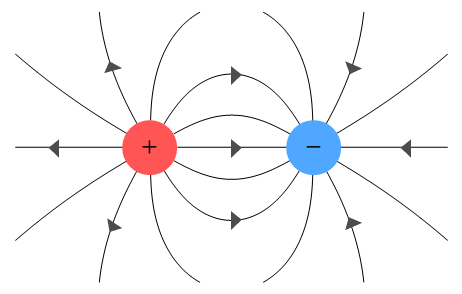
Obviously, these aren't all of the paths that the particle fluctuates on. The drawing is topological. I draw more lines to denote heavily traveled areas, less to indicate regions that the particle rarely sees. Does that sound familiar?

Electric Field

This new mode of movement makes the position of a particle not into a single point, but rather a field of "existence", or to use standard terminology "probability". This field has many of the properties you'd expect a field to have, such as continuity, the existence of a current, etc. This field, for all intents and purposes is the particle. The structure of quantum mechanics allows us to totally determine the field. It is this fact that allows us to determine precisely the predictions of quantum theory. Every particle is a geometry, the structure of the particle determines the shape of that field. For instance, the electric field is the geometry created by the existence of the photon.

The Experiment Below

Experiments can be designed to show that this geometry can't be given by a classical particle. Let's say that the quantum particle is slow, much slower than light. Put a pair of sensors are placed on the angle iron mentioned above. The first sensor is placed in an area that is not accessible by classical movement, but it can fluctuate up there. When activated, it turns on the second sensor placed in an area that is classically acceptable. If the second sensor is ever activated at all, then you know that the particle is moves in a quantum way. Nice and binary.

Now be careful about thinking about this. It is not the case that the particle randomly chooses one of these paths and follows it. It fluctuates out over all of these paths. As it turns out, there are experimental consequences of this. I'll go over this in a couple posts.

Finished With Step 0

Now that I've given the flavor of quantum mechanics, a couple of steps remain before we get into the interpretation matters. The above gives the quantum idea of a single particle, in fact there are multiple particles in the universe. This gives rise to a density matrix and entanglement. More difficultly, the above gives the field that is a single particle, but we know in this world there are also fields. If particles quantize to be fields, what do fields quantize to? Finally, I need to show that the above arguments lead to the Schrodinger equation (there's a standard argument due to Feynman). But that can wait for later. See You Next Time!

Friday, September 19, 2014

Is It The Same Temperature In Every Possible World? Part 2 - The Flavor Of Quantum Mechanics

Not This Stuff Yet

It has been decided that instead of making a strictly logical foundations post, I'm going to start by writing a post to give someone unused to quantum mechanics an idea of the general flavor. I'm going to do my best to make this maximally bland when it comes to theory, giving a couple of asides for those who already have this way of thinking in their head.

Animated Double Slit

The usual approach to quantum mechanics involves the double slit experiment. This is how Feynman approaches Quantum Mechanics in his lectures, and this is clearly how Bohm thought of the whole problem. The basic issue is this. If something is a wave, like water or possibly light, we know what will be seen on the other side. We know because Huygens taught us. If you want to know, look above. If something is a particle, then the tiny slits will only allow the particles through in one direction:


See the difference? Well, an issue comes up in interpreting the experimental results. The same things that to all - literally all - direct experiments look like a particle, move like a wave. This used to be called particle-wave duality, complementarity and other unclear names. And there is really no issue in classical quantum mechanics that can't be stated in terms of this experiment, so that's nice.

But Who Cares?

Despite the depth of this approach, I don't think it really gets at what people want to know about quantum mechanics. In addition, it doesn't obviously generalize to relativistic quantum mechanics, which you need if there are magnetic fields. So, I'm going to try a different method. If this fails to give you any intuitive view of quantum, feel free to blame me.

You And Me and Coal


Imagine that you are the blue person and I am the black person. I want to give you some carbon, and I'm holding some nice anthracite coal. Now, there are two ways that I can get this carbon to you. One is that I can move it to you on some path, perhaps by throwing it to you.

For Certain Values of "to you"

But that isn't always possible. For instance, if there is a fine grating between us, the above picture is impossible. What I can do then is burn the coal, and fan the smoke to you. Then you can reconstitute the smoke into carbon.

Less Dangerous, Less Efficient

In other words, there are two possible methods of getting the carbon to you. One is by direct movement, the other by fluctuation. In classical mechanics, fluctuation is treated as a limit of direct movement. In quantum mechanics, the two are given equal weight. It really is the case that something can get to me by traveling straightforwardly or by fluctuating over. The Schrodinger formulation emphasizes the wave like movements, the Feynman formulation the diffusive movement. The rest of the difficulties of quantum mechanics are mere physics.

Let's go through a more directly quantum version of this idea. Let's look at some particle in a box! This box is divided into three parts, outside the box there is nothing. In the first part and last part the potential is zero. In the middle there is some potential to stop particles from moving:

The Potential

If there is any direct movement path for a quantum particle to get somewhere, then you call that region classically allowed. In those place, you expect to see waves, just like classical mechanics waves. If you have to fluctuate to get there, call it classically forbidden. In those places the distribution should fall off exponentially, just like classical mechanics diffusion. This is called the WKB approximation. This idea gives the following idea about where the particle could be:

The Distribution of Where the Particle Could Be

In the classically allowed regions, the particle moves around on easy classical paths. I represent that rapid movement with a big wave. In the classical forbidden region, the particle must fluctuate into weird areas. I represent that region by a exponentially decaying curve. But this is just formulation. I must now show how this quantum view of the world differs from the classical vision. I'll do this by proposing a thought experiment. At the beginning of time, the only particle in the universe is entirely at one location. Perhaps you, a god, have some sort of sensor that lets you tell this.

In the beginning, there was the Dirac Delta

We turn off the sensor, allowing the particle to move again. At first, it mostly moves in the left classically permitted zone, moving in the quick, easy way. But soon the fluctuation type movement starts becoming visible. At this point, it starts to look like the WKB approximation above.

This again.

Over time, the particle's movement and fluctuation start to balance out. At this point, it's spread evenly in the first and third in the two classically permitted areas and to a lesser extent in the classically forbidden area. I'd make a picture, but I left all my scripts on another computer. You turn on a sensor on the right classically permitted area. You can get the expected waiting time from the probability the area under the curve over the sensor. Though this is a classically permitted area, there is no classical path that brought you here. The history of this experiment is a quantum history. This might sound silly, and I tried to make it that way. But this has real experimental and theoretical consequences.

G Gamow

This situation is analogous to an atom undergoing fusion. The left classically permitted region is like free space, the right classically permitted region is like a fused nucleus. The bump in the middle represents the region that the incoming proton is to weak to get past the nucleus's magnetic field. With only classical movement, fusion is not possible. But quantum physics permits a new type of movement, and even if one can't move past the bump, one can fluctuate past.

In the next post in this series, I'll show how this idea of movement by fluctuation leads to a path integral and maybe do some interpretation. In the mean time, I have a couple other ideas to try out. See you next time!

Thursday, September 11, 2014

Is It The Same Temperture In Every Possible World? Part 1


It's strange, but people didn't argue about the interpretation of classical mechanics. The usual explanation is that classical mechanics is intuitive, which is obviously untrue - if it was why are so many students so bad at it? Even if it wasn't obvious, psychologists have convincingly argued that our intuitive reactions to how objects move do not follow Newton's Laws. There are at least two facts about quantum mechanics that lead people to feel it needs interpretation:
  1. Not everything can be sharply defined at the same time. (what used to be called 'complementarity')
  2. Things are not, in general, continuous (what used to be called 'quanta')
Most of the unintuitive physics results come from the second fact. The idea that in order to get there, you must pass through here is a deeply held belief. One big reason we need mathematics is to force people - such as economists - to say it out loud.

However, the first reason clearly raises two questions. One is "Where does apparent sharpness come from?" and the other is "How does nature know what to make sharp?". The second question is very tough. There are a variety of answers. The original answer, enshrined in ancient texts, is that how you set up your experiment somehow decides what nature will make sharp. Explaining this led von Neumann to support the idea that the universe is guided by each human consciousness. Many leap all to quickly to reject this idea, but I will argue in a bit that it could conceivably be a theorem of quantum mechanics!

Harald and Niels Bohr

The most powerful man in early quantum mechanics was the great physicist Niels Bohr. Bohr's complete work runs 13 volumes, his scientific work covering 9 fat books. Throughout his graduate studies, Bohr worked on the problem of modeling solids (specifically, metals) with dynamical models. Einstein and Jean Perrin had convincingly shown that the atomic hypothesis was not just a convenient thought experiment, but a genuine description of the world. A couple years later, Einstein had published the first modern (that is, quantum) solid state physics model, which was a bit of a proof of concept showing that quantum mechanics could be used to new physics. Bohr's thesis included a proof that classical physics could not explain ferromagnetism. The intuition is that in classical physics, jiggling atoms are as likely to go one way or another, and since their little magnetic poles can point at any angle, there will always be enough room for them all to point different directions. This demonstrated that only quantum mechanics could explain solid state physics, which remains a very interesting and deeply quantum mechanical field!

But I digress. Bohr, when confronted by the question "How does nature know what to make sharp?" would say that there is nothing behind the experiment. All we do is observe, beyond that we can neither see nor speak. "Whereof one cannot speak, thereof one should remain silent." - Wittgenstein. Bohr was influenced in his description by positivism, but many have argued that he may have been more influenced by other philosophies, such as existentialism. Regardless of whether this vision was positivistic, pragmatic or mystical, it was accepted as gospel for some time. In this series of posts, I will explain what the possible replacements of silence could be. I'll have more on this subject in the fullness of time, including: 1) Why did people get bored with Bohr?, 2) What are the most prominent alternatives?, 3) What do the alternatives mean mathematically and philosophically? and 4) What can we believe?.