Wednesday, August 13, 2014

Contra Feyerabend

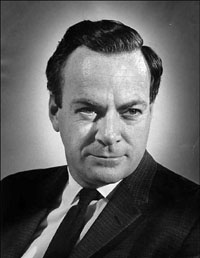
P Feyerabend

I've mentioned before that I don't like the work of Paul Feyerabend. Some groundwork for what is going to be done here. First of all, there is no complete Feyreabend philosophy. He didn't want a system, and didn't build one. This is not a criticism. If you want to critique him you have to critique individual papers and critiques. I doubt that Feyerabend could be so dense that everything they wrote was completely wrong, so I'm just going to stick to a few broad notions that he is famous for. I'm not going to, for instance, attack his historical work or explore his opinions on philosophy of mind. Instead, I'm going to go after the notion of epistemological anarchism and some of the arguments for it.

First of all, there is the notion that every observation is theory laden. This is either false or trivial, depending on how widely you let the notion of theory stretch. If you let the light tickling your retina be a theory, go ahead. But there is nothing special then about being "theory laden". No reason to suspect there is anything even subjective about them. Modern data-driven, nonparametric learning theory allows one to do explicit, quantitative mathematics without being "theory laden" in the way important to philosophers. I recently wrote a classifier to try to count the number of little buggers on some seagrass leaves. The data was collected totally independent of any input from me, it was already here by the time I joined the project. I don't even know what the schmutz is, biologically speaking. But despite having no theory of what they should look like, I managed to successfully classify them and other kinds of objects on the leaves using tools that didn't require me to have that knowledge. Theory-ladenness can matter, but it it isn't a necessary truth or even central to science.

L Valiant (nothing but pictures of black and white men in this post)

A simpler criticism can be made. Theory-ladenness is based on a false, "Good Old Fashioned AI" view of knowledge. When I walk through a room with a table, I don't and don't have to represent the room in my mind and trace my whole path through it before I walk. What I really do is much simpler to process and more fallible. You can see Leslie Valiant's excellent book Probably Approximately Correct for more on this subject.

S Wright

There is a deeper critique of epistemological anarchism, that it is doesn't give you what you say you want. There is nothing wrong with taking the 'let ten thousand flowers bloom' approach. But Darwin informed us that not all flowers are created equal. Seawall Wright introduced the very useful idea of a fitness landscape, evolution is an optimizing procedure on this landscape. Having many peaks and noise is not a flaw of this theory, just parts of it. The mass of beasts and scientists wander around this landscape, compelled to optimize. The difficulty with epistemological anarchism is that it uses the vague, equivocal notion of "incommensurability" as a hammer to flatten out the landscape. A totally flat landscape is what Feyerabend needs, a highly peaked landscape has far different properties (Stuart Kauffmann has done fascinating work in this area).

What we actually deal with is much harder work, people doing a lot of work actively trying to make better epistemologies. Science is a dirty, complicated, thing with complex dependencies, not a flat "everything is as good as everything else" field. One could say that the different notions of better ("unbiased" vs "efficient", for instance) make the choice of what one wants a bit subjective. But this is not anarchism, not a simple democracy. It's a hierarchical bureaucracy with republican elements at best. It is even possible that the dynamics is objective, as seen in statistical mechanics, but I won't defend that notion since.

A real example will hopefully help clarify. I was talking recently with a friend who is a bit of a biblical scholar. He mentioned that the discovery of some old papyrus falsified the work of many old time German historical critics that claimed it wasn't written for centuries after we now have documented evidence of their existence. According to Feyerabend, the historical critics should have said "We aren't interested in carbon dating. In this department, we use philology.". This isn't what they do. It's the epistemological anarchist thing to do, declare freedom from physics. It isn't what people do, not in the real world. So epistemological anarchism goes.

I've already mentioned the severe criticisms of the notions of democracy that were supposed to be what epistemological anarchism were defending. The problem is that real democracy, like real science, is much more complex, more peaked, more dynamic than the flat philosophical politics that Feyerabend defended.

So, what is left? Feyerabend left us a lot of criticism of over ambitious philosophy of science arguments. I've read philosophers call the discovery of the Higgs Boson in high energy physics "bad science" because it didn't exactly match their pre-conceived notions of what a good scientist should do (they used p-values at some point). Perhaps Feyerabend will help philosophers avoid hubris. This modest achievement doesn't leave the working scientist with much. That's only because there isn't much to it.

Tuesday, August 12, 2014

Wendy's Old Fashioned Scientific Terms

I was reading an old book, and I don't mean to name names but it's definitely an instruction in why we need mathematical economics! Bertrand Russell once said "A good notation has a subtlety and suggestiveness which at times make it almost seem like a live teacher.". It doesn't follow that a bad notation is like a quack spreading confusion, but it is true and one can find it in old books like diseased mosquitoes preserved in unholy amber.

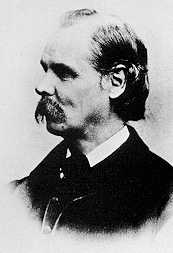
A Marshall

The confusion is around the economic notion of the "short run" and "long run", terms that I think were introduced by Alfred Marshall. Marshall, the old empiricist, noticed that in the beginning of the industrial revolution people tended to be immiserated by machines, then later they (not necessarily the same people, but "the people" all the same...) became exponentially wealthier because of the fruit of the capital. This was probably already known by other economists before him, but I plead ignorance about their. This was one of many things that were noticed by Marshall. Marshall was a talented monetary theorist in addition to everything else, developing the cash-balance (that is, demand oriented) version of the quantity theory of money. In so doing, he must have noticed that a bit of inflation now can give a temporary boost, but in the long run inflation tends to hurt. The modern version of this observation - which is now called "dynamic inconsistency" - got Finn Kydland and Edward Prescott a Nobel Prize.

Marshall put these two empirical eggs in one basket, perhaps wrongly. He divided the economy into two different "runs", the "short run" where inflation boosted things and new machines immiserate workers and the "long run" where better capital is the source of most wealth and low inflation is good. This is very misleading! What Marshall was after was the fact that the economy can be modeled by - in a way, "is" - different dynamical systems, some where some things are held still and others where others are held still. I think this is well known in economics, but don't feel like looking it up. There will never come a day in which we are suddenly out of the short run and into the long, or vice-versa. It is always 40 years from 40 years ago, the long run of our fathers is already here. It will always be this time tomorrow in 24 hours. The right way to think about these issues, perhaps the unique one, is the perspective of dynamical systems.

Marshall chose the term "short run" and "long run" because of the empirical facts, he was observing the industrial revolution turn from a force that throws workers on the streets to one that feeds them all healthily. You argue that he was after and dimly perceived an idea like a Kuznets Curve, but not well or forcefully. Kuznets showed that there exists some economic dynamics that can produce Marshallian runs. It doesn't take much thought to realize that there are far too many dynamic paths for just one, Malthus believed that one would get an exponentially curve during a growth phase, followed by exponential decay in the famine phase- like the following:


Since this is periodic, it completely lacks anything like Marshall's simplistic idea of runs. I'm not saying this particular dynamics is the true dynamics of the wealth of nations - in fact there is absolutely no empirical evidence that it is. What I mean is that the dynamics that Marshall talked about are not fundamental, but the terms make it seem that they are. In fact, the dynamics questions in economics are right now at the forefront of the field, both in theory and in empirical matters. Thomas Piketty's best selling book is, at root, about the empirical underpinnings of dynamic models of the economy - what features must a model have and which must it lack to resemble reality.

Mislead by Marshall's terms, several economists and writers on economics have made daffy mistakes. As I already noted, in the above book, Henry Hazlitt notes without irony that it took more than 40 years for Marshall's long run to get to workers in the garment industry. Hazlitt strangely takes this as vindication. Perhaps it is for one notion, but the theory he puts around it is filled with confusion. The notion was fundamental to the worldview of economist Joan Robinson. She thought that the greatest task facing economist was to turn idealized periods into real time, in other words to do dynamics. Sadly, she contributed nothing to this task

There has been much written about dynamics and equilibrium. A modern has no excuse for making the excuses of the esteemed ancestors written about in the previous paragraph. The book reviewed below is a good primer for the theory of dynamics in general.

Monday, August 11, 2014

Abduction


I've been meaning to watch this for some time. Abduction is the process of going from effects to causes. The name is due to the American philosopher CS Peirce. I wonder if it really is different than deduction and induction, since there are special cases where it clearly isn't, such as learning circuits.

Thursday, August 7, 2014

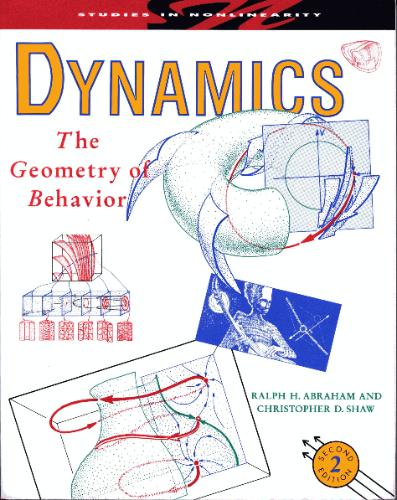
Quick Review: Dynamics - The Geometry of Behavior

Given that something is in some state, how will that thing change? This is the problem of dynamics, and if it seems vague part of it is that dynamics is really that general. Born for applications to physics, this theory is now used everywhere, including economics. We start by making assumptions about continuity and such in order to use the powerful tools of calculus. These assumptions are the same assumptions that give us a nice geometric picture of an evolving system. Each state of the system is a point in space. We try to figure out the geometry of how the system moves around, and what doesn't change about that geometry as things move. This is the methods of topology and catastrophe theory. We can go around looking for "equilibria". An equilibrium is a state where if you start there, then you stay there. Close to an equilibrium, the system will be approximately linear. There are only a few possible general shapes a linear system can give you. You can use these to figure out where the system will be in the long term. This becomes the method of equilibrium analysis and chaos theory.

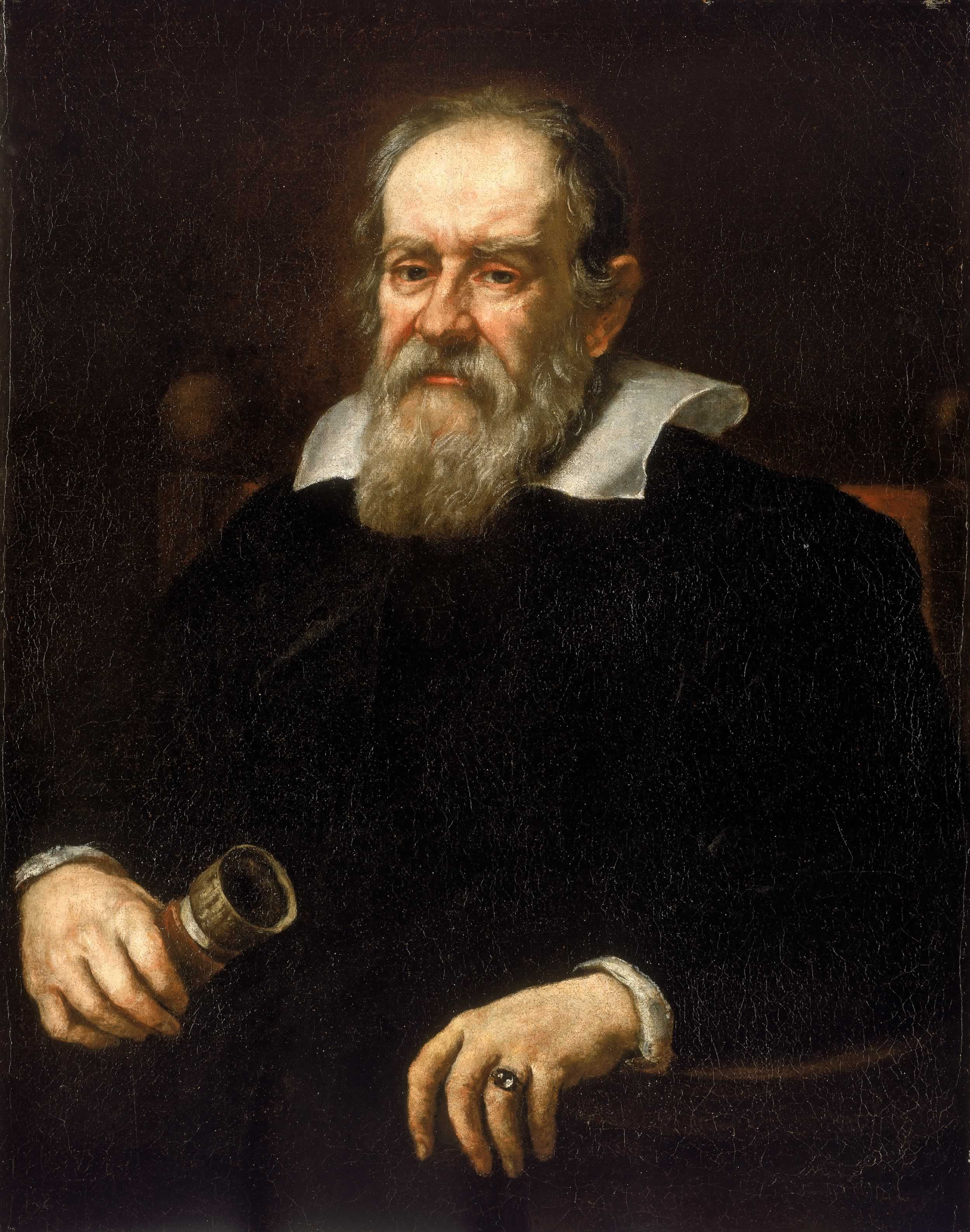
G Galileo

The study of dynamics was begun by Galileo, all previous thinkers had been forced to remain in the field of statics. The field remained informal and many of the theorems implicit until the work of the French physicist and mathematician LaGrange formalized the calculus of variations. Later, the English physicist and mathematician Hamilton redid the same thing from a different angle (interesting to note what Hamilton was doing, he was convinced there would be a deep connection between theoretical optics and basic physics ... and he found it!). Unfortunately, these analytical methods rarely result in explicit global solutions

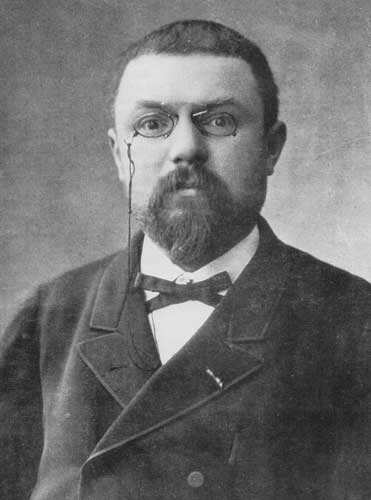
H Poincare

 There was a revolution in these techniques brought out by the great French mathematician Poincare, who developed methods of analyzing classes of solutions. These methods use a new science of topology (he called it "analysis situs"), looking for things left unchanged by the kind of evolution we often see in systems. At the same time, Russian mathematician Lypunov was discovering the methods of linearization and equilibrium analysis. These methods dovetail nicely with each other.

A Lorenz Attractor

In the usual presentation, all of these techniques are heavily analytical, involving tremendous and difficult mathematics. This is perhaps a little strange, after all the whole theory works because there are a) only a few configurations one can have around an equilibrium (for equilibrium analysis/chaos theory) or b) only a few possible globally interesting shapes you can get (in topology/catastrophe theory). Christopher Shaw and Ralph Abraham's book Dynamics: The Geometry of Behavior is the book that uses this possibility. This book is very good for learning the heart of the theory, avoiding merely technical distractions. It is entirely geometric, taught without equations. I feel that from this book the very important subject could be learned by an ambitious high school student. Those technicalities must be dealt with in the long term if you want to become an expert, but this is a great first book.

R Abraham

The book is divided into four parts - it was originally multiple books. The first part is an excellent introduction to dynamical systems and a treatment of periodic systems. This part is interesting, though an economist might wish they spent more time on stable equilibria. They seem to regard them as fairly uninteresting, but as the above linked discussion makes clear, considering basins of attraction of a stable equilibrium can be good science. This is discussed in the third part, but I think it is more fundamental. The second part treats chaotic systems - which are extremely interesting to me personally. Most discussions of chaos focus on the consequences treated in the last part of this section, such as unpredictability, fractal structure and noisy spectra. These results are very clearly presented in an easily understood and demystifying way. Multiple equilibria are treated in the next section, which is good, but I again feel it should have been treated earlier. Finally, catastrophe theory is treated. Since much of my understanding of this theory comes from this book and Vladimir Arnold, I feel unable to comment on what I don't have a mastery of. I certainly feel as though I learned a lot from this section.

Very highly recommended, especially for self-teaching and especially to visual learners. However, be warned that Ralph Abraham's later books do not reach this standard.

Wednesday, August 6, 2014

A Warning


Don't fear those who abuse the legal system! Sometimes it works out okay! This is an old story at this point, but a good one.

Tuesday, August 5, 2014

Hempel's Paradox

Hempel's Paradox is yet another problem with induction. Hume taught us that much of what we consider to be induction is fallible and probabilistic, rather than certain. But this raises a whole host of difficulties, difficulties that Hume - who lacked training in mathematics and statistics - dimly perceived. Statisticians from CS Peirce to Bruno de Finetti have tried to firmly grasp what Hume offered, and found much to disagree with each other even within this. Bruno de Finetti was a Bayesian - perhaps the Bayesian. In the frequentist/error statistics tradition from CS Peirce to Deborah Mayo, have attempted to use probability in a way that has been called ampliative, they amplify our knowledge. Deborah Mayo is explicit on this point, a severe test teaches us something new. There is another tradition running from Frank Ramsey to de Finetti and through to modern Bayesian theory, that probability is a form of logic - and therefore not ampliative. I don't mean that probability is founded on logic - nobody doubts that probability is a branch of mathematics and statistics is applied mathematics. What is at stake is what statistics could teach us even in theory. The question "Is probability a form of logic?".
C Hempel

Carl Hempel added a new wrinkle to this debate with his raven paradox. How would you go about testing the proposition "All ravens are black."? Look for an albino raven? Save your time, there's a much easier way. Obviously, this is equivalent to testing the proposition "If something is a raven, then it is black.". This is equivalent to saying "If something is not black then it isn't a raven.". So, look at your shoes. They're not black and not ravens. So that's some evidence. And hey, your fingernails aren't black either, are they? Thinking about it, how many van Gogh paintings aren't black? How many dots in a Seurat painting? The world is mostly evidence that there are no white ravens!

There are, of course, solutions for those who hold, with de Finetti, that probability is a form of logic. The technique is to use the size of the sets involved. There are so many non-black non-raven things in this world that the weight of observing one is low. That is, we do learn that there are no black ravens by drinking white milk, but it is weak evidential milk. This is a bit counter-intuitive, since the eye color of Chuck Berry's eyes seems to be completely unrelated to ornithology. In addition, this response gives rise to odd ducks (perhaps odd ravens...), like Laplace's argument about the probability of the sun rise.

This argument is popular with those who accept a Bayesian view of probability as something more than a sometimes useful tool. What is the frequentist/error statistic point of view? It might seem extreme, but it actually makes good sense. Observations of ravens gives us an estimate of the ratio of black ravens to the count of ravens. Obviously, this ratio will be near one. But what the frequentist test gives is error bars, confidence intervals. These confidence intervals can overlap, be useless or shrink around one. In the last case, the frequentist/error statistician will converge on popular opinion. But what of the non-white non-raven? Since a frequentist does not accept that tests are closed under logical operations, they don't accept them as tests. They are only interested in tests of the object in question.

In my view, this makes error statistics less expressive, but less paradoxical than Bayesian statistics. Which you need depends on the practical situation, and so I say let ten thousand flowers bloom. Incidentally, the philsopher Willard Quine also wrote on this subject. Quine's solution was to claim that non-black things didn't form a natural kind. This is worse than accepting the paradox, since it will soon mean natural kinds aren't closed under any logical operation, yet we're supposed to use logical analysis and probability theory to learn... Good luck writing a classifier with that in mind!

Sunday, August 3, 2014

Quick Review: Elementary Particles and the Laws of Physics

Or, The First Annual Paul Dirac Fan Club!
P Dirac

This is actually a pair of lectures from physicists Richard Feynman and Steven Weinberg entitled "The Reason for Antiparticles" and "Towards the Final Laws of Physics". They were on topics inspired by the great English physicist Paul Dirac, one of the people who codified Quantum Mechanics and one of the first to deal with quantum mechanics and relativity. The excellent biography The Strangest Man is about his life and work, so ... go read that too. Dirac is widely believed to have suffered from Asperger's Syndrome, so people with an interest in that topic might find it interesting to read about one person's life.

R Feynman


Feynman's work is pedagogical, it explains the modern view on antiparticle that evolved out of Feynman's elucidation of Dirac's work on relativistic quantum mechanics. This is a really good lecture, very well presented. Many of the most important laws of physics, such as the Pauli Exclusion theorem and the  spin-statistics theorem (and therefore, virtually all of chemistry...), are direct consequences of relativistic quantum mechanics. Feynman talks about Dirac's style, which he describes as trusting his equations. There's been some interesting history of science work on Dirac's attachment to projective geometry, which was essential to his understanding of relativity. H S M Coxeter wrote several articles on this idea for classical (that is, non-Quantum) relativity, such as "A Geometrical Background for de Sitter's World" and elsewhere. Feynman aims his lecture at a fairly high level, knowledge of basic quantum mechanics and relativity, but this is fairly well presented. Familiarity with Bra-Ket notation and space-time diagrams should be enough when it comes to physical theory. More important is the level of mathematical imagination it requires. Feynman puts the interpretation into easy to understand levels, a process he compares to Maxwell's mechanical models of electrodynamics, but it will really help if you're already used to this kind of discussion. This is too bad, since this is a very important topic, especially for chemists, and could use better popularization. Of course, it would take at least three times as much time and space... If you're capable of doing math at an advanced undergraduate level, I highly recommend this talk for a deep understanding of the parts of this theory most relevant to non-specialists. I'd particularly recommend it to chemists for the proofs of the Pauli Exclusion Principle and the Spin-Statistics Theorem. Particularly excellent is his discussion of the proof (first arrived at by Dirac) that if there is one magnetic monopole then magnetism is quantized everywhere, essentially as a consequences of path independence of a particular integral that comes up naturally in the theory.

S Weinberg

Steven Weinberg's lecture is more philosophical. He describes the symmetries and physical intuitions that lead to QED and then later theories, and takes care to be critical of insecure notions. Weinberg is careful to note the actual consequences of knowing the ultimate laws of physics and disclaims overblown Laplacian conclusions, distancing himself from what Daniel Dennett would call "greedy reductionists". This part has less diagrams, less physical intuition (it is after all, being compared to Feynman) and more speculation, but Weinberg also covers a much more ambitious topic. Feynman doesn't discuss, for instance, Dirac's model of anti-particles, the Dirac Sea, just constructs the modern version. This is a good discussion, but still a textbook topic. Weinberg explains why the Dirac Sea was abandoned for the modern theory in a footnote (it only works for spin-1/2 particles), and moves on to more speculative theories. Weinberg doesn't cover any topics not of interest to specialists, but it is good for young people wondering if they want to become specialists. This area, the idea of final laws of physics, is an area of interest to Weinberg and is better covered in Weinberg's book Dreams of a Final Theory. Weinberg's connection to Dirac is mostly from Dirac's Platonism, Dirac's suggestion that the final laws of physics will be mathematically beautiful. Weinberg points out that much of our skepticism of proposed roads to final theories - such as String Theory - comes from their mathematical inelegance, such as renormalization difficulties or lacking non-perturbative forms. This is a nice observation and obviously true, but I don't know what to make of it philosophically.